• Nocturne

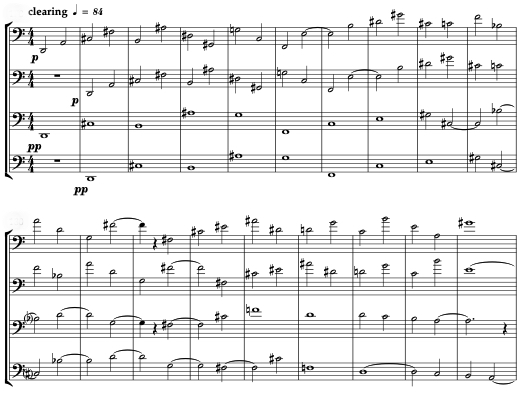
    2021 . . . . chamber winds and percussion . . . duration: 11 minutes

    To request performance materials and permission, email the composer, tc24@txstate.edu.

  • LIGHTFORMS 2: Star Spectra

    1993, Borik Press (Raleigh, NC) . . . computer music . . . duration: 7:30

    Three excerpts:

  • PENINSULA

    1984 . . . piano and recorded computer music . . . duration: 8:30 . . . . . . . . . . published by Borik Press (NC)

    Glacially-etched shorelines inspired sonic imagery for a series of pieces culminating in PENINSULA. Mappings of the natural contours of the Leelanau Peninsula provided richly varied patterns as basic coordinate numbers for sculpting sound patterns. The piano explores some of the endless possibilities for articulating a spectrum of sonorities. A surrounding environment of synthetic sounds was made by digitally analyzing timbral qualities of acoustic instruments, mostly with percussive articulations (metaphorically the rocky shore). The timbres were modified and resynthesized into a pointillistic sound texture. The density of the sound events rises and falls in waves according to changing values derived from the basic mappings. Larger confluences of waves are located in time by map points of special significance on the graph.

    The coexistence of piano sonorities and synthetic sounds is a metaphorical meeting of seascape and landscape, both animated in time.

    performance by Clifton Matthews, Winston-Salem NC, February 2007

    View Post

  • Mucha’s Light: Ancient Images

    Five sound sketches on the historical paintings of Alfons Mucha (1996/2005)

    I first traveled to the Moravian region of Czechoslovakia in 1991 to conduct my own music at the 26th International Music Festival in Brno. While there, I visited the South Moravian town of Moravský Krumlov. Its castle served as a museum gallery for the epic paintings, Slovanská Epopej, of Alfons Mucha. Better known as the father of art nouveau through his many famous Paris posters, Mucha was deeply interested in Slavic culture and history. The 20 paintings, each a monumental canvas hung as a tapestry, vividly depict both historical and mythical scenes.

    Mucha’s Light: Ancient Images is dedicated to Miroslav Marada, the Moravian gentleman who first showed the paintings to the composer in 1991. A teacher, history buff, and lover of the local wines of south Moravia, Marada fascinated me with elaborate tales, explaining the symbolism of each painting. The five works I selected to sketch musically have a common element, masterfully painted images of exotic light. Composing musical analogs for these ancient images, I incorporated medieval music from the Bohemian/Moravian region of central Europe. The music weaves authentic medieval chant tunes into an intensely contrapuntal fabric, interspersed with modern sparks, streaks, and splashes of sound color. Originally composed for brass quintet, the musical images called for a richer, more varied sound-color palette:

    Instrumentation: piccolo, 2 flutes, 2 oboes, 3 Bb clarinets, bass clarinet, 2 alto saxes, tenor sax, baritone sax, bassoon; 2 F horns, 2 Bb trumpets, 2 trombones, euphonium, tuba; timpani, 3 percussion (misc. unpitched – triangle, sus.cym., etc.; bells, chimes, vibraphone, xylophone)

    I. Star Light (detail of 1. Slavs in their Original Homeland)

    II. Green Light of Mysticism (detail of 17. Holy Mount Athos)

    III. White Light of Learning (detail of 4. The Bulgarian tsar Simeon)

    IV. Lantern Light of Hope (detail of 16. The Last Days of Jan Amos Komenský in Naarden)

    V. Fire Light (detail of 18. The Oath of Omladina Under the Slavic Linden Tree)

  • Angels of Bright Splendor

    2013 . . . . computer music, optional solo treble instrument . . . . duration: 7 minutes

    In Zuni origin mythology, according to Wikipedia, thunder sounded, and all The People climbed from darkness, emerging into the daylight world. Seeing the Sun (Awonawilona) and not used to such intense light, they cried. Where their tears fell, sunflowers sprang from the earth.

    Angels of Bright Splendor is the second in a series of pieces about angels that began with The Fourth Angel, computer music also with optional instruments, portraying an image from the Biblical book, Revelation. The seven angels in chapter 16 inflict suffering upon humanity: “The fourth angel poured out his bowl on the sun, and the sun was given power to scorch people with fire.”

  • Landscapes in Motion

    2016 . . . . mezzo-soprano, viola, piano . . . . duration: 8 minutes

    Premiered 6 February 2018 by Youna Hartgraves (voice), Ames Asbell (viola), Joey Martin (piano)

    Riding Backwards on a Train

    “The cider mill beside the river, cows grazing by a dead tree,
    a red barn stuffed with hay. An old square house alone on a hilltop,
    a church’s silent steeple above the trees, a country cemetery,
    old stone crosses guarding against oblivion. Then the sun is gone,
    storm clouds ripple across meadow skies, the river turns away.
    Riding backwards on a train, frozen fields float by. Glossy sheets of white ice glow with winter sun. Dead brown stubble breaks the mirror, patchy footprints of autumn’s retreat. Pale late light of afternoon flickering through leafless trees that line the lifeless fields in rows, through fields of withered cornstalks.
    Leap into brown dry woods, plunge past barren trees,
    spray a wake of fallen leaves, lunge into holy autumn stillness,
    riding backwards on a train, headed east into a frozen future.”

    Sailing at Sunset

    “Dusty dusk settling silk on dying silver of wave-modulated water,
    the sail still silently searching for a departing breeze, swinging gently its boom and softly rattling its blocks in confounded cross-rhythms to the lapping shore.
    Streams of crimson flowing dust streak the sky above looming shadowed firs.
    Deepening shadows settle dark dust on the deck while still the mast peak
    rages red and soars into a deepening sky.
    Scorched face soothed by the oncoming night breeze,
    eyes searching the sunset sky for sign of tomorrow’s wind.
    Where will we sail then? Wherever wind wills . . .
    and a new dusk consume our shadows.”

    To request performance materials and permission, email BMI-affiliated composer Thomas Clark, tc24@txstate.edu

  • Nightscape

    2021 . . . . digital sound sculpture . . . . 16 minutes

    Abridged 9-minute version:

    Back in the 1970s and ’80s, I explored images suggested by nocturnal titles (Night Songs, Dark Haven, Somniloquy) and landscape titles (Animated Landscape, Dreamscape, Icescape). Rather than depicting events in narrative form, Nightscape builds a quiet nocturnal soundscape of gentle shadows, silhouettes, and points of light, inviting simple observational or meditative listening.

  • By the Shining Water

    2021 . . . . sound sculpture . . . . duration: 7:30

    I have often gazed at beautiful bodies of water, especially Lake Michigan and, more recently, the river Vltava in Prague. This sonic sketch combines musical metaphors for several features common to these majestic waters: waves and currents; sun sparkling on the surface; deep hues of the colder water below; twinkling stars above.

    Longfellow’s famous poem, The Song of Hiawatha, though it is about Lake Superior, in the first two stanzas vividly verbalizes some of these images:

    “By the shining Big-Sea-Water”

    “Bright above him shone the heavens, Level spread the lake before him”

    “Sparkling, flashing in the sunshine”

    “Motionless beneath the water.”

  • Sacred Springs

    2020 . . . . trombone or euphonium and piano . . . . duration: 7:50

    Peaceful Spring Lake and the San Marcos River flow from ancient springs emanating up from the Edwards Aquifer in the Texas Hill Country. For centuries, Native American tribes considered these powerful springs a sacred place where they worshiped eternal spirits. In the 20th century, the springs became the centerpiece of a famous recreation resort, Aquarena Springs. Now that the park has been restored to its original natural habitat, it remains a place of beauty and spiritual contemplation.

    The main tune of Sacred Springs is based on a 15th-century English carol, a graceful tune that became the melody for the lyrical modern hymn, “O Love, How Deep.” The melody’s canonic treatment, both in somber chant and spinning ostinato, continues my modern obsession with that ancient musical technique.

    To request performance materials, email the composer, tc24@txstate.edu.

    COMPLETE SCORE

  • Flanders Canon

    2020 . . . . . . . for 8, 12, or 16 guitars. . . . . . . duration: 6:40

    Merging two fascinations, musical canons and the contrapuntal style of 15th-Century Flemish composers, this work sets in modern style a wonderful quadruple canon of the period (composer uncertain). The style difference, though, is subtle: the 2oth-Century explorations of some American composers (Riley, Reich, Adams) involved hypnotic overlapping ostinato repetition of diatonic patterns much like this magical Medieval canon.

    To request performance materials and permission, email the composer, tc24@txstate.edu.