A Musical Sketchbook
Composed in the years 2016 through 2024, these eight compositions all utilize the same economical chamber orchestra scoring for four winds, three brass, timpani, percussion, and strings. They are Impressionistic soundscapes rather than symphonic narratives in form. Each of the sketches paints vivid harmonic and instrumental colors in simple to complex textures of dynamically evolving tempo and pace. Titles of the sketches, though evocative for a listener, were not the generating determinant for the development of the musical ideas.
The prevailing Midwestern composers’ large-ensemble style of the 1960s and ’70s, exemplified by composers such as Donald Erb, Leslie Bassett, and Joseph Schwantner, featured moving sound-masses. My 1971 orchestral composition explored this musical approach, very much in a rhythmic sound-mass style and aggressively atonal. Its title, ANIMATED LANDSCAPES, captured the
essence of the style.
My harmonic and contrapuntal craft has matured enormously since then, as has my engagement with this textural approach, employing processes such as canon, variation techniques, metrically notated complex rhythms, and evolving tempi.
____________________________________
The sketches
____________________________________
APPALACHIAN AUTUMN
Appearing first in my 50-years-later “Animated Landscapes” Sketchbook for small orchestra, Appalachian Autumn pays homage to Aaron Copland’s 1944 masterpiece, Appalachian Spring. In my composition studies in the 1970s, I became fascinated with Appalachian Spring the ballet as originally scored for only 12 orchestral instruments. This original scoring was a masterpiece of orchestral painting blended with the clear contrapuntal lines of chamber music, highlighting each instrument’s colorful voice. My now developed harmonic sensibilities also resemble Copland’s open, bold sonorities.
sample score page . . .
ARISTOTLE’S ELEMENTS
FIRE: Amber Atoms in the Fire Gleaming
“Where the amber atoms in the fire gleaming
Mingled their sarabande with the gymnopaedia.”
AIR: Yin Yang
“Fresh wind weds the land and water,
Sun warms bright sails and sailor.”
WATER: Otter Creek
Where tiny Otter Creek trickled out onto a secluded sandy beach
Offering northward a spectacular view of Empire Bluff.
EARTH: Black Canyon
The Black Canyon of the Gunnison, named for the ever-present shadows
The narrow canyon’s steep, sheer, tall rock walls cast on the river flowing far below.
My modern-music composition e-book Mapping the Music Universe [2022] offers a set of composing experiments called MapLabs. Each provides lab instructions to gather material and make compositional choices, and each provides an example built step by step along the path of the lab instructions. The sample pieces for the first four MapLabs fit together here as the metaphorical elements fire, air, water, and earth, of Aristotle’s concept of the world’s physical matter.
sample score page . . .
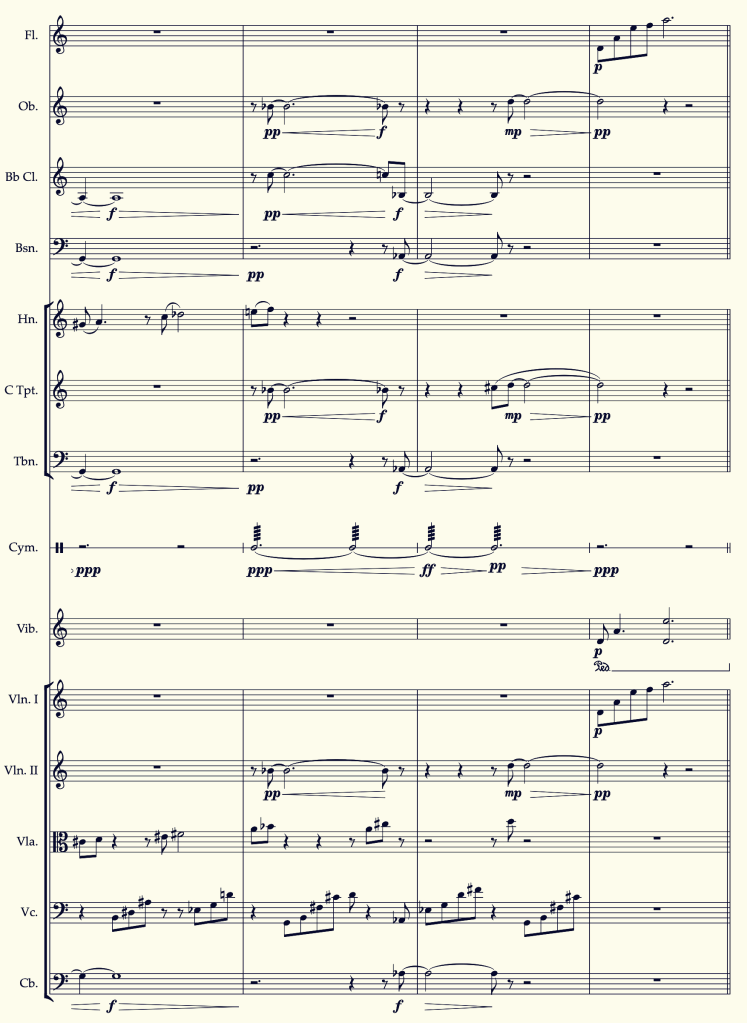
CANYON SKETCHES
Three sound sketches explore the timeless qualities of three magnificent canyons: Black Canyon of the Gunnison (Colorado); Glacier Gorge in Rocky Mountain National Park; and Palo Duro Canyon (Texas). Each sketch is fundamentally based on particular musical techniques.
Black Canyon
A complex three-part canon of meandering 12-tone lines, musically sketching the colorful streaks of pegmatite dikes in the Black Canyon’s cliff walls of Precambrian gneiss.
Glacier Gorge
Downward plunging arpeggios experiencing relentless musical gravity, sounding
out the energetic fall of whitewater over boulders.
Palo Duro sunset
Gently changing kaleidoscopic sonorities and a slow descent of pitch
constellations progressing to stillness, expressing the timeless quiet of the canyon.
sample score page . . .
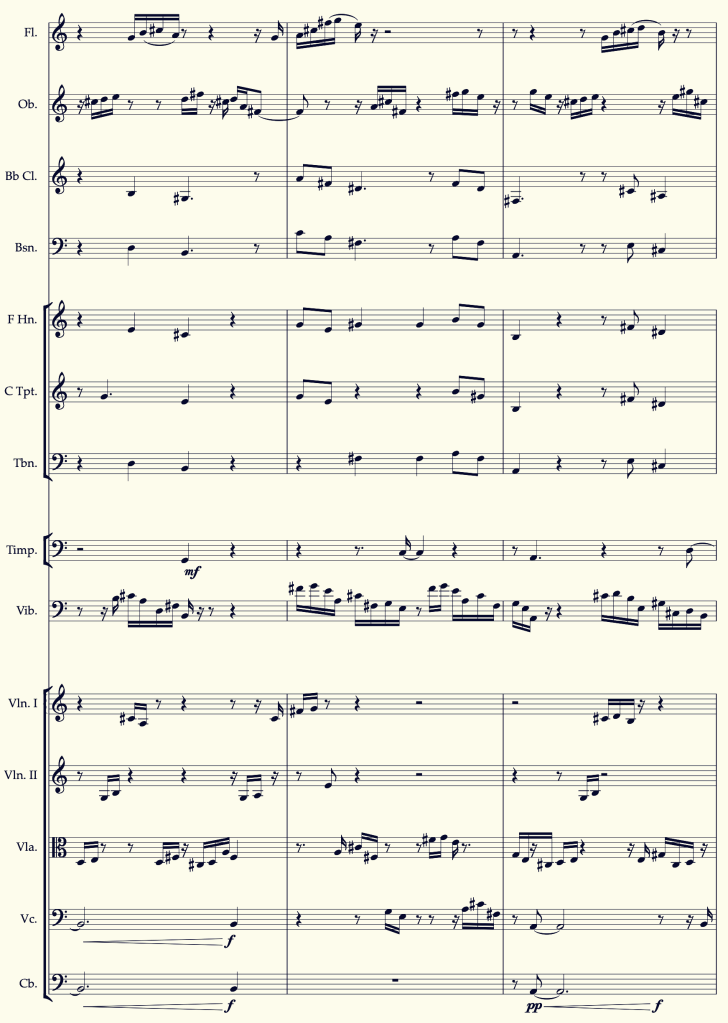
LOOKING FOR THE RAINBOW
First composed in 2021 during the COVID pandemic, the piece expresses both the uncertainty and hopefulness in our collective struggle to survive the storms of disease and violence.
A prequel to Rainbow Rising (2016), an earlier canonic piece for cellos, Looking for the Rainbow explores a more complex rhythmic counterpoint of darker sonorities, evoking a restless spirit of searching, anticipating. (Canon is an ancient compositional technique, a melodic line that is closely echoed while in progress by one or more other “voices” to weave an entire contrapuntal texture of matching threads.)
sample score page . . .
HIGHLANDS SKETCHES
Massif (“Velký Blaník“)
Storm (“bouřka“)
Highland dusk (“soumrak“)
There are many Highlands in my life. I am part Scottish, though my great grandparents are from Glasgow, not the Highlands. I do enjoy its single-malt whiskeys, though, and I graduated from Howell High School, the “Highlanders,” in Livingston County, Michigan. And I now live in the Texas Hill Country. Then there is Českomoravská vrchovina. I first visited what was then still Czechoslovakia in 1991. The Bohemian-Moravian Highlands are between the two main regions of what is now the Czech Republic. The ancient town of Tabor and the massif Blaník are two points of scenic and historical interest. Highlands Sketches sound-paints a climb up the mountain’s forrested slope, a thunderstorm of dissonant accents, and the quiet harmonic progression of an autumn dusk.
sample score page . . .
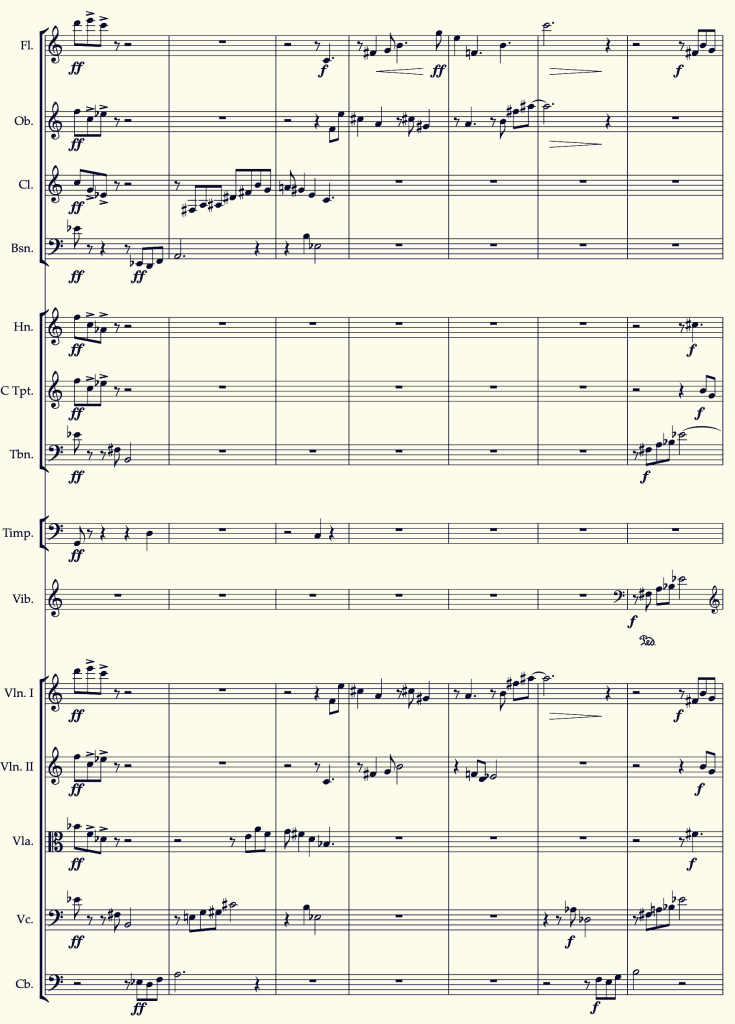
VIENNESE SKETCHES
Twelve Miniatures in Twelve Tones
I have long admired and been influenced by the music of early 20th-century Austrian composer Anton Webern. Known historically as a member of the Second Viennese School with Alban Berg and mentor Arnold Schoenberg, the three were pioneers of so-called atonal music and 12-tone-row serial harmonic organization. I find the term “atonal” misleading and negative, however, as their 12-tone processes achieved new “12-tone tonalities” — not simply a rejection of traditional tonal harmony but also striving to create new, more complex tonalities.
Miniatures I through IV are adapted from Webern Elegy; V through XII are from MapLab7 – For Little Arnold. Viennese Sketches does not portray the historical European city but rather explores various musical textures and tonalities using the 12-tone serial techniques of the so-called Second Viennese School of composers associated with Schoenberg. While their music using these techniques was unfortunately dubbed “atonality,” my uses focus on creating constellations and counterpoint that are complex but less dissonant and more sonorous: my sense of a new tonality.
What I admire about Webern’s mostly quiet instrumental miniatures (his Symphony, Op. 21 has only two sparsely scored movements) is the delicate, crystalline quality of his pitch constellations; and their gently lyric, precious setting into transparent textures, pearl-strings of delicate sound colors (Klangfarbenmelodie). Webern’s mentor, Schoenberg, as a Jew was compelled to emigrate to the U.S. in 1933 before it was too late to escape persecution. Webern, not Jewish, stayed in Vienna and survived World War II, only to be tragically killed, mistakenly shot by a U.S. Army soldier during the Allied occupation of Austria.
sample score page . . .
SINFONIA
Blue Ridge
Tango nuevo
Jupiter Rising
Mozart’s Symphony No. 41 (“Jupiter”) is one of his greatest masterpieces. His No. 40 in G Minor and No. 38 (“Prague”) are also magnificent. It makes one wonder if he had lived longer, what other stunning music would have poured forth. Back to No. 41 Jupiter, the first theme is a curving melody of such rhythmic vitality and fascinating turning shape that I used it as an example of both in my ebook, Mapping the Music Universe. Mozart makes the theme into a fugato, and I have adopted it in my study of canons. You can see the shape of its first six notes in the viola opening of “Blue Ridge,” then it permeates the contrapuntal material of the rest of the piece. The middle movement takes a break from the theme, setting instead the main themes from the opening of the G Minor No. 40 as a languid tango tune, followed by a trio in slow waltz meter that reverts briefly back to the bright Jupiter tune. The final movement extends our signature Jupiter 41 theme into a 12- tone row, generating a more expansive tonality in this animated landscape.
Blue Ridge refers to the beautiful hazy curves on the horizon as one gazes out from the top of the Blue Ridge Parkway, an hour west of my former home in the Piedmont in North Carolina. I also remember a similarly mystic vista looking south from Monterrey, Mexico, toward the foothills of the Sierra Madre Oriental mountains. The musical fabric is what I have called an “animated landscape” – not a still postcard but a soaring flight over and through the soundscape.
Tango nuevo is set in G minor, appropriate for this venerated dance form though uncharacteristic for my writing. The harmonies flow like dancers, the musicians feeling their way through the tonalities while never seeing an actual key signature.
Jupiter Rising depicts the mysterious splendor of moonrise, large and deeply-hued in the evening eastern sky. This movement creates a sonic metaphor for that visual phenomenon, but instead imagining the rising of Jupiter, the largest object in the solar system other than the sun. It only looks much smaller than the moon because it is so much farther away. My favorite Mozart symphony is his No. 41 in C Major, K.551, his last, nicknamed “Jupiter.” It is fitting that his lengthiest and greatest symphony is named for this great gas giant. A vivid musical motive begins and generates the majestic final movement. I use it as the theme of this sketch, relentlessly canonic in deployment. At some moments, as many as 8 contrapuntal soundings overlap each other in a gentle, cloud-like texture.
sample score page . . .
HUKVALDY SKETCHES
I. Hrad – morning climb to the castle ruins
II. Ptáci – watching Leoš’s birds
III. Vody – forest streams and shadows
IV. Bystroušky – mouflons and other mountain wildlife
V. Podzim – autumn sunset
The Czech mountain village of Hukvaldy was the summer home of the 20th-century Moravian composer Leoš Janáček. I visited there in 1991 when participating in the Brno International Music Festival. This launched a study of Janáček’s music and composing a ballet, PTACI, which was premiered in Brno in 1993.
Janáček loved nature walks and studied bird songs. From the ballet, Hukvaldy Sketches is a set of five modern musical impressions of old Moravia, in the ancient heart of Eastern Europe. The gracefully dancing themes of the five sketches show the direct influence, almost quotation, of Janáček’s journal of bird song sketches. The gracefully dancing themes of the five sketches show the direct influence, almost quotation, of Janáček’s journal of bird song sketches.
sample score page . . .
____________________________________
Performance challenges
____________________________________
Meter and rhythm
While there are some unusual prime-number meter signatures, such as 7 8 and 5 4, the music is mostly cast in ordinary 4 4, 3 4 and 6 8 meters. In these common meters, however, there is considerable blurring of the meter with triplets and even quintuplets, sometimes directly against the duple groupings of the meter. More extensively, notes often avoid the beat. In some sketches, the beat and meter are reduced to mere notation, as very slow tempos and irregular note
groupings create a floating feeling of timelessness.
Pitch and intonation
Despite the absence of key signatures, melodic pitch patterns and chords are formed mostly as subsets of changing tonal scales. There are lots of Perfect-Fifth intervals, which when purely intoned not tempered should produce a sturdy stability of chords. Sonorities also often include Major-Seventh intervals, which should not sound dissonant (as they would if stretched too sharp,
coming too close to an octave). Melodic intervals rarely involve conjunct scales. Their larger intervals are not “disjunct,” breaking apart a line, but rather stretch out into the freer mobility of flight.
Dynamics and color
Many long-sustained sonorities, especially in the strings, maintain a quiet stillness. Others, especially in the brass, surge in crescendos and fadeaways. “Terraced” changes from loud to soft and vice versa, as well as changes from mostly string color to winds to tutti, serve like key changes in traditional tonal music to mark milestones in large-scale form.
Orchestration
The scores all show transposed pitches for the clarinet and horn (not concert pitches). The trumpet part, however, is written for C trumpet and thus in concert pitch. A bass clarinet part is available as an alternate to bassoon. String parts are straightforward in bowing but offer many challenges of position shifting.
____________________________________
Analytic notes
____________________________________
Sonorities of Sevens
Looking at sonorities, we should consider both the vertical, chords, and horizontal, scales and lines. In my first book, Learning to Compose, my co-author Larry Austin and I coined the term “pitch constellations” to also include diagonal interval relationships in counterpoint between lines. The pitches of a constellation form a web of intervals with each other. To analyze this complex interval web, we can look either horizontally at a scale-like pattern or vertically at an array of stacked intervals. (This was the central concept of my second book, ARRAYS.) Finally, to see patterns more clearly, I always measure intervals by the number of chromatic-scale semitones (“half-steps”), transcending the historical baggage of naming intervals as “perfect, major, minor,” etc., from a tonal scale basis. So a “Perfect Fifth” is 7 semitones:
semitones
tonal name
1
minor 2nd
2
Major 2nd
3
minor 3rd
4
Major 3rd
5
Perfect 4th
6
Aug. 4th / dim. 5th
7
Perfect 5th
8
minor 6th
9
Major 6th
10
minor 7th
11
Major 7th
Here is a successive-interval array analysis of three scale sets drawn from to build five chords typical of the constellations predominant throughout the Sketchbook:
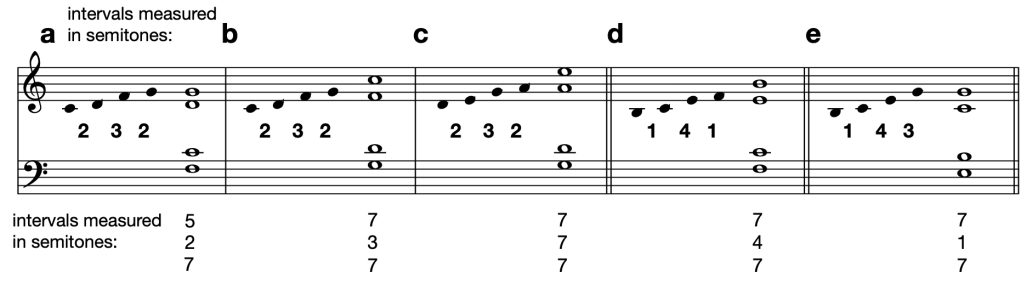
Observations:
- all have four pitch classes (a basic triad has only 3 pitch classes)
- none are a simple triad or triadic seventh chord (a stack of thirds)
- all scalar arrays are subsets of a diatonic (major or minor) scale
- a, b, and c are all built from the same set/scalar array
- all illustrated chord stacks are dominated by 7-semitone Perfect 5ths
In fact, a, b, and c sound very much like sonorities typical of Copland’s 20th-century American style of tonality, featuring the open, bold rooted stability of the 7-semitone Perfect 5th. They also have no intervals one semitone larger or smaller than a unison or octave. The d and e sonorities (my favorites in the “Stack of Sevens” category) have a darker flavor – like a dark roast espresso – due to the
stronger dissonance of their 1-semitone and 11-semitone intervals.
Here are some simpler three-pitch sonorities that emerge as subsets of the 2 3 2 and other scale arrays above:

Though only three pitches, none of these are traditional triads, but instead are more
complex interval combinations. Here is a sampling of larger sonorities:
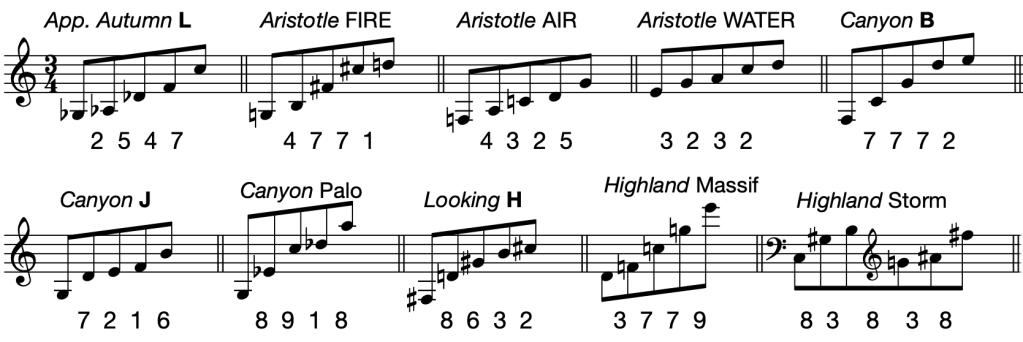
While some are close to being Debussy-like triadic 7th or 9th chords, the last example, Storm, is the only aggressively atonal sonority in the entire Sketchbook.
Primes and Palindromes
The number 12 is interesting in that it is readily divisible in four different ways with just whole numbers (integers). A set of 12 items can be divided neatly into two groups of 6 items each, three groups of 4 each, four groups of 3, or six pairs. That relates to common musical meter signatures of 2, 3, 4, or 6 beats per measure that break down into equal subdivisions.
A prime number is interesting in that it cannot be divided without fraction by any whole number. There are theoretically an infinite number of prime numbers, but the smallest that are useful for our pattern purposes are 1, 2, 3, 5, 7, 11, 13, 17, 19, etc. The only even prime number is 2; taken out, it leaves an interesting set of odd primes, 1 3 5 7 11, that as time chunks make rhythms that do not break down
into subgroups, seeming to float rather than march.
Examples from Appalachian Autumn:
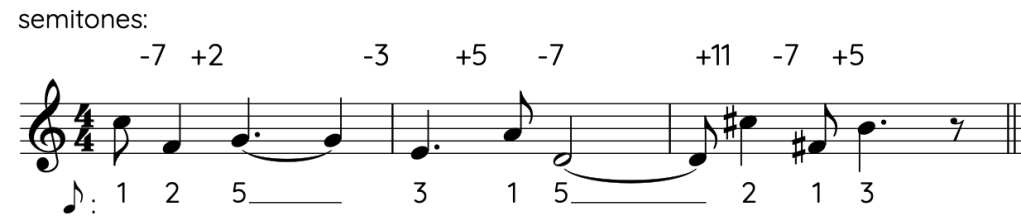

In these illustrations, the durational note values are measured below in number of eighth-notes of time. Melodic intervals are measured above in number of semitones (“half steps”). Both the intervals and the duration values measure in only prime numbers. That means though the passage is written in 4 4 time, no measure breaks down into half-measure sub-units; and no duration note value is immediately
repeated. The rhythm cannot be felt as marching quarter notes in half-note pairs, and even some of the downbeats avoid being moments marked by a new note. The rhythm floats, like the curving Blue Ridge Mountains skyline.
Melodic lines and sonorities also float through different pitch-set collections suggestive of different scales and tonalities. This evolving tonal feel is also an Impressionistic reflection of the many shapes and hues of that blue skyline.
Tone Rows
The 20th-century compositional technique of a 12-tone row organizes rapid tonal flux into a dynamic yet coherent flow. This tone row is from Variation III of Viennese Sketches:

All 12 pitch classes appear just once, designated by the standard Pitch-Class (PC) numbers (C = 0) separated by commas.
Another rather different row, from Appalachian Autumn, rehearsal letter G:


Note that the first six pitch classes all are found in the diatonic scale of C major, and the other six can all be found in the scale of B major. You might say the row “modulates” in the middle. In standard theory terms, its retrograde inversion is identical to the original in interval succession.
By definition, this is another palindrome. The melodic interval shape determined by these octave choices for each pitch is also a palindrome, with melodic interval sizes starting at the second note, F, increasing through the prime numbers 2 to 11, then decreasing through the same series. Though the work’s title refers to Copland, this kind of symmetrical structuring is typical of Anton Webern’s work, especially his Symphony, Op. 21. Prime numbers and palindromes underlie many of the rhythmic, melodic, and tonal structures of other pieces in the Sketchbook.
Contrapuntal Canons
An ancient compositional device, canon goes back many centuries to Medieval sacred choral music. A leading thematic voice or line is echoed after a brief time delay in another voice or voices, duplicating the rhythm and melodic shape of the lead line. If the exact pitch succession is duplicated, it is said to be Canon at the Unison. Canon at the Octave is also common, and duplication by the following voice at some other transpositional interval is also possible, though that complicates the harmonic relations between the voices.
It is Rumpelstiltskin magic, spinning a single and sometimes simple line into complex counterpoint. Of course, a magician’s expert contrapuntal skill is necessary to make a canon, even in just two voices, work as a rhythmically and harmonically elegant texture. Once again, Appalachian Autumn shows some clear examples:

Time delays are calculated as the equivalent number of eighth-notes. Sure enough, I chose prime numbers for those delay durations! The interlocking of the rhythmic pattern with itself at these delays means that two voices seldom start a new pitch at the same moment (few contrapuntal accents). The voices continue to be mostly staggered, taking turns moving in a flowing fashion.
The first two followers are an octave lower than the original, and the last follower is down two octaves. This canon at the octave means each voice begins on Db and proceeds to Gb and Ab, forming the harmony of the entire first two bars. Those three pitch classes make the 2 5 interval array shown above in letter a. The last pitch of the three, Ab, overlaps in the third bar with the start of a new set, F Bb Eb
(also the 2 5 chord stack), making in the third bar a transitional 2 3 array.
Canon appears in various places throughout Animated Landscapes Sketchbook. (Title is followed by locations in the score, rehearsal letters or movements.)
- Appalachian Autumn [A E]
- Canyon Sketches [“Black” B C, I]
- Looking for the Rainbow [A D H K]
- Highland Sketches [“Storm”]
- Viennese Sketches [1st variation only]
- Sinfonia [A C D N P, 1st movement, 3rd movement]
- Hukvaldy Sketches [C F, 5th movement]
The last sketch in Sinfonia, “Jupiter Rising,” starts with a simple canon whose 12-tone melody is shaped after the first six notes of the opening theme for the finale of Mozart’s Symphony No. 41, the “Jupiter Symphony.”

This demonstrates that any compositional device – canon, tone row, pitch set, palindrome – can be a tool used to craft something quite beautiful.
____________________________________
Score samples
____________________________________
To request a free score and performance parts, email:
tc24@txstate.edu
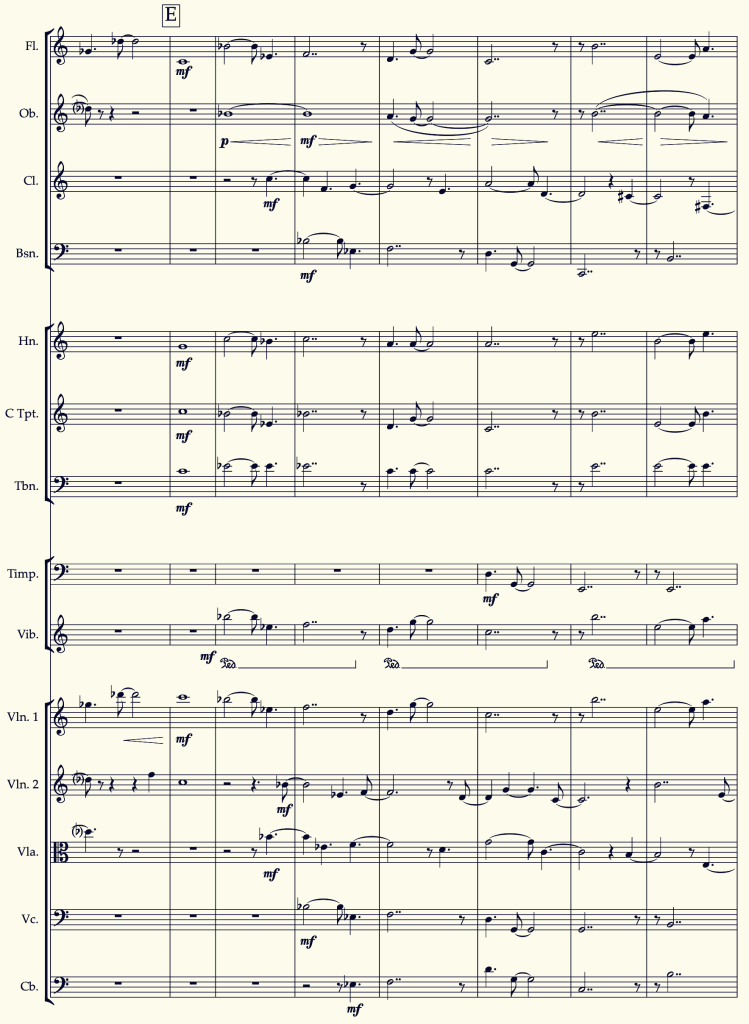
Appalachian Autumn
Aristotle’s Elements
Canyon Sketches
Looking for the Rainbow

Highlands Sketches
Viennese Sketches

Sinfonia

Hukvaldy Sketches

To request a free score and performance parts, email:
 Thomas Clark - composer / digital artist