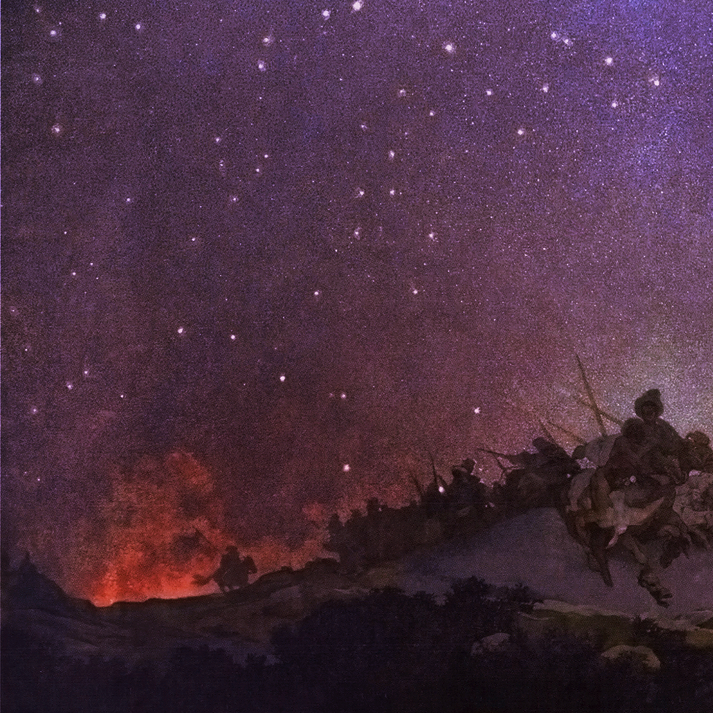
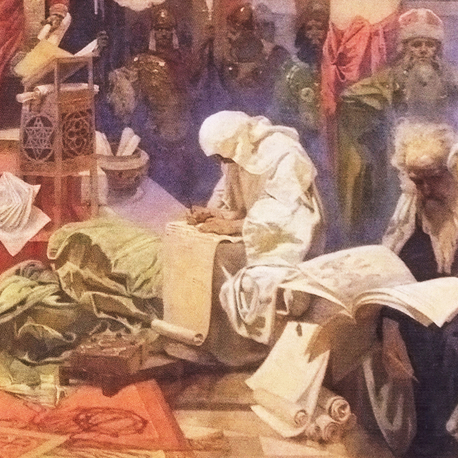
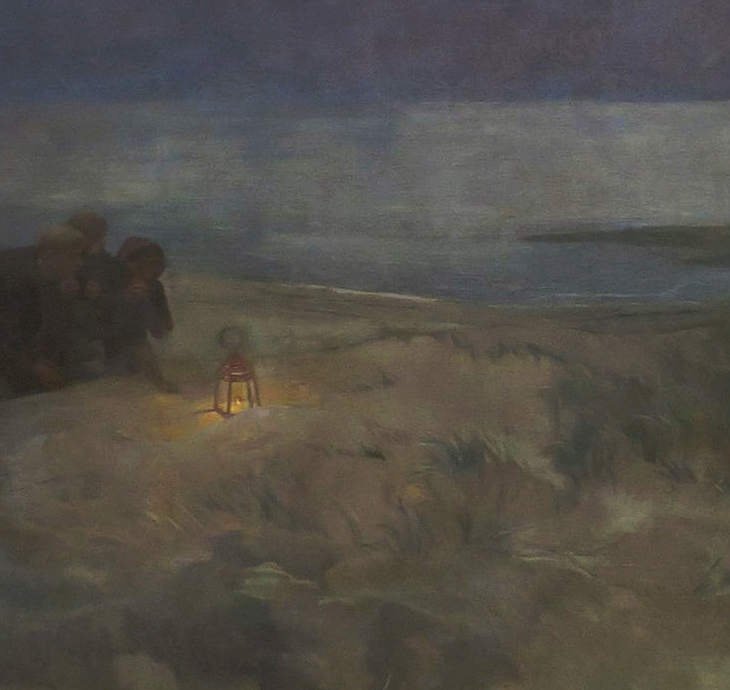
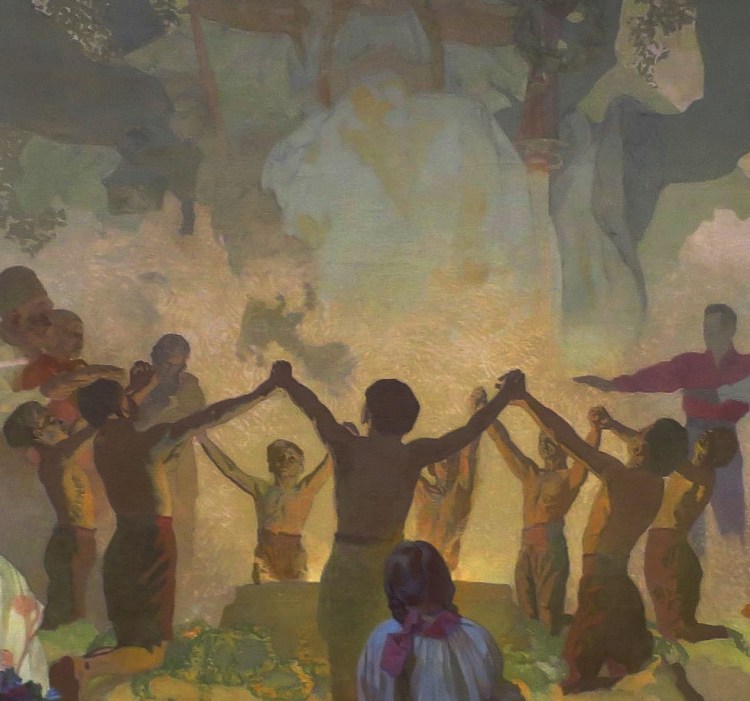
In 1991 I made my first trip to Czechoslovakia to perform at the International Music Festival in the ancient Moravian city of Brno. It was on a side trip to the nearby town of Moravsky Krumlov that I first saw Alfons Mucha’s series of epic paintings depicting the history of the Slavic world. The stories expressed in these 17 enormous unframed canvases were intriguing, but I was most inspired by his dazzling rendering of light, the hallmark of truly great artists. Five stood out and became my challenge to complete the transformation of their depictions of light into music.
In the midst of my recent Impressionistic “Sketches” series, the 2024 piece Folio was a throwback to the more abstract sound mass style of the 1960s and ’70s. Its percussive attacks and inert masses of sound were all synthesized, also throwbacks to my early days of electronic tape music. (One of the earliest electronic compositions, Stockhausen’s 1960 Nr. 12 Kontakte, was full of sounds like giant steel beams hitting a concrete floor!) The other retro feature of Folio is suggested in its title: homage to Earle Brown’s 1952 FOLIO, a collection of abstract art scores in stark, proportional graphic notation.
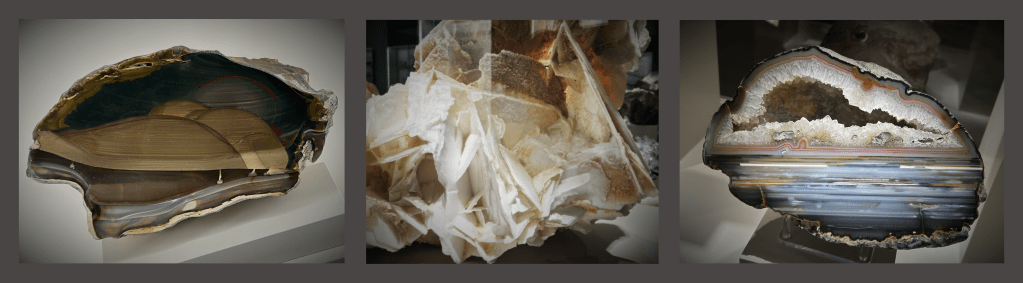
This wind and percussion transformation of Folio was challenging. But I thought about the chaotic boldness of rocks — my own collection of many found on beaches and hikes, but also splendid displays at three places: Dick’s Rock Shoppe in Estes Park, Colorado; Lizzadro Museum of Lapidary Art in Elmhurst (now in Oak Brook), Illinois; and a wonderful gallery of geodes at the Permian Basin Petroleum Museum in Midland, Texas. Geodes are Nature’s sculptures, inscrutable gray rocks that, when sawed open, reveal magical worlds of dazzling-colored crystal structure.
1985-2022 . . . Fourteen canonic studies in three voices (19 minutes)
My compositional fascination with canons began in the early 1970s with study (at the University of Michigan) of Ockeghem’s 15th-century polyphony, the 10 canons in Bach’s 18th-century The Musical Offering, and Webern’s 20th-century Symphonie Op.21. As a young professor in the 1980s teaching 16th-century counterpoint at what was then North Texas State University (now UNT), I used canon as a challenging contrapuntal writing assignment. In 1985, a wind ensemble piece, Parallel Horizons (Homage to Schoenberg), was my first formal composition constructed by canon. In Dark Matter, other contrapuntal writing surrounds an extended canon. Now canon pervades much of my 21st-century writing, a challenging yet stimulating and gratifying approach to texture and continuity of material.
Homage to Debussy’s Impressionistic masterpieces, La Mer and Nocturnes
Debussy avoided the label “symphony” or “tone poem” by calling them each “three symphonic sketches”. The first sketch of Nocturnes, subtitled “Nuages,” is musically quoted in IV “Nuages blanc”.
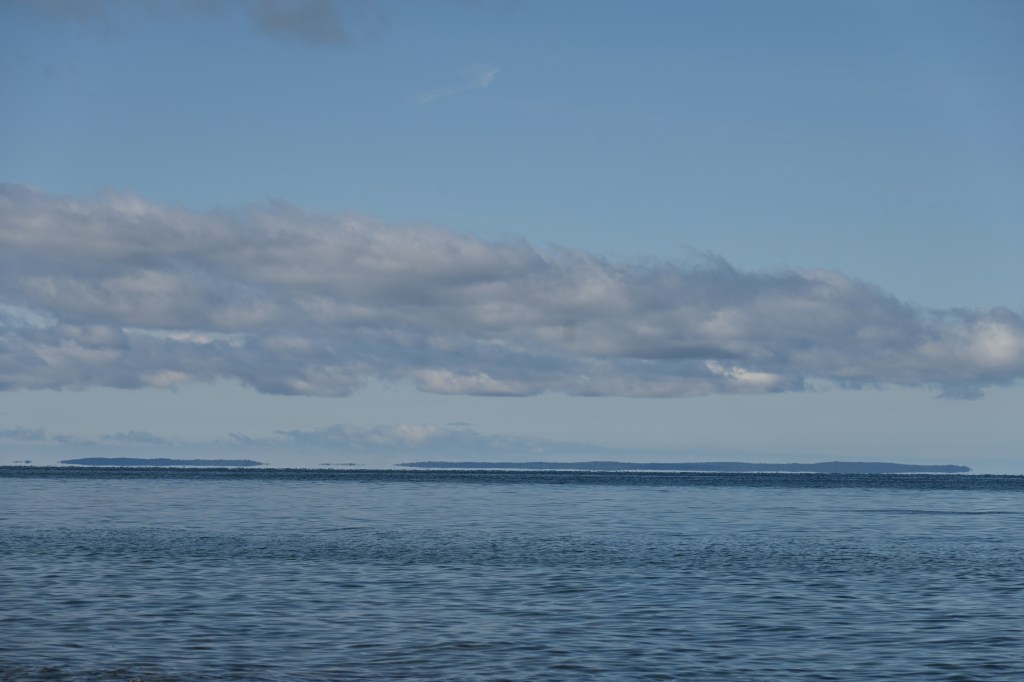
Adopting his French language also recognizes the early explorers of the Great Lakes region of North America. The first decades of my life began there in Michigan’s Lower Peninsula (the “mitten”). It has its own smaller Leelanau Peninsula in the northwest corner (the mitten’s “little finger”) near Interlochen’s National Music Camp, where I spent many summers. Nearby Grand Traverse Bay has its own even smaller Old Mission peninsula, where I loved to visit its lighthouse. The Leelanau has a grand lighthouse at its northern tip and a scenic drive, state highway M21, winding for 64 miles all the way around the peninsula’s shoreline, through forests and past the Great Sleeping Bear Sand Dunes.
In 1984 my piece titled PENINSULA for piano and sound synthesis was a more experimental work that traced a map of the Leelanau and its landmarks to determine by their spatial coordinates the timing and pitches of sound constellations. Moving forward from that mapping phase of my compositions, my Impressionistic phase produced the sound sculpture Leelanau Sketches in 2022. Some of its musical material reappears now in these five symphonic sketches, Belle Péninsule.
In notes on a recent composition, Frost Serenade, I described “changing tonal temperature.” Here is a deep dive into what that meant.
The metaphor of tonal color and temperature has to do with what we normally call consonance and dissonance in a chord or other harmonic entity.
Centuries-old tradition classified musical pitch-intervals as pure, perfect consonances (“Perfect Fifth” and “Perfect Octave” for example); major or minor (exp. “Major Third” or “minor Sixth”); or problematic (“Augmented Fourth” and “diminished Fifth”). Some major and minor intervals (thirds and sixths) were considered imperfect consonances; the others (seconds and sevenths) were considered dissonant. Every music student learns these categories while studying 16th-century model counterpoint.
Using the color spectrum in temperature order:
Let’s convert the consonance/dissonance concept to think of a pitch-interval’s acoustic complexity. Every musical tone has a fundamental pitch, plus faint overtones that give the sound its color. They are of fading intensity and felt (as color) more than actually heard as the distinct pitches they are. Discovered by Pythagoras as partial vibrations in whole-number fractions, the overtones are always in a fixed interval ladder rising from the fundamental: Up an octave, then a Perfect Fifth, then a Perfect Fourth, a Major third, minorthird, then to the eccentric seventh partial, which is out of tune by our scale-trained pitch perception (and shown a darker gray below), and on to the eighth partial, which is three octaves above the fundamental. (An octave is a multiply-by-2 operator, so partials 2, 4, 8, and 16 of the C overtone series are also the pitch-class C. Likewise, partials 3, 6, and 12 are all octave related.)
Two different fundamental pitches sounding together each bring into the acoustical mix their distinct overtones. The overtones from one either match (simple) or clash with (complex) overtones of the other. This is what makes the sonic complexity or perceived purity of the interval between two fundamental pitches. Using this relationship, we theorize that the higher we need to go to start finding matching overtones between the two pitches, the more complex is the interval. Following this logic, here is an overtone-match analysis of all harmonic intervals smaller than an octave.
PERFECT CONSONANCES
The rather pure Perfect Fifth interval between fundamental pitches, C up to G, matches overtones at G’s partial 2, a low level in the series, matching the C’s partial 3. The interval makes four such matches in this lowest-two-octaves span. The pitch match up of the G’s 2nd partial with the C’s 3rd partial (both are the same pitch, G) will be duplicated in all higher octaves, making this an acoustically simple interval. The two pitches’ overtones mostly match and don’t interfere with each other much.
IMPERFECT CONSONANCES
The triadic consonantMajor 3rd interval between fundamental pitches, C up to E, matches overtones at a somewhat higher level in the series, partial 4, and makes two matches in this lowest-two-octaves comparison.
DISSONANCES
The dissonantminor 7th interval between fundamental pitches, C up to Bb, matches overtones makes only one match in this lowest-two-octaves comparison, at partial 5. That means its harmonic quality is more complex, with most of the lower overtones interfering, not matching. Not a strong dissonance, but more complex than the others.
By contrast, with the more complex Major Seventh interval (ex. C up to B), you have to go all the way up three octaves to the B’s 8th partial (matching the C’s 15th partial!) to find an overtone that matches and doesn’t conflict/interfere. The Major 7th interval can be considered much more complex at a rating of 8 than a Perfect 5th at rating 2.
The most complex interval analyzed, the minor 2nd, clashes all the way up until the 15th partial.
Summarizing the analysis with a complexity rating number for each interval:
minor 2nd = 1 semitone
15
Major 2nd = 2 semitones
8
minor 3rd = 3 semitones
5
Major 3rd = 4 semitones
4
Perfect 4th = 5 semitones
3
Augmented 4th = 6 semitones
10
Perfect 5th = 7 semitones
2
minor 6th = 8 semitones
5
Major 6th = 9 semitones
3
minor 7th = 10 semitones
5
Major 7th = 11 semitones
8
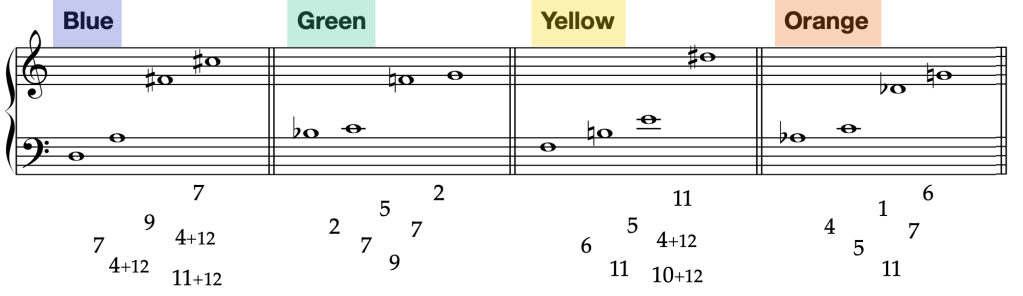
Now we can add up the ratings of each interval in a chord and take an average complexity quotient. And we can think of complex as darker than simple, or we can invoke the color spectrum. In digital photo imaging, we use a temperature metaphor, seeing red as warmest (infrared heat) down through orange, yellow, green, down to blue, the coolest. The “hottest,” most complex harmonic interval is the minor 2nd. The “coolest,” purest (other than the octave) is the Perfect 5th.
The intervals in the following example are shown in semitones. Each chord has four pitch classes and six intervals between them. The Blue chord has an average complexity rating of 3.8. Green chord is slightly more complex, at 4.3. Yellow, which includes the more complex 11-semitone Major 7ths, rates 5.5. And Orange, with the only minor 2nd 1-semitone hot dissonance, is warmest at 6.2. Try to hear the differences. (No attempt here to demonstrate a red-hot cluster mashup of pitch!)
Here is a little demonstration phrase using those four chord types to build a progression of tonal temperature colors. Again, as you listen, try to feel the temperature warm up then cool back down.
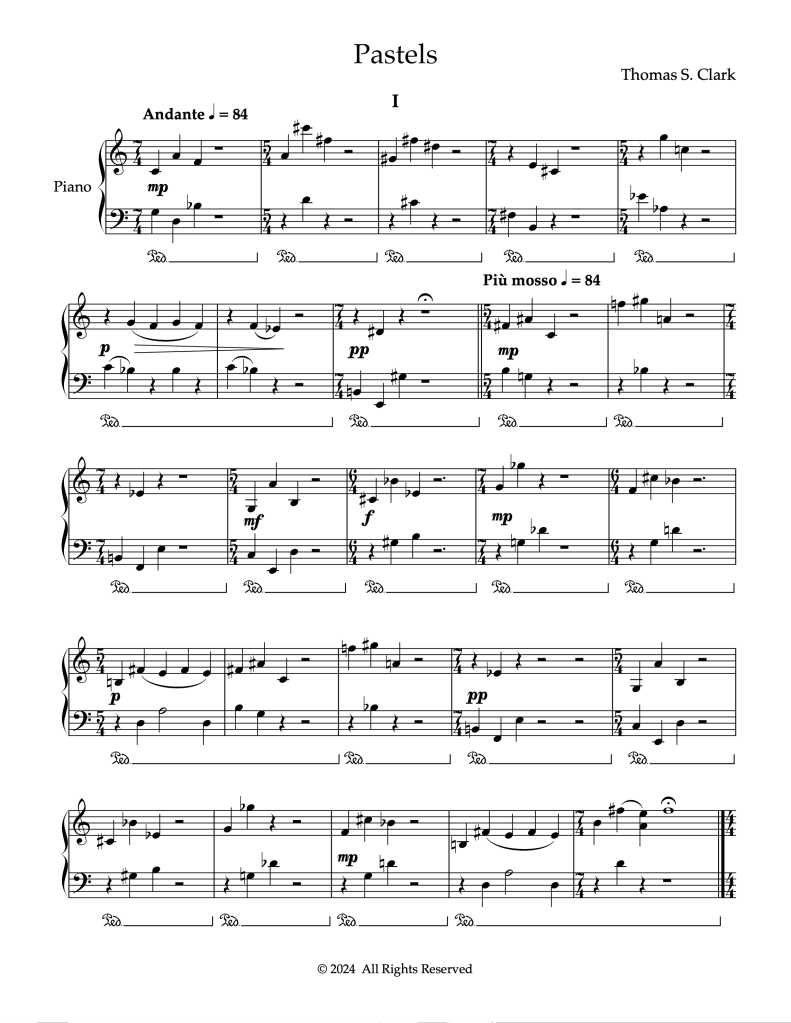
2024 . . . Four Small Tonal Studies for piano (4:00)
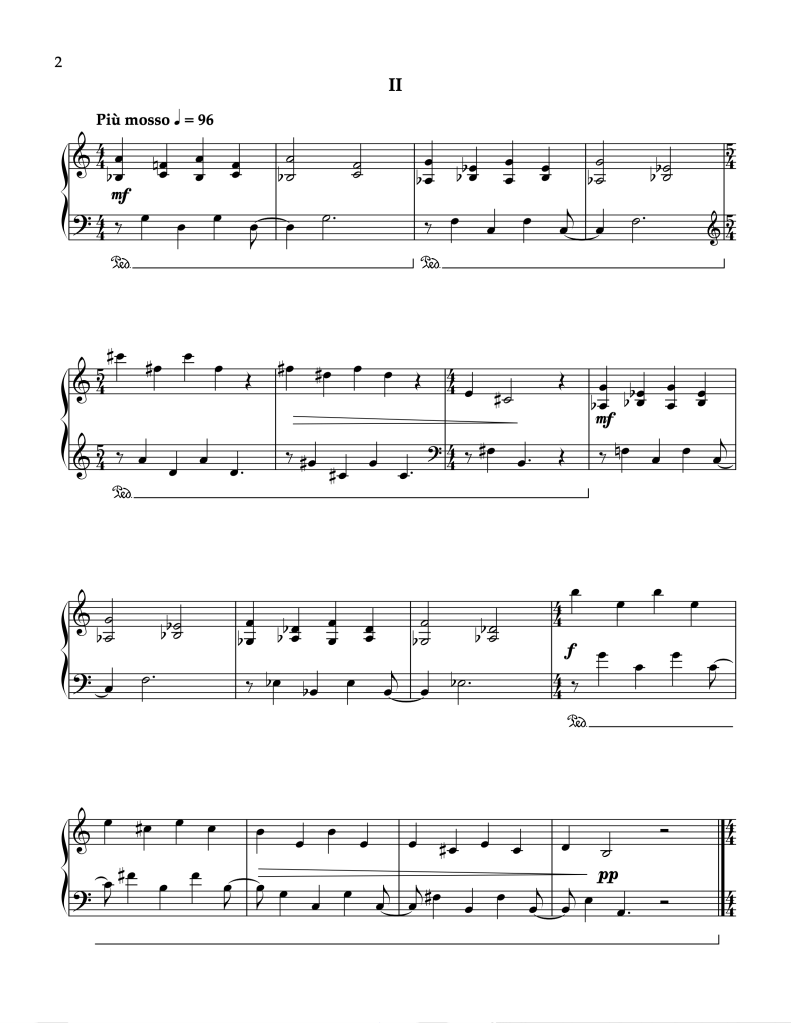
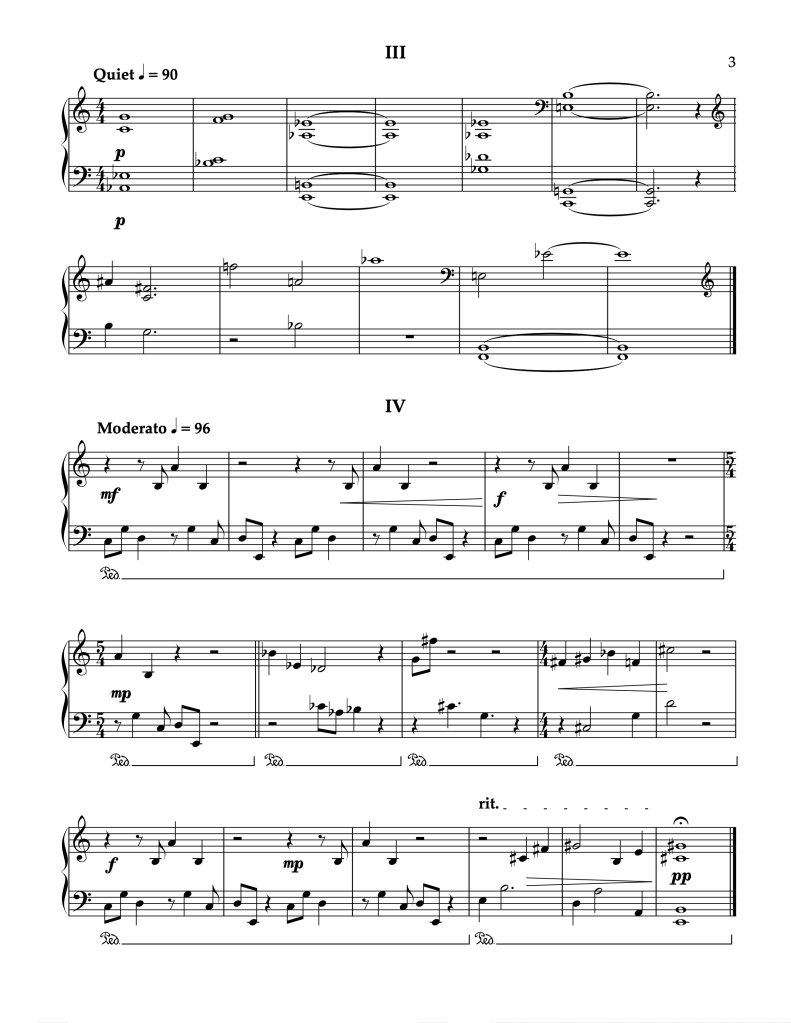
Recent compositions have shifted from my longstanding focus on contrapuntal writing, especially canons, and animated sound masses to chordal development of my personal harmonic language. Crystallography and Folio explore arpeggiated chords, pitch constellations of four or more pitches forming a mixture of pure, consonant, and mildly dissonant intervals. The changing tonal color of these sonorities in succession, from bright to dark, prompted this small tonal study. As the color or brightness differences are subtle, pastel water color painting is an appropriate visual metaphor.
A video cross-dissolving my own digital images combined with synthesized sound makes a multimedia version viewable on YouTube:
Pastels — Four Small Studiesof Tonal Color for piano:
In Robert Frost’s poem “My November Guest,” an exquisite expression of loss and sadness, four phrases stood out expressing the gray beauty of November:
“these dark days of autumn rain” . . . “my sorrow when it’s here with me”
“the bare, the withered tree” . . . “the sodden pasture lane”
Autumn RainMusic was originally composed in Ann Arbor for oboe and piano in 1971. Decades later in San Marcos, in 2017 the music evolved into an elegy for unaccompanied English horn, and now to this duo arrangement, heard here with sound-synthesis enhanced background.
Inspired by wonderful colleagues (and also my two daughters) who played viola, my love continues for its beautiful rich lyric voice.
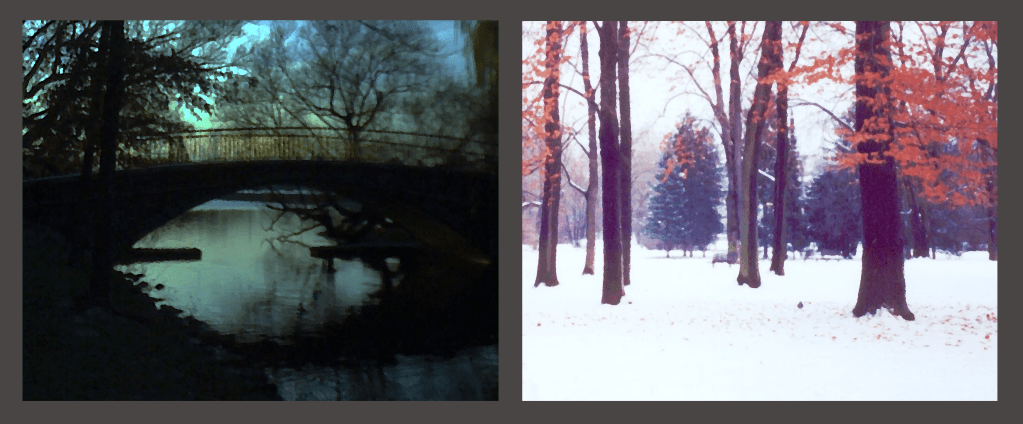
The title is a double reference, both to the still iciness of an autumn night and morning, and to a great American poet. Robert Frost’s “Stopping By Woods” was the inspiration for Before I Sleep, a 2018 unaccompanied work for Texas State violist Ames Asbell. Much melodic material was drawn from it for this Serenade. The two parts, “Twilight bridge” and “Snowy dawn,” grow lyric lines out of intricately articulated harmonies of changing tonal “temperature.”
At this stage in my 60-year composing career, I feel free to explore whatever intrigues me and, however complex or simple, craft a tranquil listening experience.
2024 . . . Serenade for viola and strings . . . 8 minutes
This is not a musical sketch about bridges. Its impetus is a musical idea, the exploration of complex patterns for articulating a chord.
An arpeggio is the pitches of a chord sounded one at a time instead of as a block simultaneity. The order is usually straight up from lowest to highest pitch (Moonlight Sonata), or up and back down, or jumping around (Alberti bass). On a piano the damper pedal is usually used to let each pitch continue to sound with the others, bringing together the complete harmony.
In contrapuntal textures, individual voices each contribute a member pitch of the chord, either simultaneously (chorale) or at different moments, but again sustaining all pitches over time into a pitch constellation (like Orion).
In Night Bridge, pitch constellations build up from a single pitch to four pitches before dissipating back to a single tone; then a reflective pause before another constellation starts to build. A solitary musical voice floats above the resulting liquid waves of tone.
Back to the bridges metaphor: their spanning is more mysterious at night, when lights may reflect off ripples in a peaceful passage over a flow of dark water. The most venerable bridge I’ve traversed, the Charles Bridge over the great river Vltava, inspired the contrapuntal chamber music in my Karlův most (2018). Night Bridge echoes that music.
Here’s another favorite bridge, viewed at night from Chicago’s Michigan Ave. bridge:
This is the first time I began a multimedia piece with the visual element as primary design concept rather than the music, with visuals joining after. The visual concept, as suggested by the title, is an exploration of patterns in nature featuring complex masses and threads of color. They resemble busy Jackson Pollack action paintings revealing isomorphic patterns. The title evokes the abstract patterning of molecular crystal growth.
The synthesized “soundtrack” is music adapted from my 2022 work, STONEHENGE for solo classical guitar: