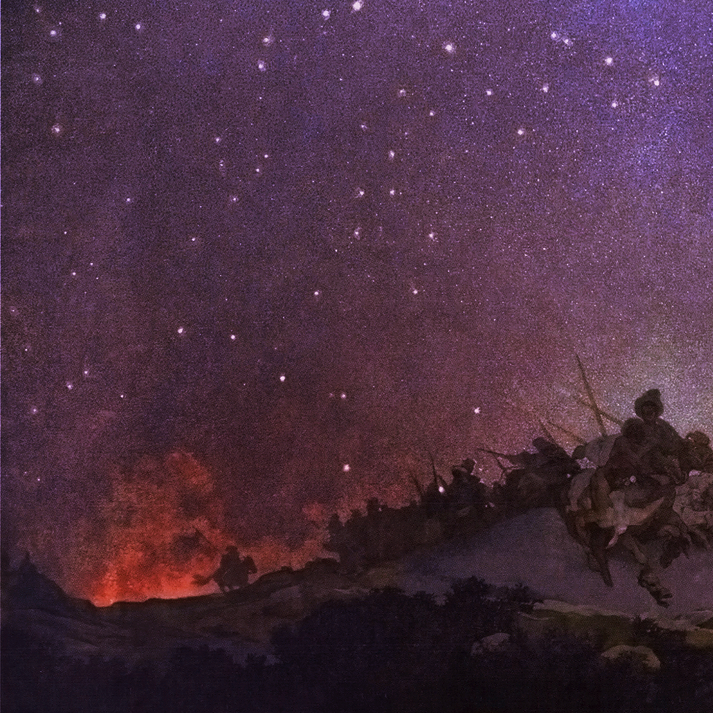
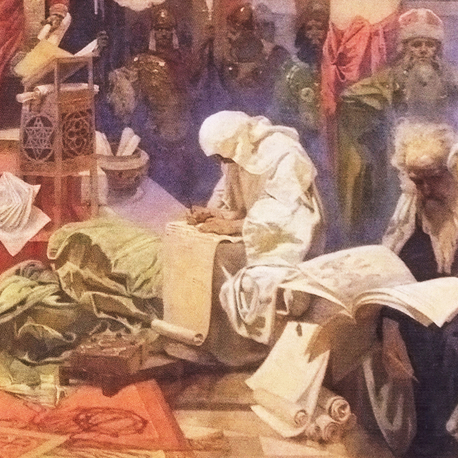
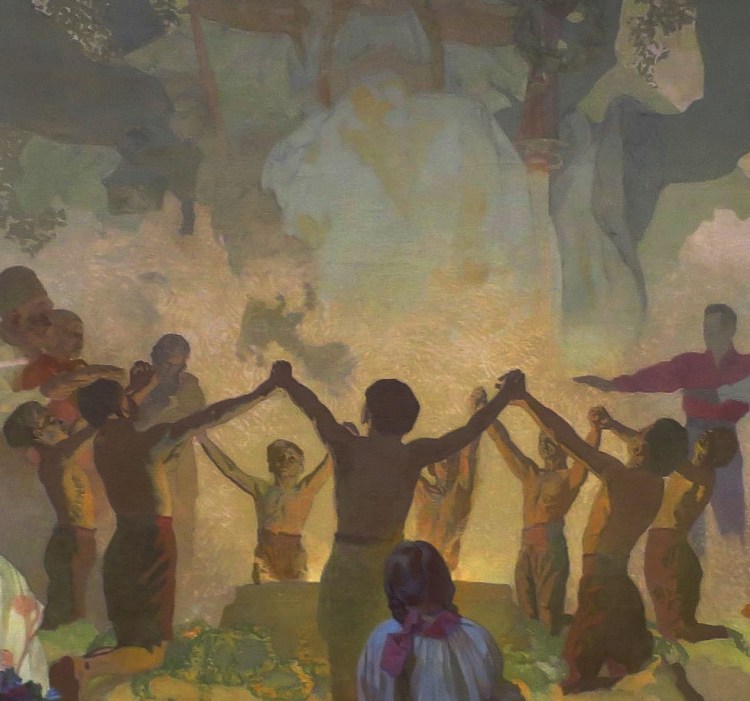
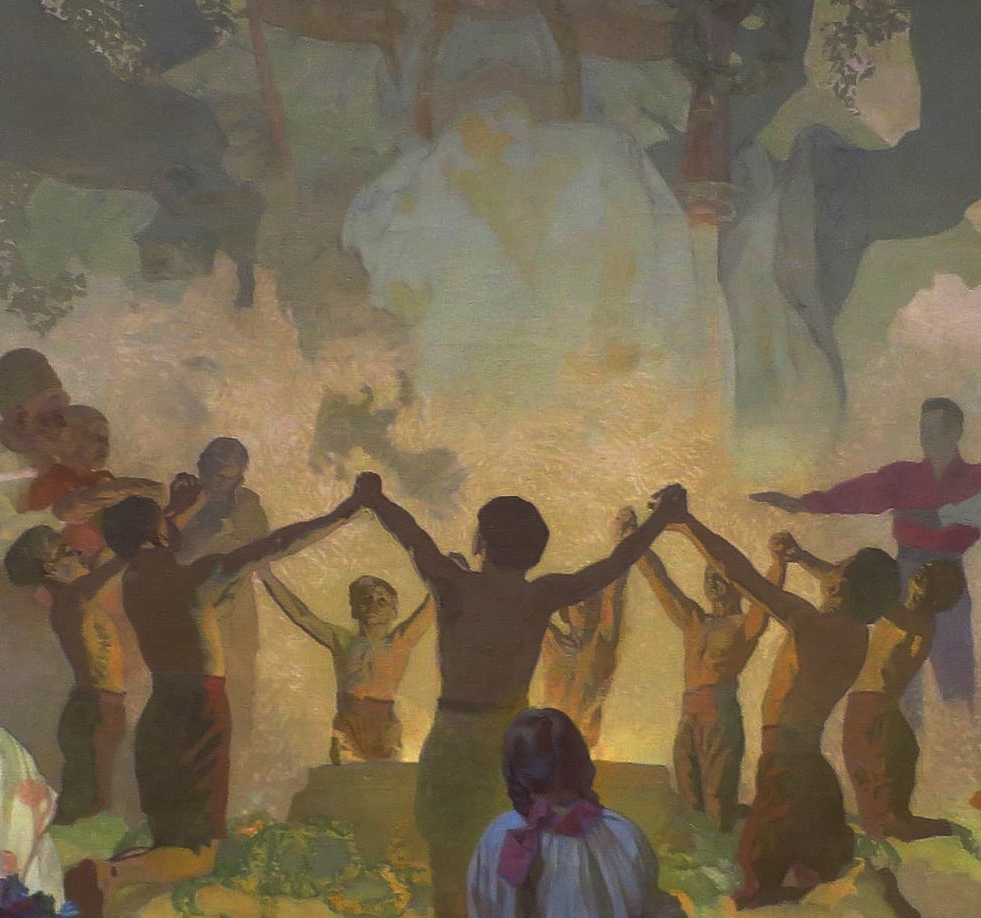
In 1991 I made my first trip to Czechoslovakia to perform at the International Music Festival in the ancient Moravian city of Brno. It was on a side trip to the nearby town of Moravsky Krumlov that I first saw Alfons Mucha’s series of epic paintings depicting the history of the Slavic world. The stories expressed in these 17 enormous unframed canvases were intriguing, but I was most inspired by his dazzling rendering of light, the hallmark of truly great artists. Five stood out and became my challenge to complete the transformation of their depictions of light into music.
Five sound sketches on the historical paintings of Alfons Mucha (1996/2005)
I first traveled to the Moravian region of Czechoslovakia in 1991 to conduct my own music at the 26th International Music Festival in Brno. While there, I visited the South Moravian town of Moravský Krumlov. Its castle served as a museum gallery for the epic paintings, Slovanská Epopej, of Alfons Mucha. Better known as the father of art nouveau through his many famous Paris posters, Mucha was deeply interested in Slavic culture and history. The 20 paintings, each a monumental canvas hung as a tapestry, vividly depict both historical and mythical scenes.
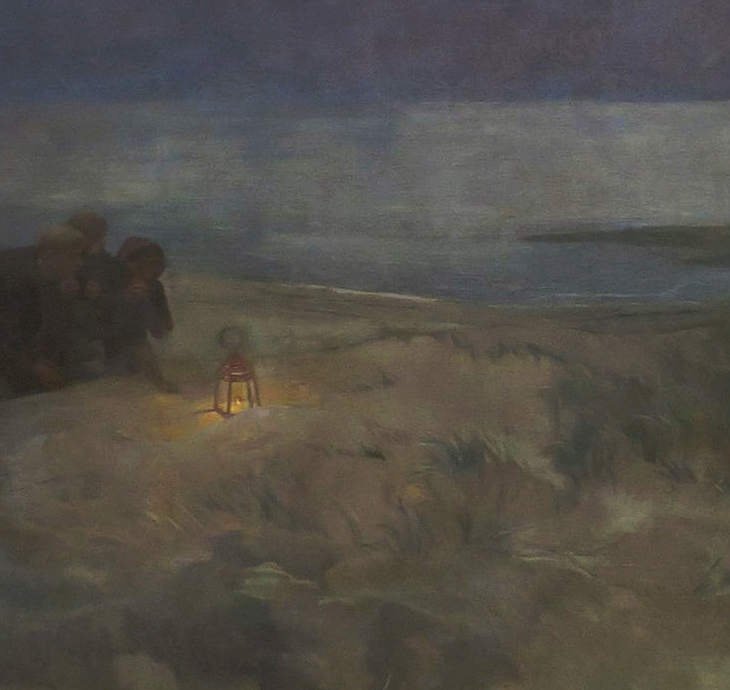
Mucha’s Light: Ancient Images is dedicated to Miroslav Marada, the Moravian gentleman who first showed the paintings to the composer in 1991. A teacher, history buff, and lover of the local wines of south Moravia, Marada fascinated me with elaborate tales, explaining the symbolism of each painting. The five works I selected to sketch musically have a common element, masterfully painted images of exotic light. Composing musical analogs for these ancient images, I incorporated medieval music from the Bohemian/Moravian region of central Europe. The music weaves authentic medieval chant tunes into an intensely contrapuntal fabric, interspersed with modern sparks, streaks, and splashes of sound color. Originally composed for brass quintet, the musical images called for a richer, more varied sound-color palette:
2006 . . . computer music, optional solo performer (flute or violin) . . . Winston-Salem, North Carolina . . . duration: 11 minutes
The Fourth Angel (2007) was commissioned by North Carolina State University’s Arts Now Series, directed by Dr. Rodney Waschka II, as an artistic contribution to The Ericka Fairchild Symposium on Climate Change. The title refers to one of the “seven last plagues” as they were called in the King James Version of the Bible. In the NRSV translation, Revelation16:8 reads: “The fourth angel poured his bowl on the sun, and it was allowed to scorch people with fire; they were scorched by the fierce heat . . .”. (The other six angels and their bowls wrought plagues of painful sores, bloody seas, bloody rivers, darkness, a dried up Euphrates, and finally the seventh angel’s loud voice pronouncing, “It is done!”) Standing in the middle of the sequence, the prophecy of the fourth angel is a dramatic metaphor for global warming.
Though there are some literal sound references, the angel is portrayed more broadly as a metaphor for the forces of nature. Rather than capturing actual samples of nature sounds, the computer-generated sounds are all synthesized, musical objects constructed employing a now-common computing technique called grain-table synthesis. (The choice of machine synthesis over nature sampling suggests a particular belief about the causes of global warming.) These synthetic sound images form a broad range of simple and complex musical rhythms and textures evocative of the natural world: sunlight reflected off water and ice, glaciers calving and cascading into the ocean, solar radiation, and night sounds. Extending the metaphor, sounds echo and swirl in sound space, just as do the dynamic, powerful weather systems that shape our global climate.




 Thomas Clark - composer / digital artist