Category: 2010-19

  • CLARK’S RULES

    These are a distillation of my guiding principles through many years of teaching, serving as an academic leader, and meeting, working with, and understanding many very successful musicians. They don’t really belong on this composer-and-photo-art site. Or do they?

    Clark’s Rules for Musician Success

    Teaching is not so much imparting knowledge as it is facilitating learning. A teacher is an enabling coach on the sideline; all the on-field action is by the student, the learner. From a veteran coach, here is a simple but effective playbook.

    Each rule is a command to action.

    Rule 1: SHOW UP.

    Music is a team sport, and the team depends on you being there every time.

    Rule 2:  PAY ATTENTION.

    Don’t just watch and listen — think about what you see and hear.

    Rule 3:  DO THE WORK.

    Just enough? No, all there is to do.

    Rule 4:  JOIN A TEAM.

    Commit to the team’s success as your own.

    Rule 5:  PLAN AHEAD.

    Essential to accomplishing Rules 1 and 3.

    Rule 6:  BECOME A LEADER.

    It’s a lifelong process of self-development, not a hat you can simply put on.           

    Rule 7:  ENCOURAGE OTHERS.

    Part of Rule 4, this is what it means to be a humane human.

    Feel free to quote and pass them on!

    The original Clark’s Rules for Musician Success above are basic principles to live by, originally posted in my Texas State School of Music Director’s DIARY on January 16, 2017 . They have worn well, largely drawn from my observation of the common traits of great musicians I’ve had the good fortune to meet or work with.

    Clark’s Rules for Good Leadership

    As I headed toward the end of my administrative career, I reflected also on the many wonderful leadership mentors I’ve had the honor to work with, especially Dave Shrader. My reflections, incorporating a few of the first 7 rules, were posted in Director’s DIARY on . We start by repeating Rules 5 through 7:

    Rule 6:    BECOME A LEADER

    Whatever you endeavor to lead, it’s a lifelong process of self-development.           

    Rule 5: PLAN AHEAD

    Fundamentally, that’s the main thing a leader does.

    Rule 7:    ENCOURAGE OTHERS

    Enable their good ideas. Trust their skill and commitment. Seek the best in others.

    Rule 8:    IDENTIFY GOALS

    Embrace a true mission. Let the practical goals flow from the mission.

    Rule 9:    TAKE RISKS       

    Take calculated, reasonable risks worth the payoff. Don’t be afraid of failure. Redefine it as simply not succeeding on the first try.

    Rule 3:    DO THE WORK

    Not everything can or should be delegated. Be well informed. Know how the systems and teams you lead operate.

    Rule 10:  SOLVE PROBLEMS

    Not necessarily quickly. Sometimes with time they solve themselves. Wait while seeking all the information, possibilities you need to consider. For the toughest, brainstorm, think the unthinkable. Engage others in the solution.          

    Rule 11:  ACT ETHICALLY

    Be considerate but honest. Avoid being unnecessarily judgmental. Transcend stereotypes. Don’t assume you know what’s best for others. Choose the greatest benefit for the greatest number of stakeholders, while being fair to all.

    Rule 12:  SHARE CREDIT

    Or just simply give it away. It will come back to you if it’s deserved. Everyone knows anyway, the best accomplishments are team collaborations.

    Since 12 is to me an almost magical number, I think I’ll stop . . . for now.

  • Angels of Bright Splendor

    2013 . . . . computer music, optional solo treble instrument . . . . duration: 7 minutes

    In Zuni origin mythology, according to Wikipedia, thunder sounded, and all The People climbed from darkness, emerging into the daylight world. Seeing the Sun (Awonawilona) and not used to such intense light, they cried. Where their tears fell, sunflowers sprang from the earth.

    Angels of Bright Splendor is the second in a series of pieces about angels that began with The Fourth Angel, computer music also with optional instruments, portraying an image from the Biblical book, Revelation. The seven angels in chapter 16 inflict suffering upon humanity: “The fourth angel poured out his bowl on the sun, and the sun was given power to scorch people with fire.”

  • Landscapes in Motion

    2016 . . . . mezzo-soprano, viola, piano . . . . duration: 8 minutes

    Premiered 6 February 2018 by Youna Hartgraves (voice), Ames Asbell (viola), Joey Martin (piano)

    Riding Backwards on a Train

    “The cider mill beside the river, cows grazing by a dead tree,
    a red barn stuffed with hay. An old square house alone on a hilltop,
    a church’s silent steeple above the trees, a country cemetery,
    old stone crosses guarding against oblivion. Then the sun is gone,
    storm clouds ripple across meadow skies, the river turns away.
    Riding backwards on a train, frozen fields float by. Glossy sheets of white ice glow with winter sun. Dead brown stubble breaks the mirror, patchy footprints of autumn’s retreat. Pale late light of afternoon flickering through leafless trees that line the lifeless fields in rows, through fields of withered cornstalks.
    Leap into brown dry woods, plunge past barren trees,
    spray a wake of fallen leaves, lunge into holy autumn stillness,
    riding backwards on a train, headed east into a frozen future.”

    Sailing at Sunset

    “Dusty dusk settling silk on dying silver of wave-modulated water,
    the sail still silently searching for a departing breeze, swinging gently its boom and softly rattling its blocks in confounded cross-rhythms to the lapping shore.
    Streams of crimson flowing dust streak the sky above looming shadowed firs.
    Deepening shadows settle dark dust on the deck while still the mast peak
    rages red and soars into a deepening sky.
    Scorched face soothed by the oncoming night breeze,
    eyes searching the sunset sky for sign of tomorrow’s wind.
    Where will we sail then? Wherever wind wills . . .
    and a new dusk consume our shadows.”

    To request performance materials and permission, email BMI-affiliated composer Thomas Clark, tc24@txstate.edu

  • Špilberk Castle

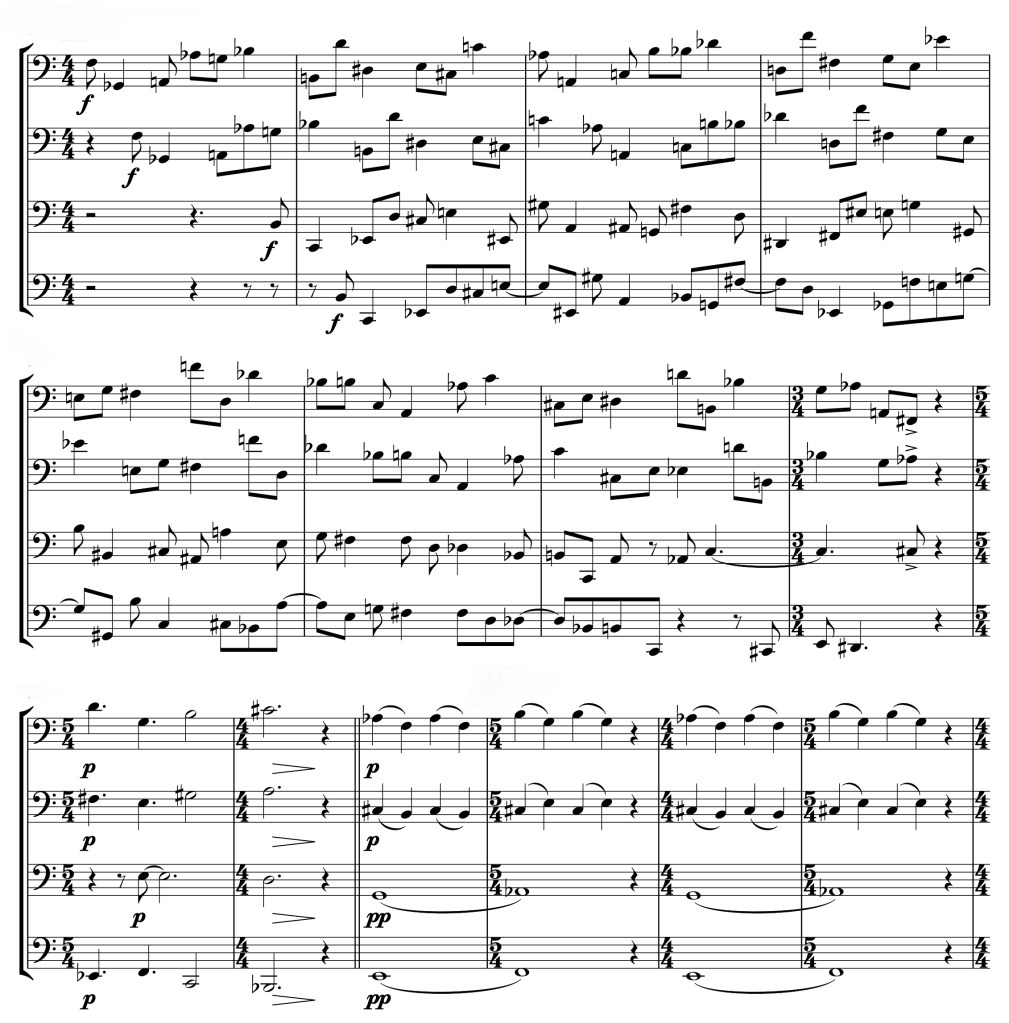
    Tuba / euphonium quartet            2019        duration: 8 minutes

    Dating back to the 13th century, Špilberk Castle has a dark history. Standing on a hilltop in the Moravian city of Brno, surrounded by chestnut trees in a beautiful park, its dungeons served for six centuries as a prison, holding war prisoners, Polish political prisoners, persecuted religious groups, and Czech patriots resisting the Nazis. Eventually it was a military barracks, and finally in 1959 became a municipal building and park and home to the Brno City Museum.

    During several visits to Brno in the 1990s, Clark spent much time walking in the surrounding park, as well as participating in rehearsals inside the castle with the municipal dance company for which he composed his ballet, PTACI. Two memories remain vivid:

    “Dark Rain”  – leaving the castle on a pitch-black night in a cold, late-October rain.

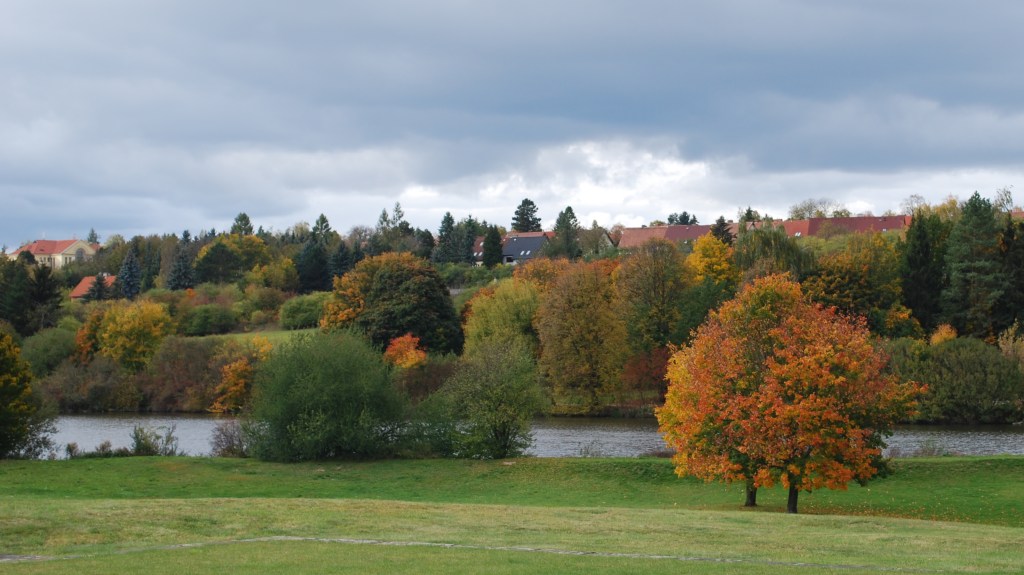
    “Moravian Autumn” – one of many sunny autumn afternoons walking through golden chestnut leaves in a timeless euphoria.

    MIDI synthesis rendering:


    To request performance materials and permission, email the composer, tc24@txstate.edu.

  • Sur la Neige

    Sur la Neige

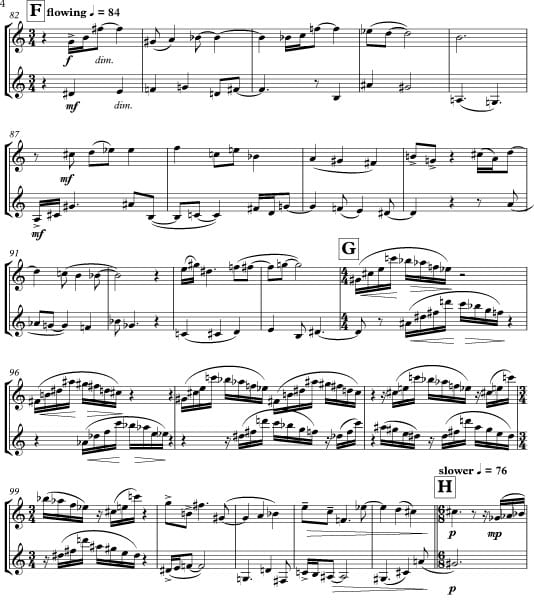
    2019            oboe, clarinet            duration: 8 minutes

    Written for Pleasant Street Players Ian Davidson and Vanguel Tangarov, colleagues at the Texas State School of Music, Sur la Neige is a snow fantasy on three quoted musical ideas. The work begins with an obscure quote from Stravinsky’s L’Histoire du Soldat, elaborated and then transitioning into a quote from Debussy’s Prelude No. 6 in his Préludes, Book I, subtitled “de pas sur la neige.” “Eventually, a small decorative figure from Janácek’s Sinfonietta appears and quickly disappears like a scurrying bystroušky (fox).

    Two memories of walking in the snow stand out in long-term memory. In about 1965, one recreation of a restless Michigan teenager on winter nights was to put on boots and parka and hike through snow-covered fields and forest in the moonlight. In 1992, my composer friend Arnošt Parsch led me on a walk into the logging forest above his Moravian village, Bílovice nad Svitavou. Through late-fall snowflakes, we retraced the steps of Janácek, passed the natural-spring well and the Sokol tavern up to a beautiful promontory view of the snow-covered village below.

    MIDI preview:

    To request performance materials and permission, email the composer, tc24@txstate.edu.

  • Kladno Sketches

    2019      duration: 10 minutes

    1. Zámek – peaceful gardens      2. Poldi – ironworks      3. Svobody – Freedom plaza

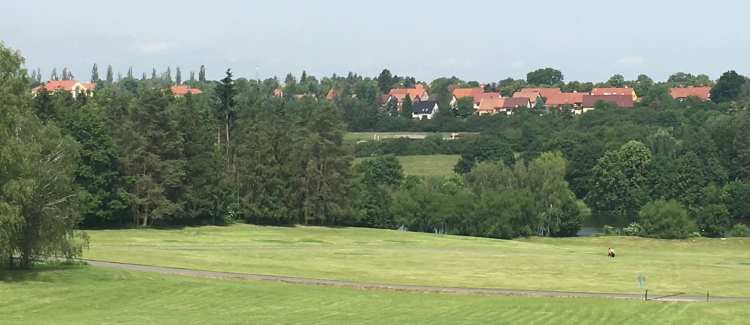
    Kladno is a Czech city in the Central Bohemian Region 25 kilometers northwest of Prague. In the middle of the 19th century, the discovery of coal there led to the establishment of one of the great ironworks and then steel mills in all of Europe.

    Kladno is near Lidice, the village destroyed by the Gestapo in 1942. Of the Lidice men who were all shot in the atrocity, many had walked to Kladno each day to work in the coal mine or the Poldi steel works.

    Poldi has thrived and survived for more than 100 years, through two world wars and occupations of the country, but the factory finally closed and most of the buildings are now abandoned.

    The city remains a thriving place with a population of 70,000, a large church, municipal building, state library and archives, monuments, theaters, museums, and beautiful parks. The Czech people have always been hard working, they love gardens, especially roses, and they love beer in the fine pilsner style they created.

    Suffering under so much occupation and oppression throughout their history in the center of Europe, Czechs especially value “svobody” – freedom.

    To request performance materials and permission, email the composer, tc24@txstate.edu.

  • A Peaceful Place

    Digital sound sculpture      2019       duration: 5:16

    The title, from the poem “The Murder of Lidice” by Edna St. Vincent Millay, is an expression of the feeling evoked by the verdant valley below the Lidice Memorial. Though horrible tragedy struck this place on 10 June 1942, now the sloping lawn and babbling creek are a safe haven to peaceful spirits.

  • SUSPIRA

    Canonic meditation on the Salve Regina chant      2017       computer music     duration  5:30

  • Carte du Ciel

    sky map

    2019      digitally synthesized sound sculpture      duration: 8 minutes

    Carte du Ciel was an ambitious second phase of an international star-mapping project initiated in 1887 by Paris Observatory director Amédée Mouchez.  A new photographic process revolutionizing the gathering of telescope images inspired the first phase, the Astrographic Catalogue of a dense, whole-sky array of star positions. Carte du Ciel, never completed after 70 years, used the Catalogue as a reference system for a complex survey of the vast field of even fainter images.

    In the music, ghostly wisps of sound are punctuated by brighter bursts, clustered in a natural, not-quite randomly dispersed texture.

  • A New Lidice

    2019      SSAA choir, string trio       duration: 7 minutes

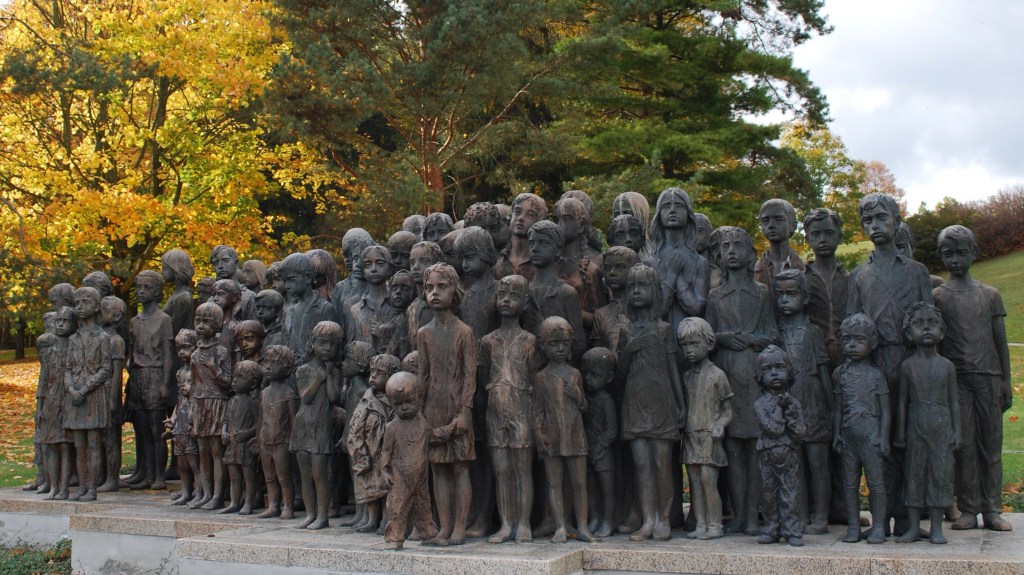
    A New Lidice is the third piece composed commemorating the story of Lidice near Prague, a charming Czech village that was brutally destroyed by the Gestapo in 1942. LIDICE REMEMBERED expressed the dark brutality of the atrocity, while RAINBOW RISING celebrated the power of hope symbolized by the beautiful memorial rose garden there.

    On June 10, 1942, all the village men were shot, the children taken away to orphanages or gas chambers, the women sent to concentration camps, and the entire village was razed. After the war, concerned British citizens led by Sir Barnett Stross convinced the world that the village should be rebuilt. The women of Lidice were able to return and were given beautiful new Czech-style homes in a planned village next to the Memorial Gardens.

    Lyrics are taken in part from a stirring Stross speech, but the voices are those of the women who bravely rebuilt their community:

    “We build a new village, while a just world watches.
    Stavíme novou vesnici. Spravedlivý svêt bude sledovat.
    Lidice belongs to the world of all who suffered.
    Mankind has one common enemy – War.
    Only a realization of our common humanity can save mankind.
    The just world will watch.”

    Premiere performance:

    April 23, 2022, Texas State University Performing Arts Center
    Student ensemble Aurora Voce conducted by Lynn Brinckmeyer
    with string students Kailey Johnson, Kelsey Sexton, Tina Moritz