Written for my colleague Ian Davidson of the Texas State music faculty and Pleasant Street Players. Autumn Rain is inspired by Robert Frost’s poem “My November Guest,” an exquisite expression of loss and sadness.
In four movements:
I. “these dark days of autumn rain”
II. “my sorrow” (remembering Lidice)
III. “the bare, the withered tree”
IV. “the sodden pasture lane”
The second movement’s memorial to the atrocity of Lidice quotes the Czech national anthem Kde domov můj (“Where My Home Is”).
To request performance materials and permission, email BMI-affiliated composer Thomas Clark, tc24@txstate.edu
The Czech mountain village of Hukvaldy was the summer home of the great 20th-century Moravian composer Leoš Janáček. I visited there many years ago when studying Janáček’s music and composing a ballet, PTACI, which was premiered in Brno in 1993. Janáček loved nature walks and studied bird songs. HUKVALDY SKETCHES is a set of modern musical impressions of old Moravia, in the ancient heart of Eastern Europe.
Premiere performance February 6, 2018, at Texas State University Performing Arts Center:
I. Hrad – morning climb to the castle ruins
II. Ptáci – watching Leoš’s birds
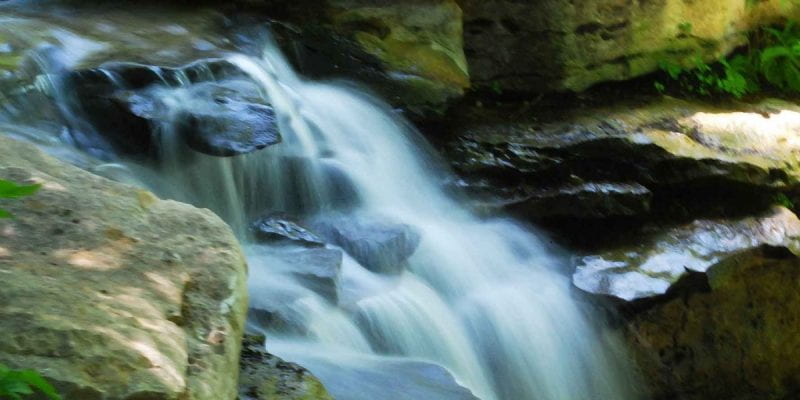
III. Vody – forest streams and shadows
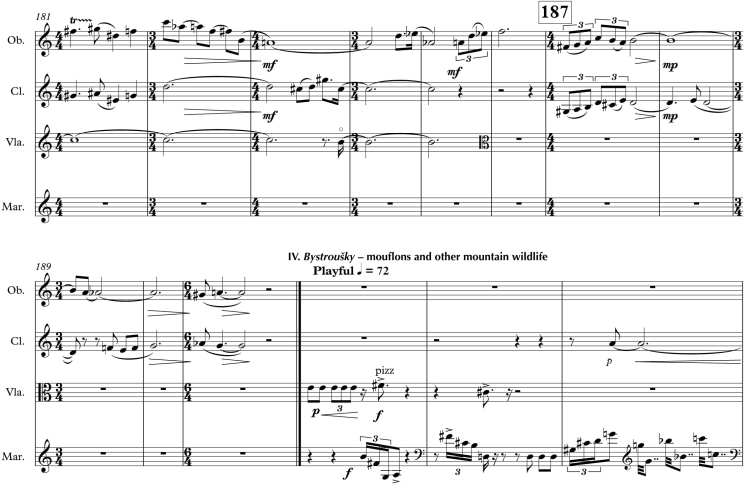
IV. Bystroušky – mouflons and other mountain wildlife
V. Podzim – autumn sunset
Ian Davidson (oboe), Vanguel Tangarov (clarinet), Ames Asbell (viola), Kari Klier (marimba)
To request performance materials and permission, email BMI-affiliated composer Thomas Clark, tc24@txstate.edu
This set of 12 etudes for two contrapuntal voices was first composed as modern 20th-century style studies for the aural skills workbook ARRAYS. They echo the musical characters of early 20th-century composers Debussy, Bartók, Stravinsky, Hindemith, Varese, Webern, and others of mid-century such as Dallapiccola. Though the “invention” designation recalls Bach’s great Two-Part Inventions, a more direct inspiration was Bartók’s Mikrokosmos, six books of piano etudes.
Though originally scored in limited treble and bass ranges suitable for singing, the intervallic and rhythmic complexities are more suitable for instrumental studies. Versions of the twelve are available for string orchestra, or for pairs of instruments:
viola & cello
clarinet & bass clarinet
trombone & bass trombone
The 12 Contrapuncti are graduated in challenge for study, but can also be performed, as one short suite of four, or two or three suites altogether in any order.
Suite I
1. Strolling – tempo = 48
2. Boldly – tempo = 72
3. Celestial – tempo = 54
4. Proudly – tempo = 78
Suite II
5. Dancing – tempo = 54
6. Skating – tempo = 126
7. Exploring – tempo = 132
8. Contemplative – tempo = 128
Suite III
9. Emphatically – tempo = 84
10. Precise – tempo = 66
11. Mysterious – tempo = 72
12. Aggressive – tempo = 84
Here are all 12 played by strings:
[order – Suite II, Suite III, Suite I]
To request study/performance materials, email composer





 Thomas Clark - composer / digital artist