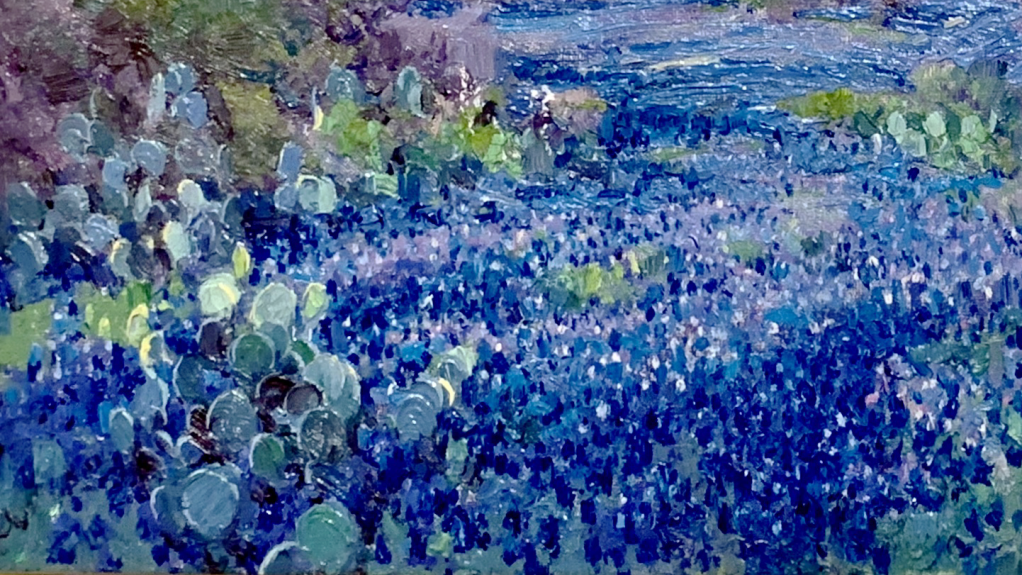
Revisiting my 1988 improvisation sketch for the New Music Performance Lab at University of North Texas became a prequel to a recent composition. FARBEN (2025), variations on the first movement of Webern’s Symphony, isolates instrumental colors as “prickly-pear” points of sound separated in time-and-pitch space.
Julian Onderdonk, Blue Bonnets and Cactus in the Rain (1914)
The recomposed 1988 music beginning SPECTRAL LIGHT takes another approach to sound color, layering canonic textures of thicker sonority in a gentle Impressionistic blur, like the brush-blended blur of a Monet painting.
Claude Monet,Waterloo Bridge, Sunlight Effect (1903)
Timbres emerge, echo, and fade in a floating, slow-moving distant landscape of color.
There are so many beloved serenades. There is Dvořák’s Serenáda pro dechové nástroje d moll (Op. 44, 1978) for winds. For strings, Smyčcová serenáda E dur(Op.22, 1875) by Dvořák and Serenade for Strings in C Major (Op.48, 1880) by Tchaikovsky stand out as masterful evocations of the genre’s elegance and vibrant color potential. And then there are Mozart’s many wonderful serenades, some for winds and the most popular, Eine Kleine Nachtmusik, for strings. (Our daughter played it as a violist in her high-school string quartet, and everyone in the family sang it around the house.)
The language of my new serenade’s title honors that beloved string piece. It also fits my ongoing obsession with nocturnal and astronomical images. (See Mapping the Music Universe.)
The introductory first part quietly morphs darkly complex sonorities. In contrast, I recently became interested in studying the lovely middle movement of Mozart’s Piano Concerto No. 18 (K.456, 1784). Its simple half-note secondary theme launched a study that led to composing variations on it, becoming the brightening latter two parts of this new serenade.
Three pieces of the early 20th century, which I studied deeply in the 1970s and later used extensively in my teaching of modern music, were each masterful explorations of musical sound color:
Claude Debussy’s La Mer (1905), an iconic tone poem of Impressionistic musical painting with an orchestral palette
Arnold Schoenberg’s “Farben (Summer Morning by a Lake: Chord-Colors”, the third of his Five Pieces for Orchestra, Op. 16 (1909) — a gentle study of orchestral sound color
Anton Webern’s Symphony, Op. 21 (1928), whose first movement is a delicate gem of pointillistic color canon built on one enormous, static, symmetrical 13-pitch constellation
After fifty years, these works are embedded more deeply than ever in my musical consciousness. Farben pays special homage to Schoenberg’s masterpiece, layering kaleidoscopic wind-instrument colors to build massive, morphing constellations, echoing Webern’s hidden chord-color symmetry.
In the midst of my recent Impressionistic “Sketches” series, the 2024 piece Folio(TC143) was a throwback to the more abstract sound mass style of the 1960s and ’70s. Its percussive attacks and inert masses of sound were all synthesized, also throwbacks to my early days of electronic tape music. (One of the earliest electronic compositions, Stockhausen’s 1960 Nr. 12 Kontakte, was full of sounds like giant steel beams hitting a concrete floor!) The other retro feature of Folio is suggested in its title: homage to Earle Brown’s 1952 FOLIO, a collection of abstract art scores in stark, proportional graphic notation.
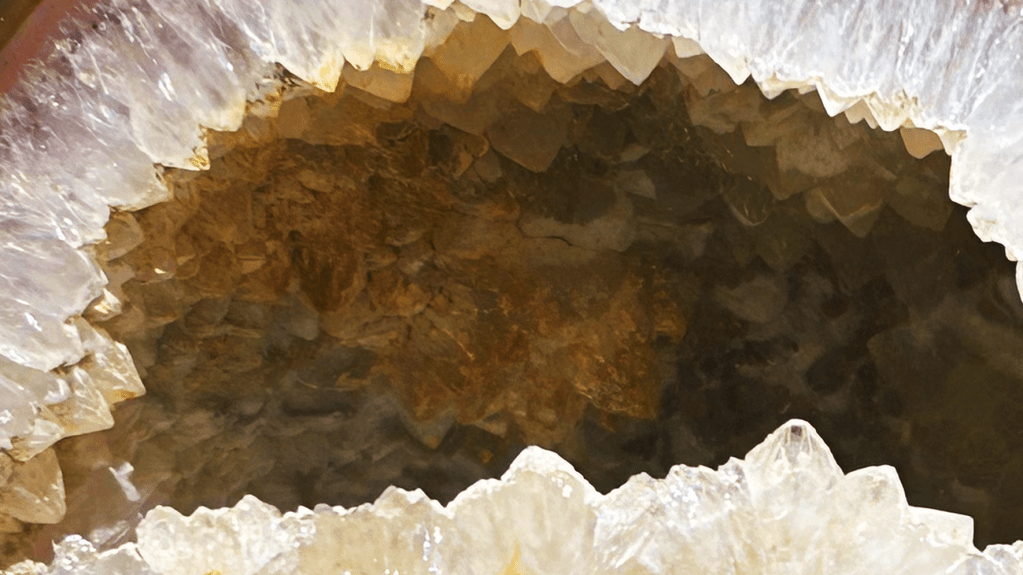
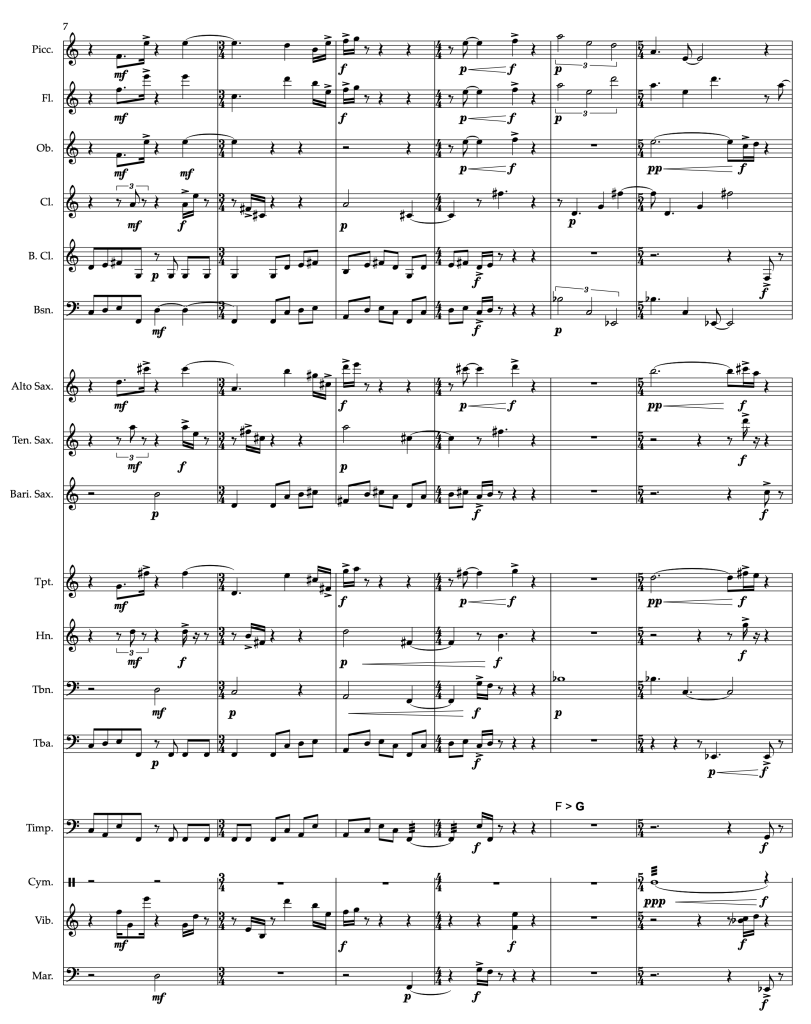
A wind and percussion transformation of Folio was challenging. Folio (TC143) was composed in the abstract avant-garde style of the ’60s. It carved sound sculptures of solid, hard-edged sonorities in expansive pitch/time space. Now colored with cool woodwind sounds, radiating brass, and sparkling percussion, GEODES animates Folio‘s solid sound masses in surging and fading rhythmic textures.
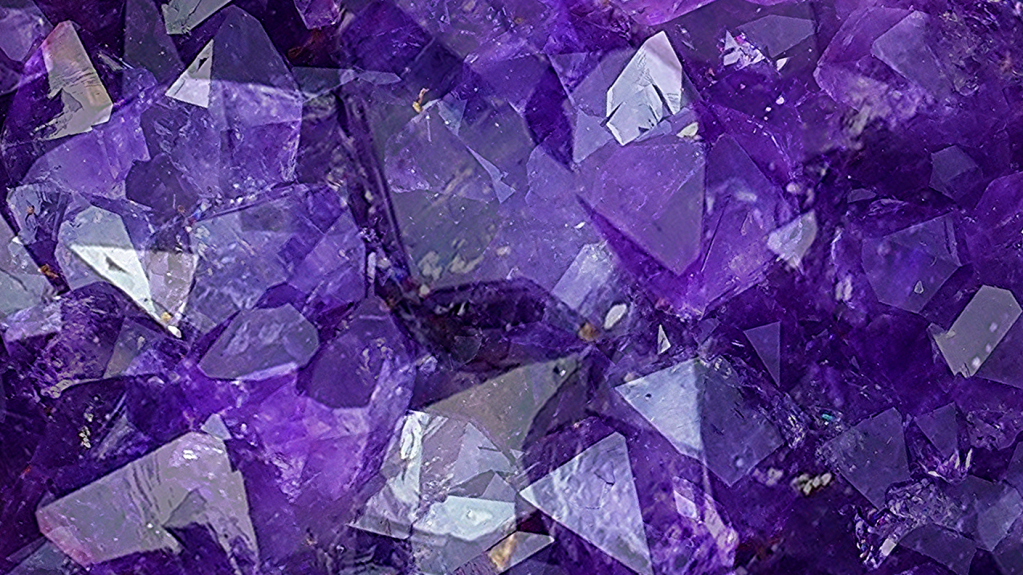
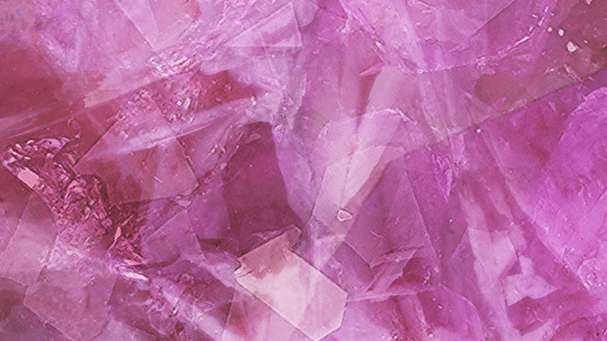
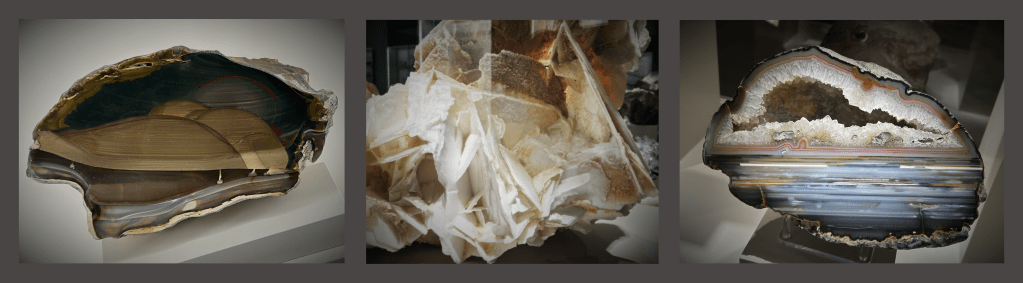
The chaotic boldness of rocks . . . my own collection of many found on beaches and hikes, but also splendid displays at three places: Dick’s Rock Shoppe in Estes Park, Colorado; Lizzadro Museum of Lapidary Art in Elmhurst (now in Oak Brook), Illinois; and a wonderful gallery of geodes at the Permian Basin Petroleum Museum in Midland, Texas. A geode is Nature’s sculpture, an inscrutable gray rock sphere that, when sawed open, reveals a magical world of dazzling-colored crystals. Different minerals make crystals of varied hues of pink, purple, umber, or cream, reflecting new light.
My mind is always silently playing music of some kind in my head. Constantly . . . including first thing every morning while I’m walking with the dog.
To focus this mental playback loop into something constructive, I’ve started humming tunes to myself on the walk. The dog seems to like it, thinks I’m singing for her.
Sometimes this new habit escalates from humming familiar jazz and Broadway classics to composing new tunes. A while ago I started composing in my head a Scott Joplin style rag. (I have always loved and admired Graceful GhostRag by Michigan prof Bill Bolcom.)
Back at the computer, here is what eventually came of this mind game:
In the midst of my recent Impressionistic “Sketches” series, the 2024 piece Folio was a throwback to the more abstract sound mass style of the 1960s and ’70s. Its percussive attacks and inert masses of sound were all synthesized, also throwbacks to my early days of electronic tape music. (One of the earliest electronic compositions, Stockhausen’s 1960 Nr. 12 Kontakte, was full of sounds like giant steel beams hitting a concrete floor!) The other retro feature of Folio is suggested in its title: homage to Earle Brown’s 1952 FOLIO, a collection of abstract art scores in stark, proportional graphic notation.
This wind and percussion transformation of Folio was challenging. But I thought about the chaotic boldness of rocks — my own collection of many found on beaches and hikes, but also splendid displays at three places: Dick’s Rock Shoppe in Estes Park, Colorado; Lizzadro Museum of Lapidary Art in Elmhurst (now in Oak Brook), Illinois; and a wonderful gallery of geodes at the Permian Basin Petroleum Museum in Midland, Texas. Geodes are Nature’s sculptures, inscrutable gray rocks that, when sawed open, reveal magical worlds of dazzling-colored crystal structure.
Homage to Debussy’s Impressionistic masterpieces, La Mer and Nocturnes
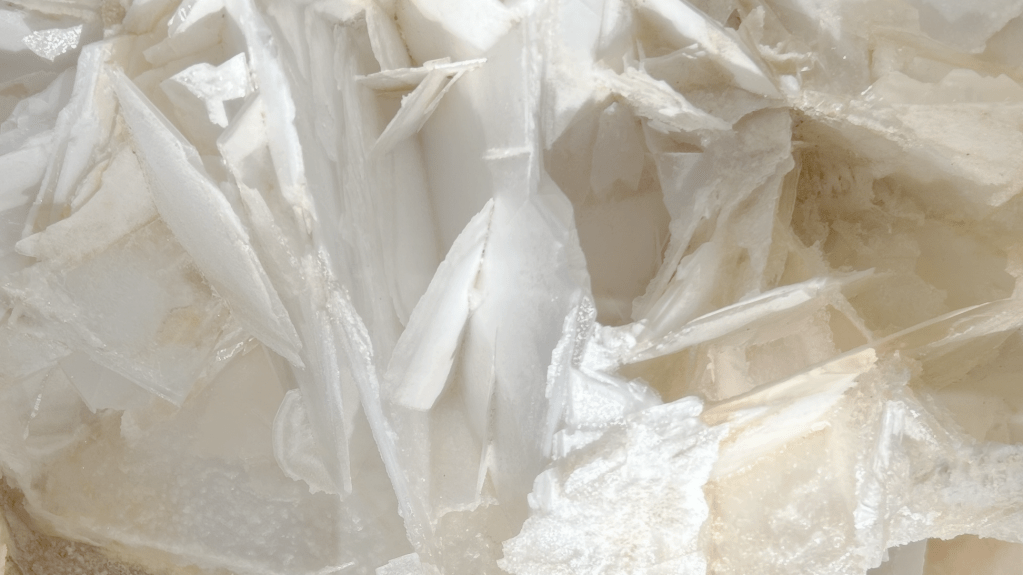
Debussy avoided the label “symphony” or “tone poem” by calling them each “three symphonic sketches”. The first sketch of Nocturnes, subtitled “Nuages,” is musically quoted in IV “Nuages blanc”.
Adopting his French language also recognizes the early explorers of the Great Lakes region of North America. The first decades of my life began there in Michigan’s Lower Peninsula (the “mitten”). It has its own smaller Leelanau Peninsula in the northwest corner (the mitten’s “little finger”) near Interlochen’s National Music Camp, where I spent many summers. Nearby Grand Traverse Bay has its own even smaller Old Mission peninsula, where I loved to visit its lighthouse. The Leelanau has a grand lighthouse at its northern tip and a scenic drive, state highway M21, winding for 64 miles all the way around the peninsula’s shoreline, through forests and past the Great Sleeping Bear Sand Dunes.
In 1984 my piece titled PENINSULA for piano and sound synthesis was a more experimental work that traced a map of the Leelanau and its landmarks to determine by their spatial coordinates the timing and pitches of sound constellations. Moving forward from that mapping phase of my compositions, my Impressionistic phase produced the sound sculpture Leelanau Sketches in 2022. Some of its musical material reappears now in these five symphonic sketches, Belle Péninsule.
In Robert Frost’s poem “My November Guest,” an exquisite expression of loss and sadness, four phrases stood out expressing the gray beauty of November:
“these dark days of autumn rain” . . . “my sorrow when it’s here with me”
“the bare, the withered tree” . . . “the sodden pasture lane”
Autumn RainMusic was originally composed in Ann Arbor for oboe and piano in 1971. Decades later in San Marcos, in 2017 the music evolved into an elegy for unaccompanied English horn, and now to this duo arrangement, heard here with sound-synthesis enhanced background.
This is the first time I began a multimedia piece with the visual element as primary design concept rather than the music, with visuals joining after. The visual concept, as suggested by the title, is an exploration of patterns in nature featuring complex masses and threads of color. They resemble busy Jackson Pollack action paintings revealing isomorphic patterns. The title evokes the abstract patterning of molecular crystal growth.
The synthesized “soundtrack” is music adapted from my 2022 work, STONEHENGE for solo classical guitar: