Merging two fascinations, musical canons and the contrapuntal style of 15th-Century Flemish composers, this work sets in modern style a wonderful quadruple canon of the period (composer uncertain). The style difference, though, is subtle: the 2oth-Century explorations of some American composers (Riley, Reich, Adams) involved hypnotic overlapping ostinato repetition of diatonic patterns much like this magical Medieval canon.
To request performance materials and permission, email the composer, tc24@txstate.edu.
The death of the great Flemish composer Jan Ockeghem in 1497 marked the end of Western Music’s Medieval style period. The most famous composer of the late 15th century, Ockeghem’s style of choral music was intensely contrapuntal, filled with canons, and freely exploratory in harmony and form. Josquin, already emerging as the great pioneering composer of the early Renaissance, revered Ockeghem, as do I. The first part of Canzona 1497 explores such canonic contrapuntal structures in a modern harmonic setting. While the second part settles into a more Medieval harmony of simple diatonic lines, both parts of the piece indulge in a striking Ockeghem idea: spinning repetitive contrapuntal material in a texture that is paradoxically animated in surface but stationary in prolonging one sustained harmony. I hear this feature of Ockeghem’s music as an ancestor to the mid-20th-century ostinato music of American composers Terry Riley, Steve Reich, John Coolidge Adams . . . and me.
To request performance materials and permission, email the composer, tc24@txstate.edu.
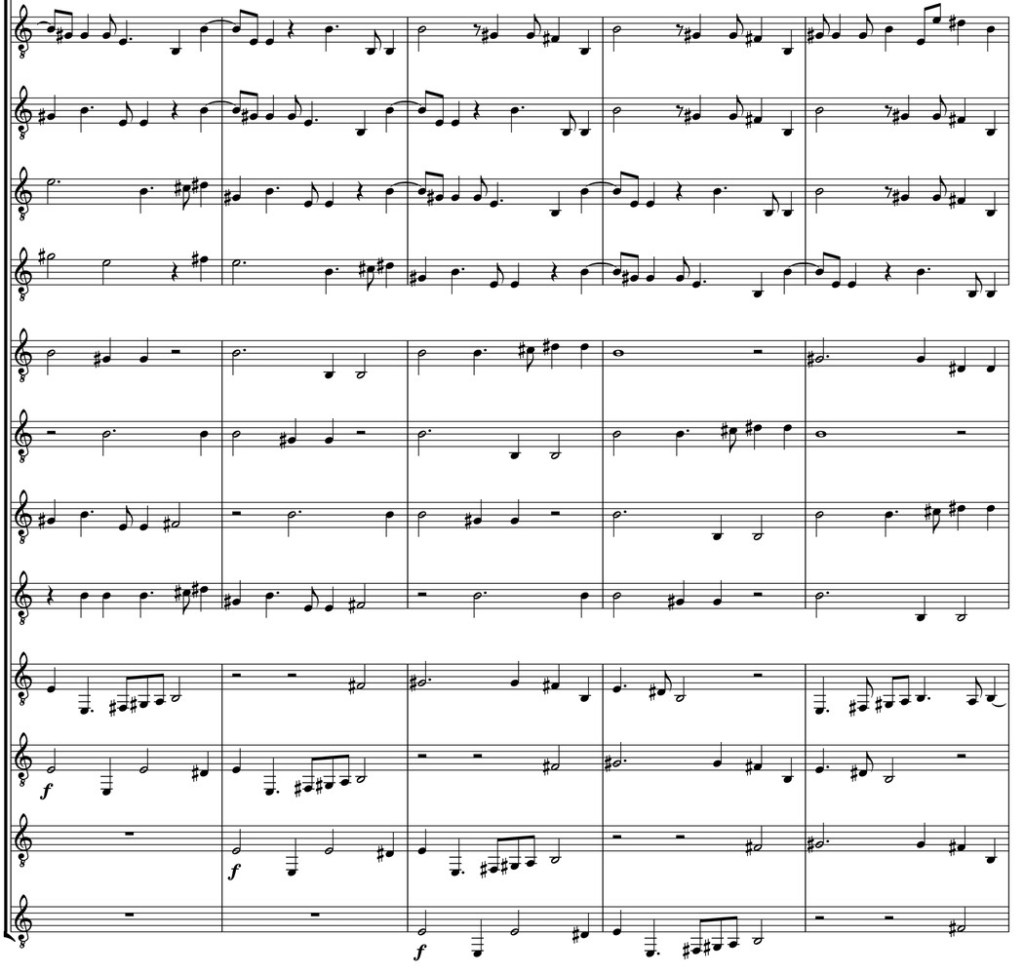
We all enjoy the mysterious splendor of moonrise, large and deeply-hued in the eastern evening sky. This sound sculpture creates a sonic metaphor for that visual phenomenon, but portraying instead the rising of Jupiter, the largest object in the solar system other than the sun itself. It only looks much, much smaller to us than the moon because it is so much farther away.
One of my favorite Mozart symphonies is Symphony No. 41 in C Major, K.551. His longest and last symphony, it is nicknamed “Jupiter” — fitting that his lengthiest and greatest symphony is named for the largest planet, a great gas giant. A vivid musical motive begins and generates the majestic final movement. I use it as the musical subject of this sound sculpture, relentlessly canonic in deployment. At some moments, as many as 8 contrapuntal soundings overlap each other in a cloud-like texture.
Notice that my rhythmic setting of the motive is designed irregularly, so that the two lines seldom move at the same time in what I would call a contrapuntal accent. This creates the overall floating quality of the contrapuntal rhythmic texture. One refreshing feature of a sound sculpture is this freedom from the metric march of time. The music does not progress, but instead creates a sonic cloud to be experienced by relaxed absorption and contemplation.
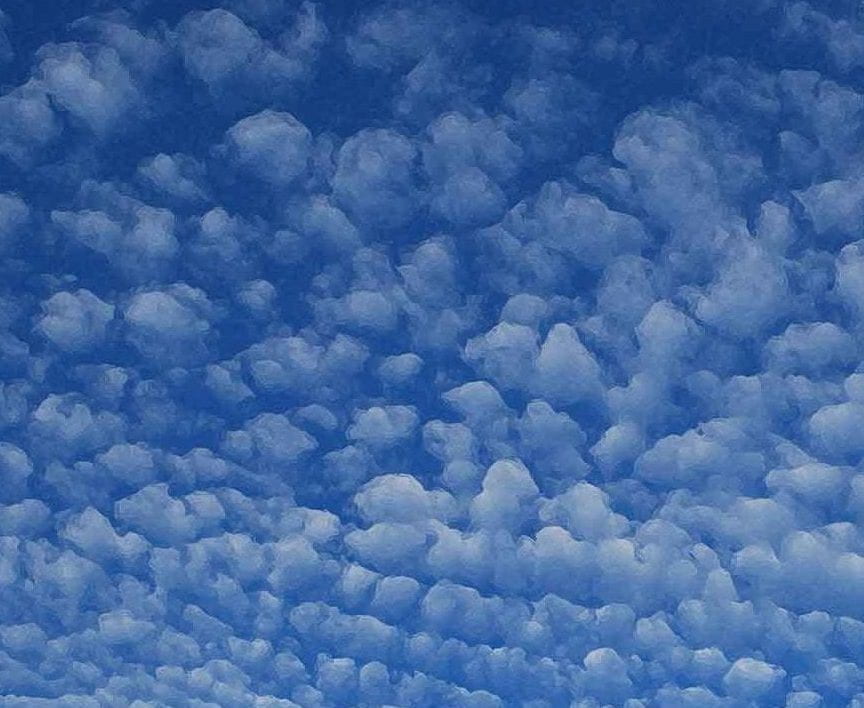
Inspired by the great serenades for strings of Dvořák and Tchaikovsky, this suite explores musical metaphors for the physics of H2O in interesting atmospheric and geographic settings.
I. Cold front (VAPOR becomes SOLID): In low clouds on mountain tops, water vapor can become super-cooled and become freezing fog, filling the air with small ice crystals and freezing to surfaces, similar to very light snow. In the western United States, the common name for freezing fog is “pogonip.”
II. Ice Dunes (SOLID): In the Leelanau Peninsula of Michigan, the Lake Michigan surf sometimes whips up and freezes in mid-air, forming weird ice caverns and ice dunes.
III. Nuages (VAPOR), French for clouds, is one of Debussy’s three beautiful Nocturnes for orchestra, quoted here as a theme for variations. Water vapor is technically invisible. The clouds we see are actually masses of minute liquid droplets and frozen crystals. Thus this movement embodies all three states of water.
IV. Vltava (LIQUID): The great river Vltava flows majestically through Prague. Smetana’s depiction of it in his monumental Ma Vlast is usually translated as The Moldau.
To request performance materials and permission, email the composer, tc24@txstate.edu.