Category: chamber music

  • Landscapes in Motion

    2016 . . . . mezzo-soprano, viola, piano . . . . duration: 8 minutes

    Premiered 6 February 2018 by Youna Hartgraves (voice), Ames Asbell (viola), Joey Martin (piano)

    Riding Backwards on a Train

    “The cider mill beside the river, cows grazing by a dead tree,
    a red barn stuffed with hay. An old square house alone on a hilltop,
    a church’s silent steeple above the trees, a country cemetery,
    old stone crosses guarding against oblivion. Then the sun is gone,
    storm clouds ripple across meadow skies, the river turns away.
    Riding backwards on a train, frozen fields float by. Glossy sheets of white ice glow with winter sun. Dead brown stubble breaks the mirror, patchy footprints of autumn’s retreat. Pale late light of afternoon flickering through leafless trees that line the lifeless fields in rows, through fields of withered cornstalks.
    Leap into brown dry woods, plunge past barren trees,
    spray a wake of fallen leaves, lunge into holy autumn stillness,
    riding backwards on a train, headed east into a frozen future.”

    Sailing at Sunset

    “Dusty dusk settling silk on dying silver of wave-modulated water,
    the sail still silently searching for a departing breeze, swinging gently its boom and softly rattling its blocks in confounded cross-rhythms to the lapping shore.
    Streams of crimson flowing dust streak the sky above looming shadowed firs.
    Deepening shadows settle dark dust on the deck while still the mast peak
    rages red and soars into a deepening sky.
    Scorched face soothed by the oncoming night breeze,
    eyes searching the sunset sky for sign of tomorrow’s wind.
    Where will we sail then? Wherever wind wills . . .
    and a new dusk consume our shadows.”

    To request performance materials and permission, email BMI-affiliated composer Thomas Clark, tc24@txstate.edu

  • Sacred Springs

    2020 . . . . trombone or euphonium and piano . . . . duration: 7:50

    Peaceful Spring Lake and the San Marcos River flow from ancient springs emanating up from the Edwards Aquifer in the Texas Hill Country. For centuries, Native American tribes considered these powerful springs a sacred place where they worshiped eternal spirits. In the 20th century, the springs became the centerpiece of a famous recreation resort, Aquarena Springs. Now that the park has been restored to its original natural habitat, it remains a place of beauty and spiritual contemplation.

    The main tune of Sacred Springs is based on a 15th-century English carol, a graceful tune that became the melody for the lyrical modern hymn, “O Love, How Deep.” The melody’s canonic treatment, both in somber chant and spinning ostinato, continues my modern obsession with that ancient musical technique.

    To request performance materials, email the composer, tc24@txstate.edu.

    COMPLETE SCORE

  • Flanders Canon

    2020 . . . . . . . for 8, 12, or 16 guitars. . . . . . . duration: 6:40

    Merging two fascinations, musical canons and the contrapuntal style of 15th-Century Flemish composers, this work sets in modern style a wonderful quadruple canon of the period (composer uncertain). The style difference, though, is subtle: the 2oth-Century explorations of some American composers (Riley, Reich, Adams) involved hypnotic overlapping ostinato repetition of diatonic patterns much like this magical Medieval canon.

    To request performance materials and permission, email the composer, tc24@txstate.edu.

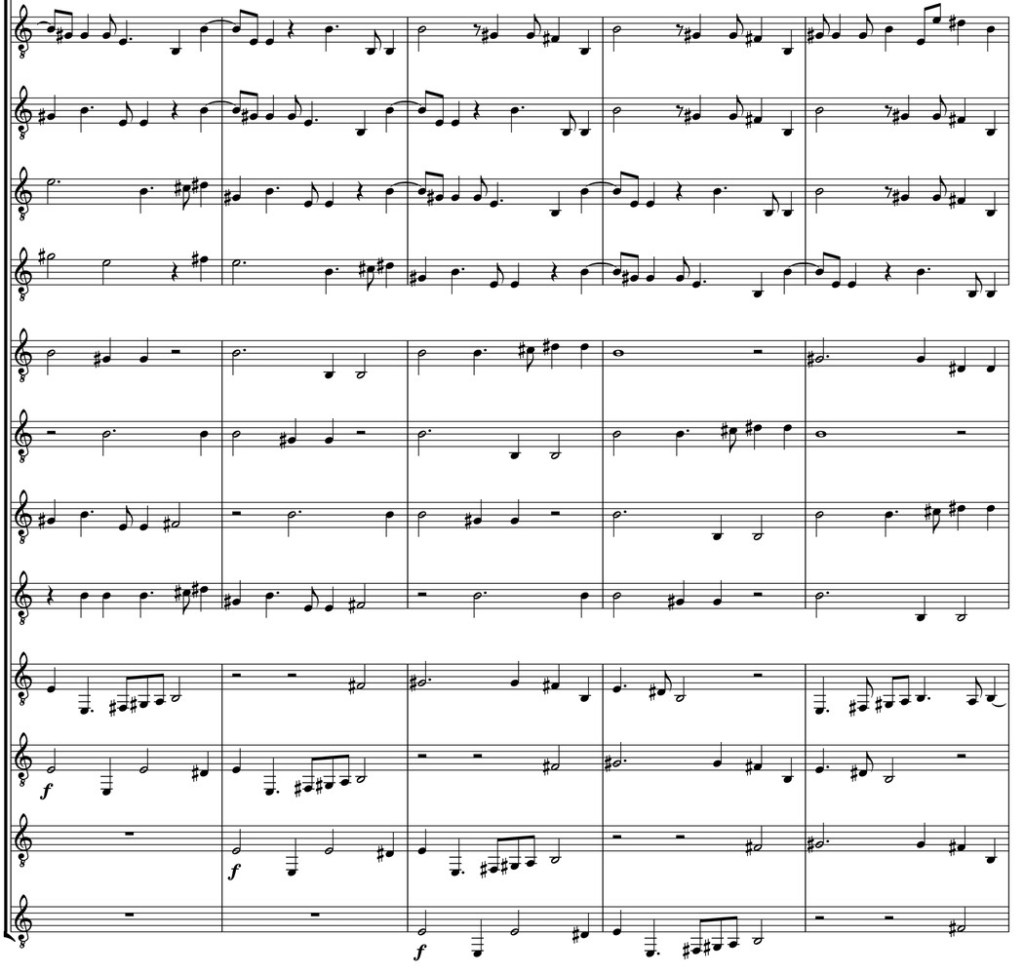
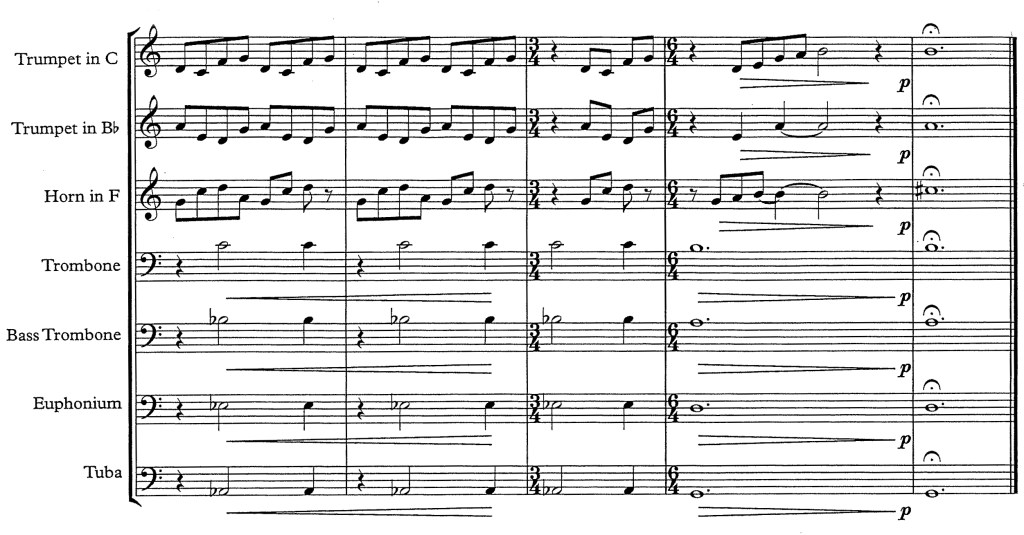
  • Canzona 1497

    Canzona 1497

    Canons for antiphonal brass . . . 2020 . . . duration: 7 minutes

    The death of the great Flemish composer Jan Ockeghem in 1497 marked the end of Western Music’s Medieval style period. The most famous composer of the late 15th century, Ockeghem’s style of choral music was intensely contrapuntal, filled with canons, and freely exploratory in harmony and form. Josquin, already emerging as the great pioneering composer of the early Renaissance, revered Ockeghem, as do I. The first part of Canzona 1497 explores such canonic contrapuntal structures in a modern harmonic setting. While the second part settles into a more Medieval harmony of simple diatonic lines, both parts of the piece indulge in a striking Ockeghem idea: spinning repetitive contrapuntal material in a texture that is paradoxically animated in surface but stationary in prolonging one sustained harmony. I hear this feature of Ockeghem’s music as an ancestor to the mid-20th-century ostinato music of American composers Terry Riley, Steve Reich, John Coolidge Adams . . . and me.

    To request performance materials and permission, email the composer, tc24@txstate.edu.

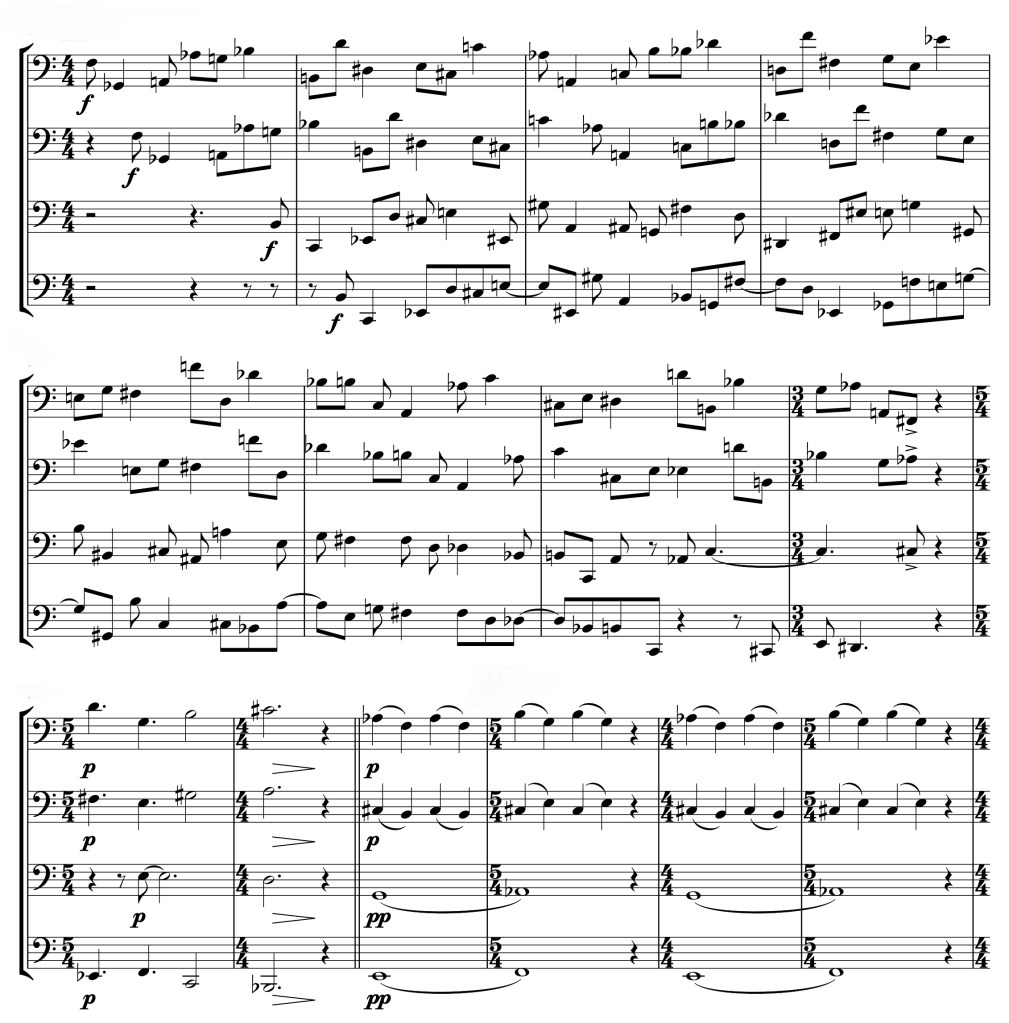
  • Špilberk Castle

    Tuba / euphonium quartet            2019        duration: 8 minutes

    Dating back to the 13th century, Špilberk Castle has a dark history. Standing on a hilltop in the Moravian city of Brno, surrounded by chestnut trees in a beautiful park, its dungeons served for six centuries as a prison, holding war prisoners, Polish political prisoners, persecuted religious groups, and Czech patriots resisting the Nazis. Eventually it was a military barracks, and finally in 1959 became a municipal building and park and home to the Brno City Museum.

    During several visits to Brno in the 1990s, Clark spent much time walking in the surrounding park, as well as participating in rehearsals inside the castle with the municipal dance company for which he composed his ballet, PTACI. Two memories remain vivid:

    “Dark Rain”  – leaving the castle on a pitch-black night in a cold, late-October rain.

    “Moravian Autumn” – one of many sunny autumn afternoons walking through golden chestnut leaves in a timeless euphoria.

    MIDI synthesis rendering:


    To request performance materials and permission, email the composer, tc24@txstate.edu.

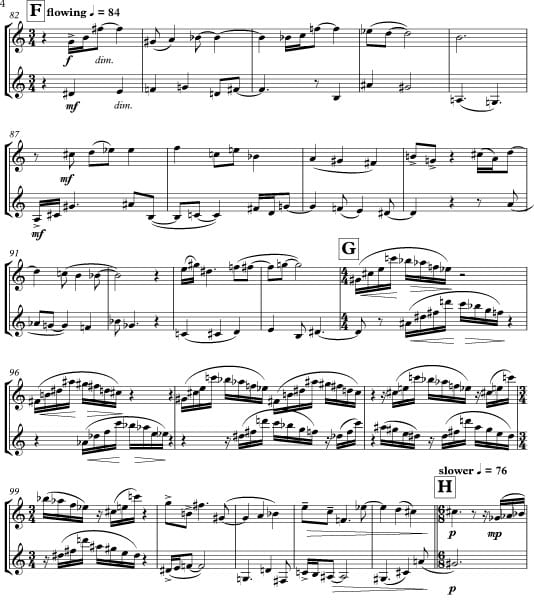
  • Sur la Neige

    Sur la Neige

    2019            oboe, clarinet            duration: 8 minutes

    Written for Pleasant Street Players Ian Davidson and Vanguel Tangarov, colleagues at the Texas State School of Music, Sur la Neige is a snow fantasy on three quoted musical ideas. The work begins with an obscure quote from Stravinsky’s L’Histoire du Soldat, elaborated and then transitioning into a quote from Debussy’s Prelude No. 6 in his Préludes, Book I, subtitled “de pas sur la neige.” “Eventually, a small decorative figure from Janácek’s Sinfonietta appears and quickly disappears like a scurrying bystroušky (fox).

    Two memories of walking in the snow stand out in long-term memory. In about 1965, one recreation of a restless Michigan teenager on winter nights was to put on boots and parka and hike through snow-covered fields and forest in the moonlight. In 1992, my composer friend Arnošt Parsch led me on a walk into the logging forest above his Moravian village, Bílovice nad Svitavou. Through late-fall snowflakes, we retraced the steps of Janácek, passed the natural-spring well and the Sokol tavern up to a beautiful promontory view of the snow-covered village below.

    MIDI preview:

    To request performance materials and permission, email the composer, tc24@txstate.edu.

  • Kladno Sketches

    2019      duration: 10 minutes

    1. Zámek – peaceful gardens      2. Poldi – ironworks      3. Svobody – Freedom plaza

    Kladno is a Czech city in the Central Bohemian Region 25 kilometers northwest of Prague. In the middle of the 19th century, the discovery of coal there led to the establishment of one of the great ironworks and then steel mills in all of Europe.

    Kladno is near Lidice, the village destroyed by the Gestapo in 1942. Of the Lidice men who were all shot in the atrocity, many had walked to Kladno each day to work in the coal mine or the Poldi steel works.

    Poldi has thrived and survived for more than 100 years, through two world wars and occupations of the country, but the factory finally closed and most of the buildings are now abandoned.

    The city remains a thriving place with a population of 70,000, a large church, municipal building, state library and archives, monuments, theaters, museums, and beautiful parks. The Czech people have always been hard working, they love gardens, especially roses, and they love beer in the fine pilsner style they created.

    Suffering under so much occupation and oppression throughout their history in the center of Europe, Czechs especially value “svobody” – freedom.

    To request performance materials and permission, email the composer, tc24@txstate.edu.

  • Dark Matter

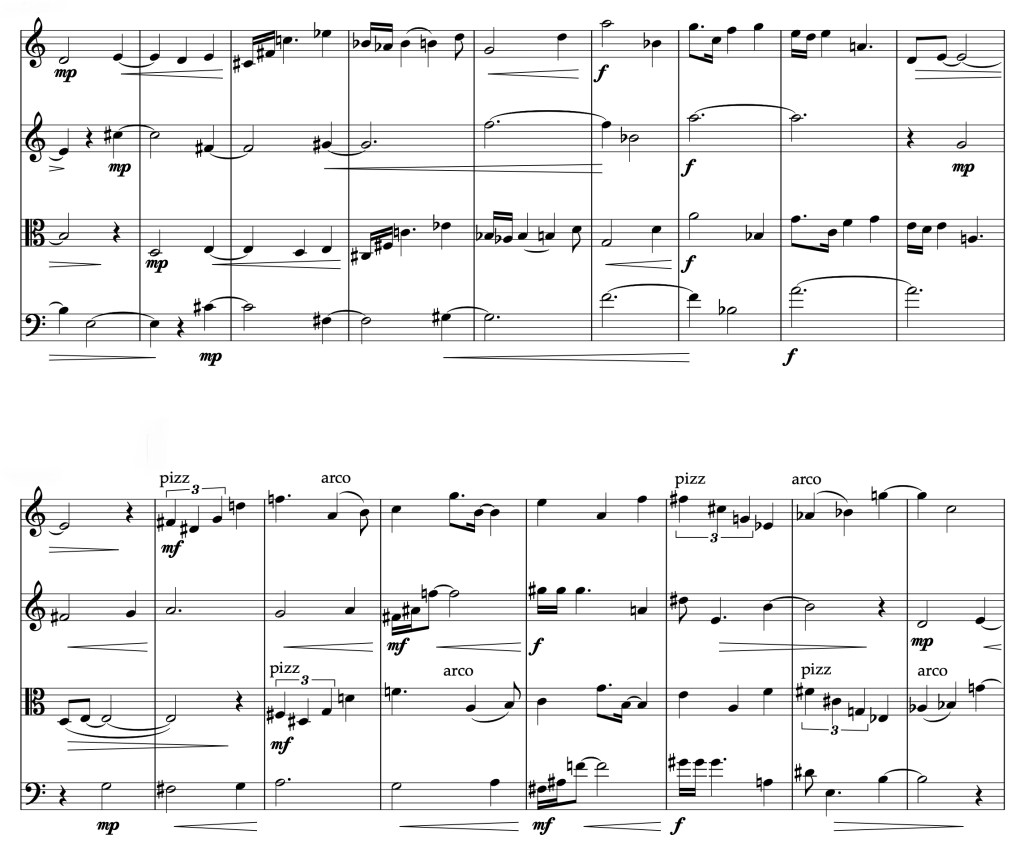
    2019      string quartet     duration: 7 minutes

    Excerpt:

    My compositional fascination with musical canons began in the early 1970s with study (at the University of Michigan) of Ockeghem’s 15th-century polyphony, the 10 canons in Bach’s 18th-century The Musical Offering, and Webern’s 20th-century Symphonie Op.21. As a young professor in the 1980s teaching 16th-century counterpoint at what was then North Texas State University (now UNT), I used canon as a challenging contrapuntal writing assignment. In 1985, a wind ensemble piece, Parallel Horizons (Homage to Schoenberg), was my first formal composition constructed by canon. In Dark Matter, other contrapuntal writing surrounds an extended canon.

    According to Wikipedia: “Dark matter is believed to be a form of matter thought to account for approximately 85% of the matter in the universe and about 27% of its total mass–energy density. Its presence is implied in a variety of astrophysical observations, including gravitational effects that cannot be explained by accepted theories of gravity unless more matter is present than can be seen. For this reason, most experts think that dark matter is abundant in the universe and that it has had a strong influence on its structure and evolution. Dark matter is called dark because it does not appear to interact with the electromagnetic field, which means it does not absorb, reflect or emit electromagnetic radiation, and is therefore difficult to detect.”

    To request performance materials and permission, email the composer, tc24@txstate.edu.

  • Bending Birches

    Bb clarinet.     2018.     Duration 5 minutes.

    Inspired by Robert Frost’s “Birches”

  • Before I Sleep

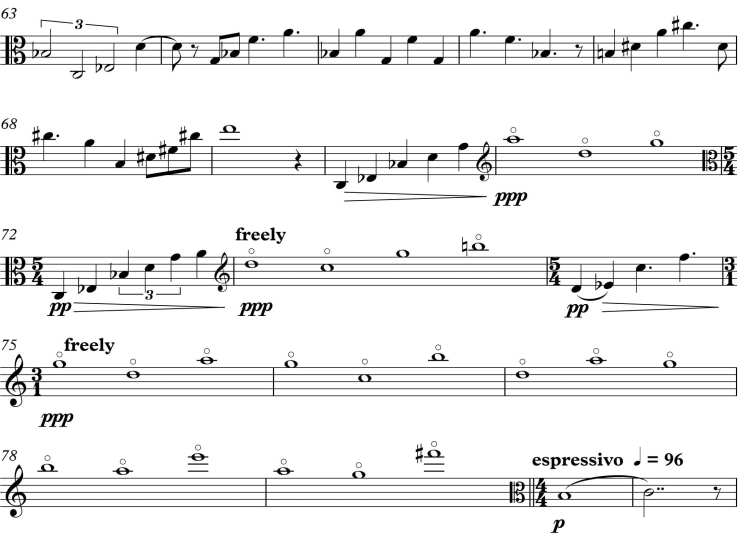
    Viola.   2018.  Duration 6:20.  

    Written for my colleague Ames Asbell of the Texas State music faculty and Pleasant Street Players, an outstanding artist and player of one of my favorite instruments.

    The title, Before I Sleep, is a quote from the last lines of Robert Frost’s famous poem “Stopping by Woods,” a contemplation of death on a nocturnal sleigh ride in the snow. The lead motive is a quote from Mahler’s Symphony No. 4, which open with flutes and sleigh bells jingling what is called the “bell theme.”