Category: ensemble

  • Animated Landscapes 2

    Olympic Shores

    1975 . . . wind ensemble . . . 9 minutes

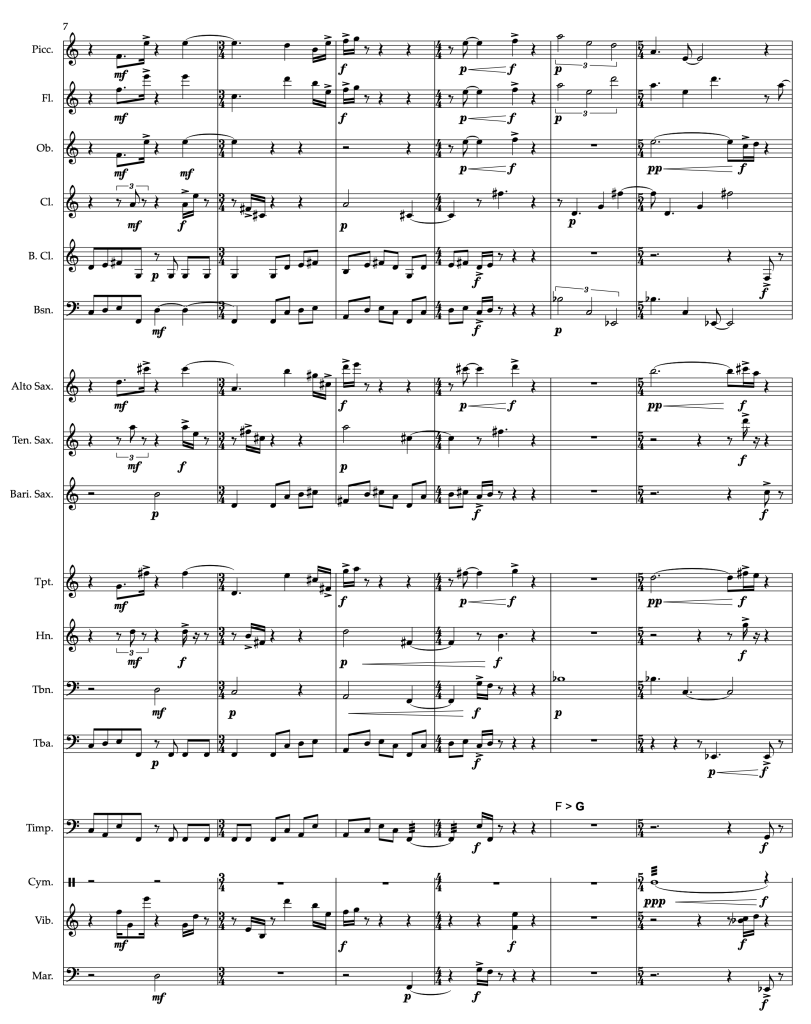
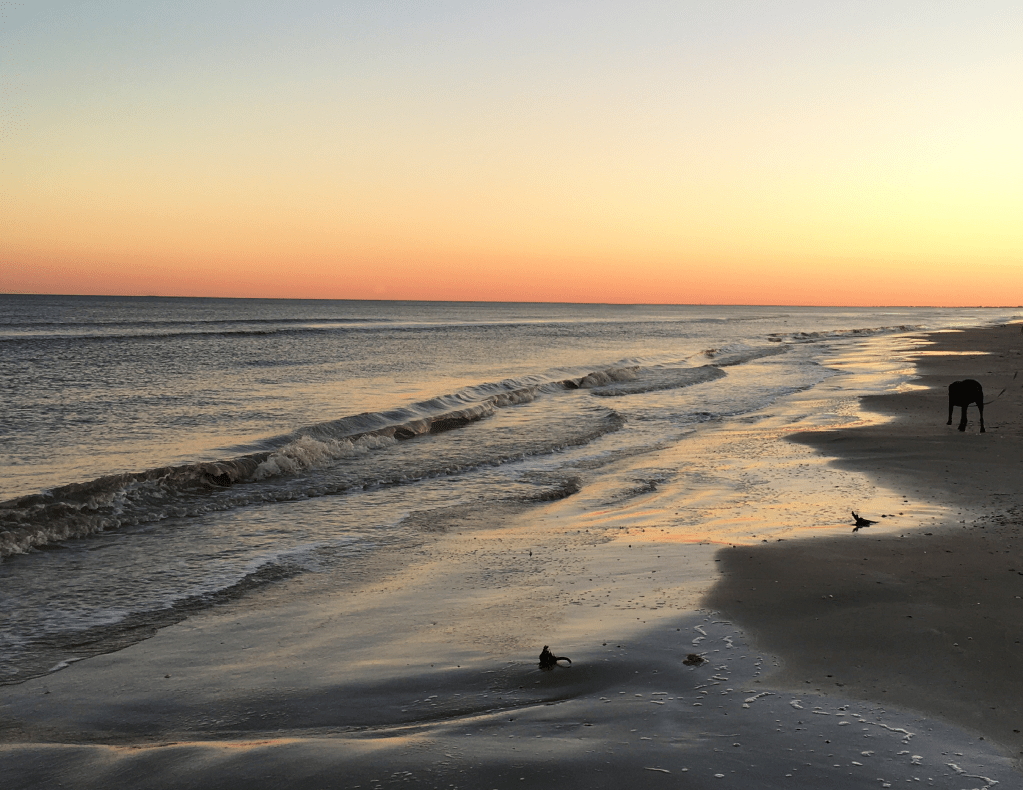
    The next in the series begun with the 1971 original, Nocturne for orchestra, Olympic Shores was scored for wind ensemble. A large 1974 work for double choir, brass, and tape, Shores of Infinity, preceded it. While the same textural approach to a large instrumental ensemble continued, the title reflected my Pacific Lutheran University experience in Washington state the previous year.

    Olympic Shores

    Clark 1975 (TC-31)
    NTSU (now UNT) Symphony Band

    A chamber music piece titled Shores (TC-44) followed in 1978, which opened a new stream of writing for me with its completely non-metric time notation, bright arpeggiated pitch constellations, and oscillations animating the harmony and the texture.
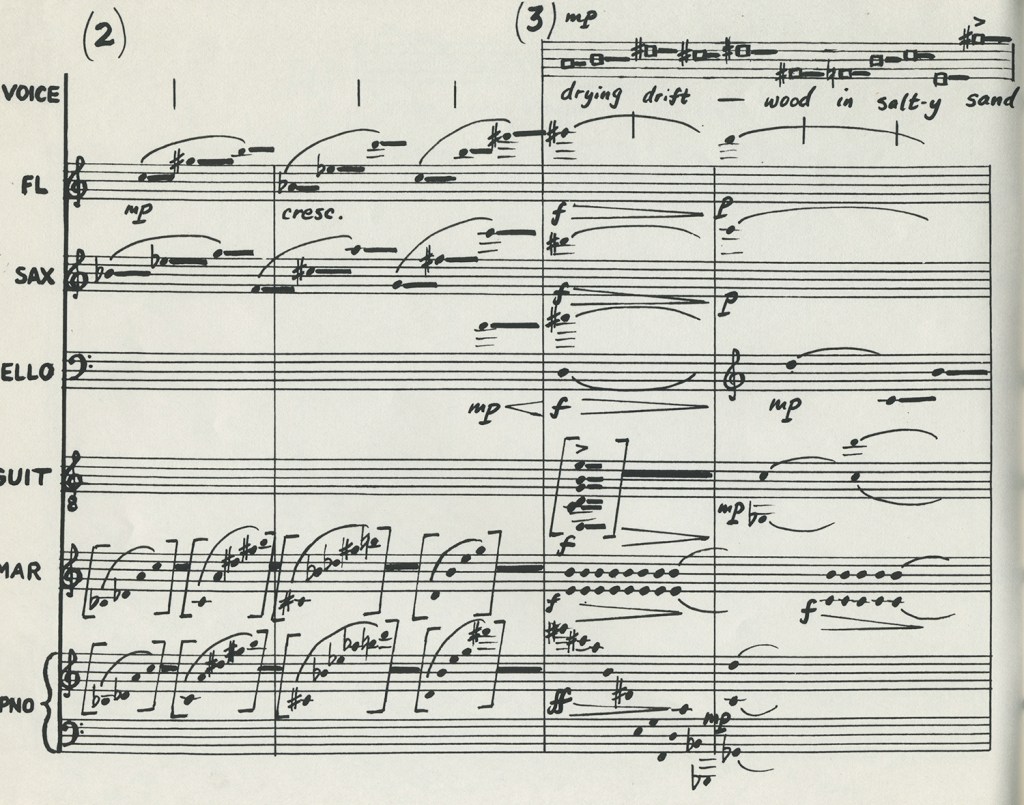
    Though it was performed in 1978 in Denton by the NTSU New Music Performance Lab, I’ve not been able to salvage an old recording.
  • Animated Landscapes

    Nocturne

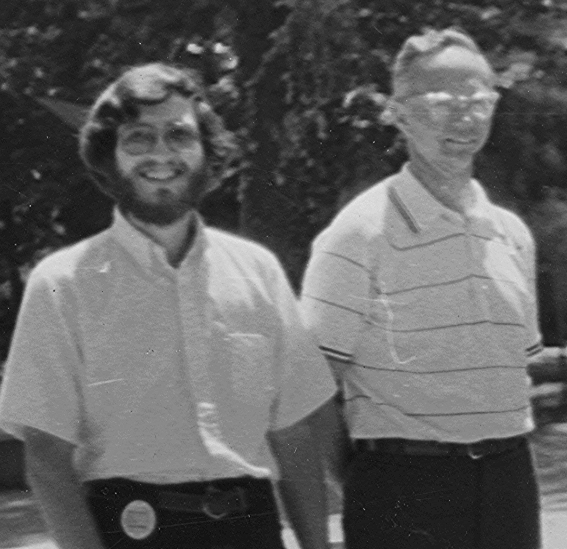
    1976 Interlochen with Prof. Bassett

    The idea of animating an otherwise static sound mass, devoid of progressive harmony, was a quintessential feature of what I came to think of as the Midwestern Style of 1960s and 1970s large ensemble music. Successful models included prize winning pieces such as (my teacher) Leslie Bassett’s Variations for Orchestra (1966), Donald Erb’s The Seventh Trumpet (1969), and Joseph Schwantner’s …and the mountains rising nowhere (1977) and Aftertones of Infinity (1979).

    As a graduate student at the University of Michigan in 1973, I composed my second orchestra piece. The title, Animated Landscapes, was inspired by John Cage’s famous Imaginary Landscapes No. 4, which we performed as I was an ensemble member of Contemporary Directions.

    Animated Landscapes

    Nocturne for orchestra

    1971 (TC-25)

    U.Mich. Symphony Orchestra

  • GEODES

    2025 . . . wind ensemble . . . 13 minutes

    In the midst of my recent Impressionistic “Sketches” series, the 2024 piece Folio (TC143) was a throwback to the more abstract sound mass style of the 1960s and ’70s. Its percussive attacks and inert masses of sound were all synthesized, also throwbacks to my early days of electronic tape music. (One of the earliest electronic compositions, Stockhausen’s 1960 Nr. 12 Kontakte, was full of sounds like giant steel beams hitting a concrete floor!) The other retro feature of Folio is suggested in its title: homage to Earle Brown’s 1952 FOLIO, a collection of abstract art scores in stark, proportional graphic notation.

    A wind and percussion transformation of Folio was challenging. Folio (TC143) was composed in the abstract avant-garde style of the ’60s. It carved sound sculptures of solid, hard-edged sonorities in expansive pitch/time space. Now colored with cool woodwind sounds, radiating brass, and sparkling percussion, GEODES animates Folio‘s solid sound masses in surging and fading rhythmic textures.

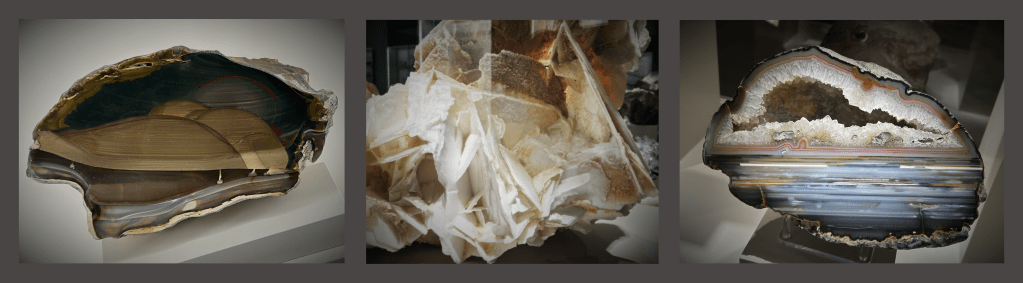
    The chaotic boldness of rocks . . . my own collection of many found on beaches and hikes, but also splendid displays at three places: Dick’s Rock Shoppe in Estes Park, Colorado; Lizzadro Museum of Lapidary Art in Elmhurst (now in Oak Brook), Illinois; and a wonderful gallery of geodes at the Permian Basin Petroleum Museum in Midland, Texas. A geode is Nature’s sculpture, an inscrutable gray rock sphere that, when sawed open, reveals a magical world of dazzling-colored crystals. Different minerals make crystals of varied hues of pink, purple, umber, or cream, reflecting new light.

    Pyrite

    Calcite

    Amethyst

    Quartz

  • GEODES

    2025 . . . 17 winds / percussion . . . 12:30

    In the midst of my recent Impressionistic “Sketches” series, the 2024 piece Folio was a throwback to the more abstract sound mass style of the 1960s and ’70s. Its percussive attacks and inert masses of sound were all synthesized, also throwbacks to my early days of electronic tape music. (One of the earliest electronic compositions, Stockhausen’s 1960 Nr. 12 Kontakte, was full of sounds like giant steel beams hitting a concrete floor!) The other retro feature of Folio is suggested in its title: homage to Earle Brown’s 1952 FOLIO, a collection of abstract art scores in stark, proportional graphic notation.

    This wind and percussion transformation of Folio was challenging. But I thought about the chaotic boldness of rocks — my own collection of many found on beaches and hikes, but also splendid displays at three places: Dick’s Rock Shoppe in Estes Park, Colorado; Lizzadro Museum of Lapidary Art in Elmhurst (now in Oak Brook), Illinois; and a wonderful gallery of geodes at the Permian Basin Petroleum Museum in Midland, Texas. Geodes are Nature’s sculptures, inscrutable gray rocks that, when sawed open, reveal magical worlds of dazzling-colored crystal structure.

  • Brno Variations

    2024 . . . wind ensemble . . . (13 min.) . . . Picc, Fl, Ob, 3 Clar, Alto Sax, Ten Sax, Bari Sax, Bsn, 3 Trp, 2 Hn, 2 Tbn, Euph, Tuba, Timp, Perc, Dbl Bass

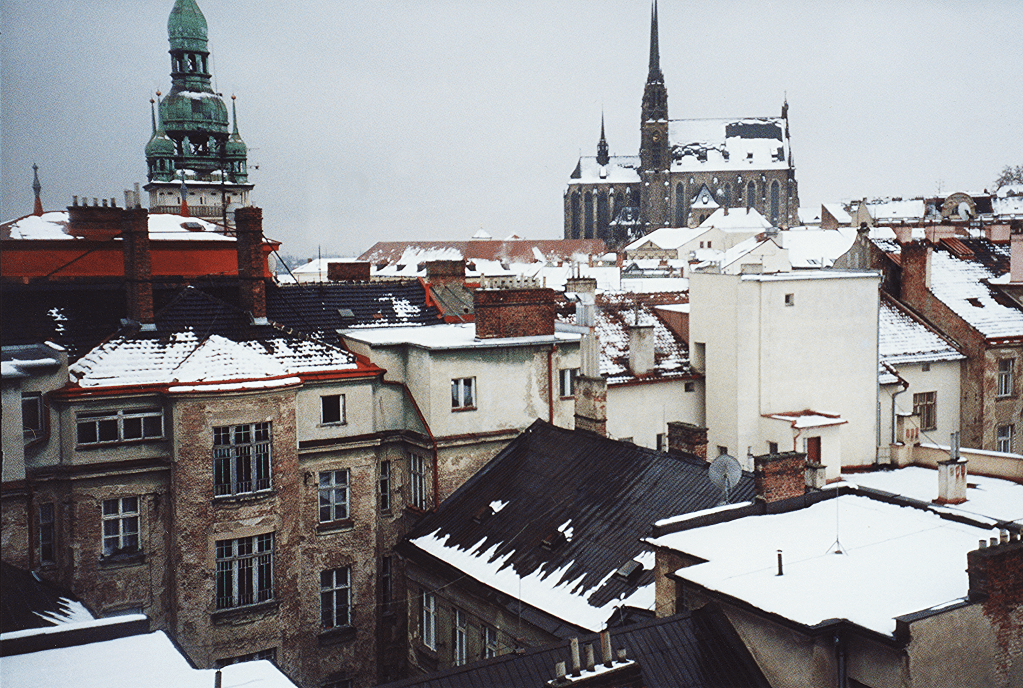
    Leos Janácek composed his great concert work, Sinfonietta, in 1926 for the Sokol Gymnastic Festival in Prague. It is what I call musical sketches of his home city, Brno, the largest city in the Moravian east of what was then Czechoslovakia. I visited Brno several times starting in 1991 to perform my music at its International Music Festival. The festival traditionally ends with a performance of Sinfonietta by the Brno Philharmonic in Janácek Divadlo (theatre). In 1993 my ballet, PTACI, was premiered at historic Mahunovo Divadlo, across a plaza from Janácek Divadlo.

    Though I could have continued my “Sketches” series with a “Brno Sketches,” instead this new work is a set of more abstract variations partly based on and quoting themes from Sinfonietta (in the tradition of Brahms’ Variations on a Theme of Haydn). Variation 1 “Canon” engages that ancient musical technique, evoking Brno’s medieval history. Variation 2 “Overtones” explores two harmonic series, C and Bb, painted over each other in layers of color, with hints of fanfare emerging through the clouds. Variation 3 “Constellations” is a kaleidoscopic succession of large sonorities built on stone-sturdy Perfect Fifth intervals brightened by jazz-like added tones. Variation 4 “Fanfare” is an ostinato pattern-music fantasia on Sinfonietta‘s grand fanfare themes.

    To obtain free performance materials, email: TC24@txstate.edu

  • Appalachian Autumn

    2024 . . . chamber orchestra (9:40) TC-142

    In 2005 through 2008, I lived in North Carolina only an hour away from the Blue Ridge Parkway. October Saturdays always involved a scenic drive up to and on the Parkway to absorb the glorious fall colors and trickling of secret waterfalls.

    Another in my “Animated Landscapes” Sketchbook for small orchestra, by its title this sound sketch pays homage to Copland’s 1944 masterpiece, Appalachian Spring. My currently developed harmonic sensibilities resemble Copland’s open, bold sonorities. In my composition studies in the 1970s, I was fascinated by Appalachian Spring the ballet as originally scored for only 12 orchestral instruments. This original scoring was a masterpiece of orchestral painting blended with the clear contrapuntal lines of chamber music, highlighting each instrument’s colorful voice.

  • Animated Landscapes

    A Musical Sketchbook

    A collection of eight new scores for chamber orchestra with the same orchestration (4 winds, 3 brass, timpani, percussion, and strings), the musical sketches are Impressionistic soundscapes rather than symphonic narratives in form. The Sketchbook also includes extensive performance, analytic and program notes.

    Read the entire ANIMATED LANDSCAPES Sketchbook

    Each sketch paints vivid harmonic and instrumental colors in simple to complex textures of dynamically evolving tempo and pace. Titles are evocative but not determinant for the development of the musical ideas. My original 1971 orchestral composition titled ANIMATED LANDSCAPES first explored this musical approach in what was then the prevailing Midwestern composers’ large-ensemble moving-sound-mass style of the 1960s and ’70s. My harmonic and contrapuntal craft has matured enormously since then!

    Appearing first in this 50-years-later Animated Landscapes Sketchbook for small orchestra, Appalachian Autumn pays homage to Copland’s 1944 masterpiece, Appalachian Spring. In my composition studies in the 1970s, I was fascinated by Appalachian Spring the ballet as originally scored for only 12 orchestral instruments. This original scoring was a masterpiece of orchestral painting blended with the clear contrapuntal lines of chamber music, highlighting each instrument’s colorful voice. My now developed harmonic sensibilities also resemble Copland’s open, bold sonorities.

    Appalachian Autumn
    Amber Atoms in the Fire Gleaming; Yin Yang (Air); Otter Creek (Water)
    Black Canyon (Earth); Glacier Gorge; Palo Duro (sunset) [Canyon Sketches]
    Looking for the Rainbow
    Massif; Storm; Highland dusk [Highland Sketches]
    Viennese Sketches
    Blue Ridge; Jupiter Rising [Sinfonia]
    Hrad (morning climb to the castle ruins); Ptáci (watching Leoš’s birds); Vody (forest streams and shadows); Bystroušky (mouflons and other mountain wildlife); Podzim (autumn sunset) [Hukvaldy Sketches]
    Separate listening to all 8 pieces found here . . .

    Free score and parts available from the composer: tc24@txstate.edu

  • Canyon Sketches

    2024 . . . synthesized soundscape (14 minutes)

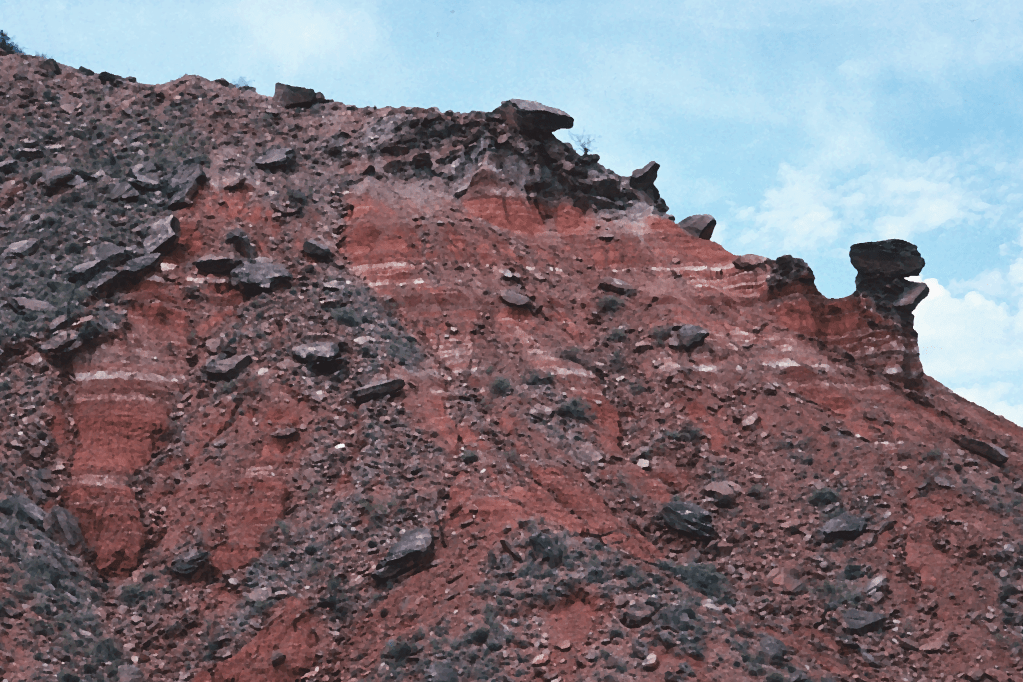
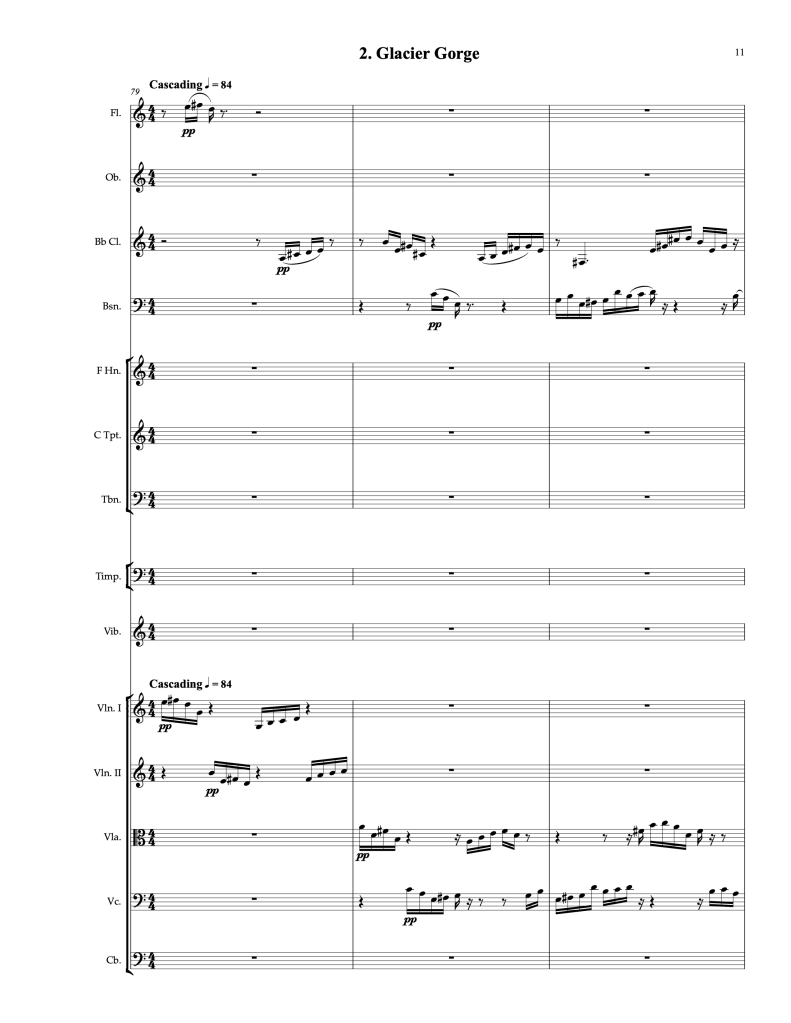
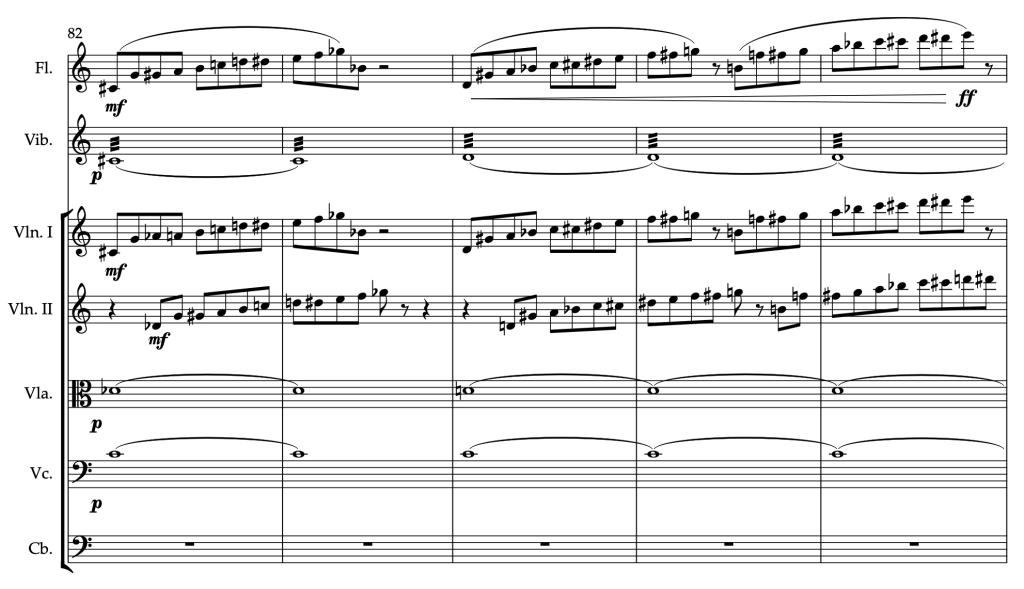
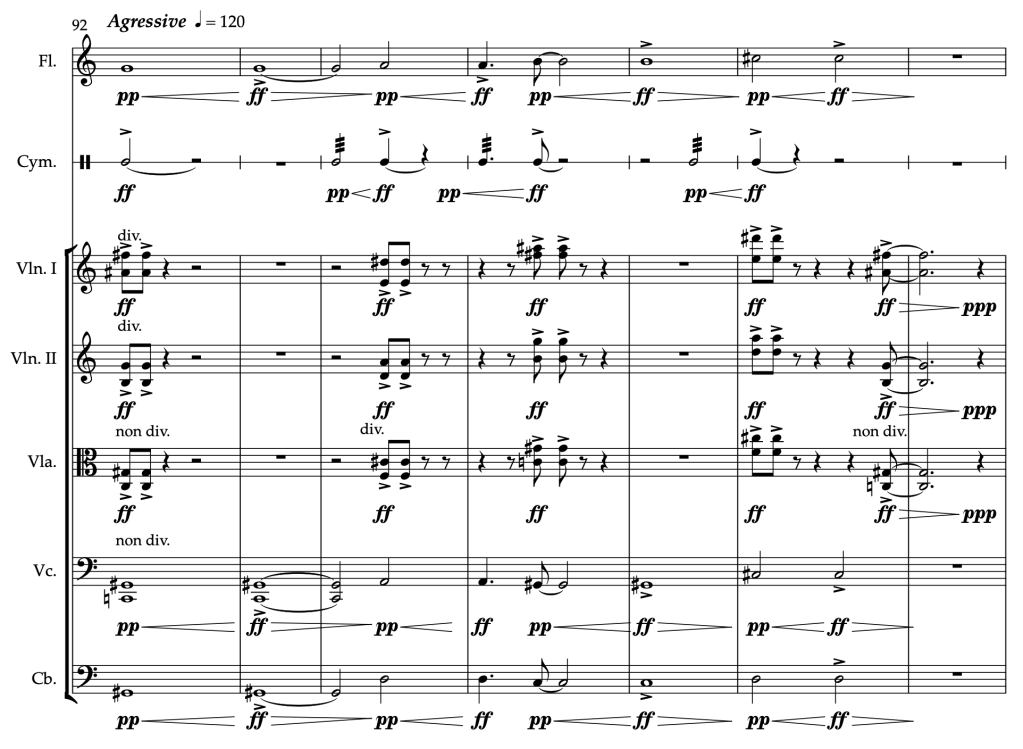
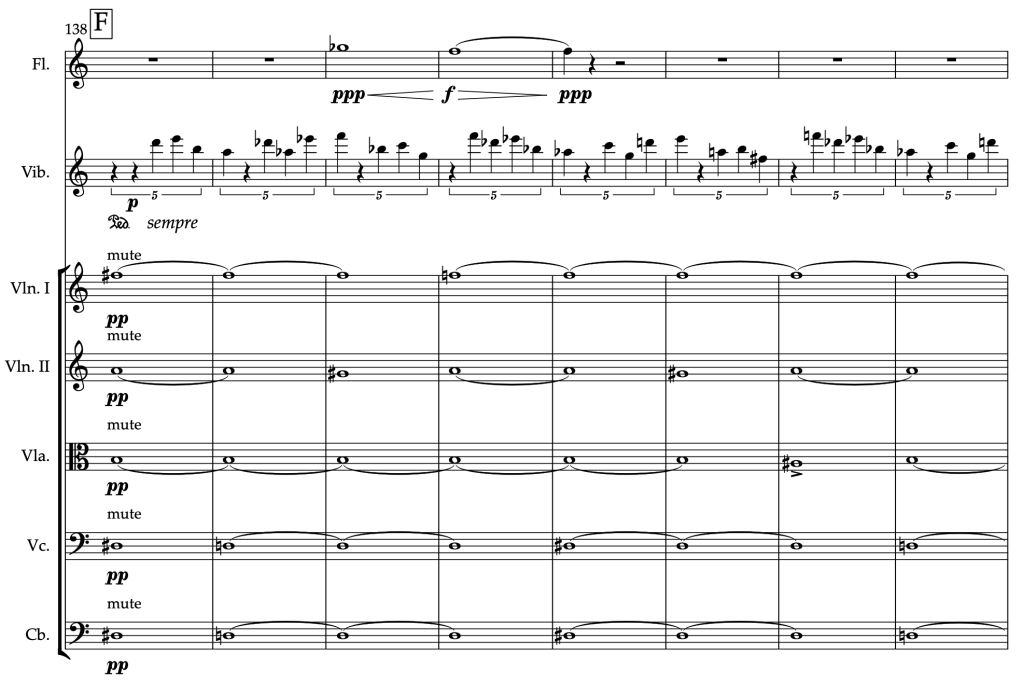
    Three sound sketches explore the timeless qualities of three magnificent canyons: Black Canyon of the Gunnison (Colorado); Glacier Gorge in Rocky Mountain National Park; and Palo Duro Canyon (Texas). Actually, each sketch began fundamentally based not so much on the canyons as on musical techniques.

    2024 . . . chamber orchestra version (12 minutes)

    A complex three-part canon of meandering 12-tone lines musically sketches the colorful streaks of pegmatite dikes in the Black Canyon’s cliff walls of Precambrian gneiss.

    1. Black Canyon

    Downward plunging arpeggios experience relentless musical gravity, sounding out the energetic fall of whitewater over boulders.

    2. Glacier Gorge

    Gently changing kaleidoscopic sonorities and a slow descending progression of pitch constellations to stillness express the timeless quiet of Palo Duro Canyon.

    3. Palo Duro dusk

    Score excerpts:

    Email the composer to request a PDF of the complete 47-page full score and 14 parts.

    tc24@txstate.edu

  • NEBULAS

    2024 . . . sound sculpture for chamber winds . . . (11:00) TC-139

    Nebulas are where stars and planetary systems are formed from collapsing clouds of gas and dust. One of the most familiar and well studied objects in space, the Orion Nebula is enormous, 24 light-years across with a mass of about 2,000 times that of the Sun.

    The single generating concept of this soundscape is musical: a slow, almost timeless metamorphosis of complex 4-pitch constellations, some bright, some darker “celestial” harmony. Rather different from Debussy’s impressionist Trois Nocturnes (1892-99), the first of which, “Nuages,” depicts earthly clouds as gently undulating, colorful orchestral lines and chords.

  • Highlands Sketches

    2023 . . . flute, percussion, strings . . . 9 minutes

    There are many Highlands in my life. I am part Scottish, though my great grandparents are from Glasgow, not the Highlands. I do enjoy its single-malt whiskeys, though, and I went to Howell High School, the “Highlanders.” And I now live in the Texas Hill Country.

    Then there is Českomoravská vrchovina. I first visited what was then still Czechoslovakia in 1991. The Bohemian-Moravian Highlands are between the two main regions of what is now the Czech Republic. The ancient town of Tabor and the massif Blaník are two points of scenic and historical interest. Highlands Sketches sound paints climbing the mountain’s rugged slope, a thunderstorm of dissonant accents, and the quiet harmonic progression of an autumn dusk.

    Score samples:

    I. Massif (“Velký Blaník”)

    II. Storm (“bouřka”)

    III. Dusk (“soumrak”)