Musical impressions of dusk, with text and images by the composer. Quoting one mellifluous phrase (boldface below) from Robert Frost’s “Waiting Afield at Dusk” (1913), the VESPERS text is like a Haiku:
Having begun composing in 1963, I started formal composition study in 1968 at the University of Michigan in Ann Arbor. American composer Eugene Kurtz, based in Paris but filling in that semester at Michigan, was assigned to teach the new freshman. A proponent of modern French music, his compositional models included Debussy and Ravel.
Sonatine
Kurtz assigned me to immerse myself in deep study of their music, in particular Ravel’s Sonatine (1905).
Fifty years later in my career as a more experimental composer, my compositional style began to mellow toward this gentler Impressionistic approach and a lush, bright harmonic language reminiscent of Debussy and Ravel.
An Homage to Ravel, my new Sonatine is spun from a single harmonic progression, seven chords each stacking a Perfect Fifth interval high above another.
This material (what Schoenberg would call a Grundgestalt) generates melodic lines and many arpeggiation patterns, in successive variations of changing register, intensity, and rhythmic pace.
In 1907, French composer Claude Debussy wrote, “I am more and more convinced that music, by its very nature, is something that cannot be cast into a traditional and fixed form. It is made up of colors and rhythms”. Color, light, and texture were also the hallmarks of a new style of painting developed by French artists — Impressionism.
At the threshhold of the 20th century on 15 December 1899, Debussy completed the first of his Impressionist masterpieces for orchestra, Trois Nocturnes. He avoided labeling it “symphony” or “tone poem” by calling the movements “three symphonic sketches”. The first sketch of Nocturnes is subtitled “Nuages,” premiered on 9 December 1900 in Paris.
Debussy’s biography describes the genesis of the piece while crossing the Pont de la Concorde in Paris in stormy weather. The composer’s notes say, “‘Nuages’ renders the immutable aspect of the sky and the slow, solemn motion of the clouds, fading away in grey tones lightly tinged with white.”
Adopting the French language and musical style recognizes the early French explorers of the Great Lakes region of North America. The first decades of my life began there in Michigan’s Lower Peninsula (the “mitten”). It has its own smaller Leelanau Peninsula in the northwest corner (the mitten’s “little finger”) near Interlochen’s National Music Camp, where I spent many summers. Nearby Grand Traverse Bay has its own even smaller Old Mission peninsula, where I loved to visit its lighthouse. The Leelanau has a grand lighthouse at its northern tip and a scenic drive, state highway M21, winding for 64 miles all the way around the peninsula’s shoreline, through forests and past the Great Sleeping Bear Sand Dunes.
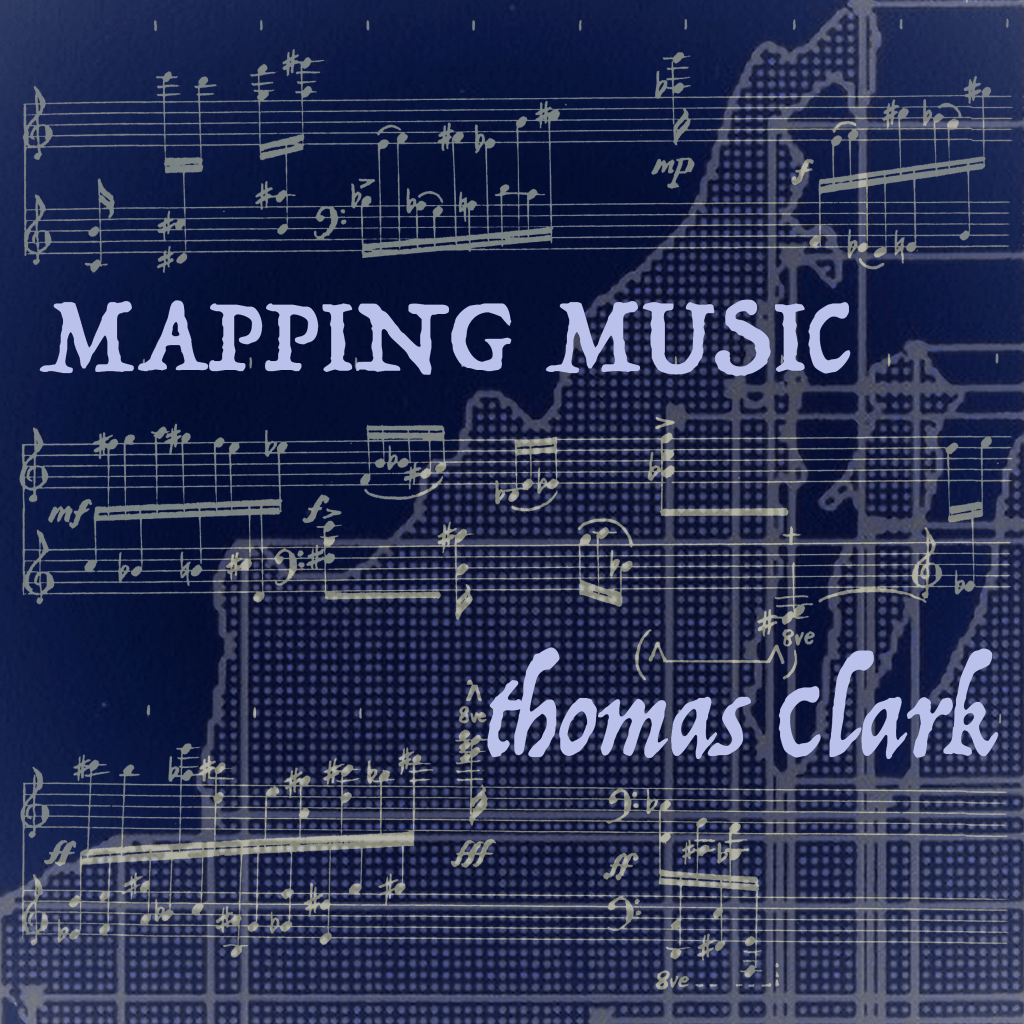
In 1984 my piece titled PENINSULA for piano and sound synthesis was a more experimental work that traced a map of the Leelanau and its landmarks to determine by their spatial coordinates the timing and pitches of sound constellations.
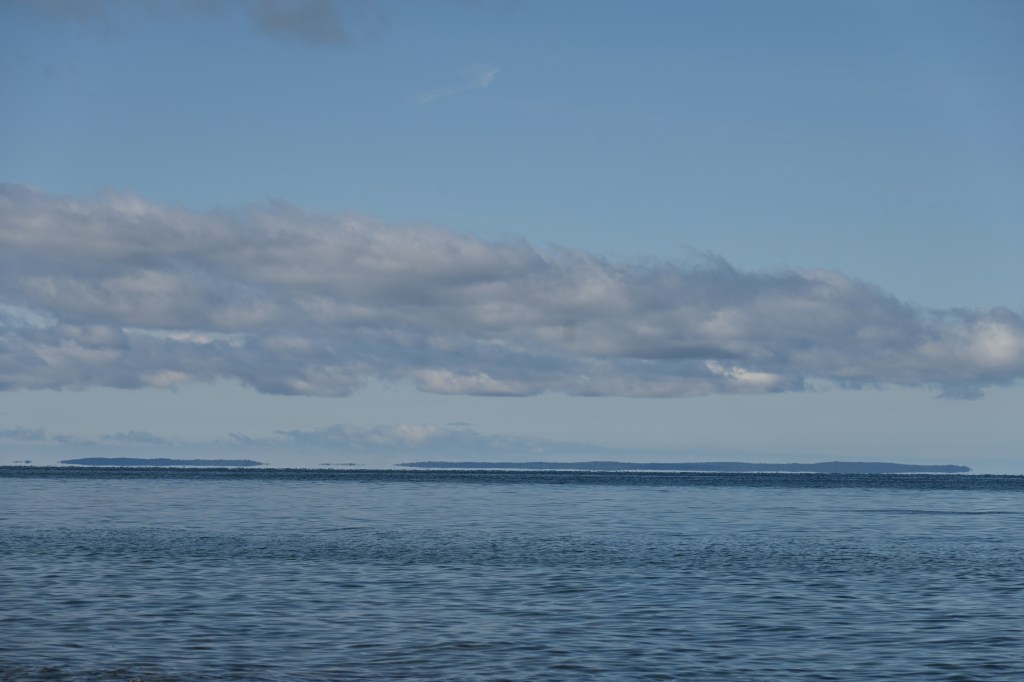
Moving forward from that mapping phase of my compositions, my Impressionistic phase produced the sound sculpture Leelanau Sketches in 2022. Some of its musical material reappears now in five symphonic sketches, Belle Péninsule. Here is the fourth movement, which quotes Debussy’s “Nuages.”
Debussy’s completed his second composition of three symphonic sketches for orchestra, La Mer, in 1905. It is a monumental work of Impressionist sound-painted textures and a textbook model of lush, beautiful orchestration. The three sketches are titled:
My homage to La Mer, SeaSketches, sound-paints waves, deep currents, wind, and sun-sparkling surfaces, employing swelling sound colors and post-modern cyclic techniques in a pan-diatonic tonal setting. The end briefly quotes the opening arpeggio of Debussy’s “La fille aux cheveux de lin” (“The Girl with the Flaxen Hair”) from Book I of his Préludes for piano (1909-1910).
Revisiting my 1988 improvisation sketch for the New Music Performance Lab at University of North Texas became a prequel to a recent composition. FARBEN (2025), variations on the first movement of Webern’s Symphony, isolates instrumental colors as “prickly-pear” points of sound separated in time-and-pitch space.
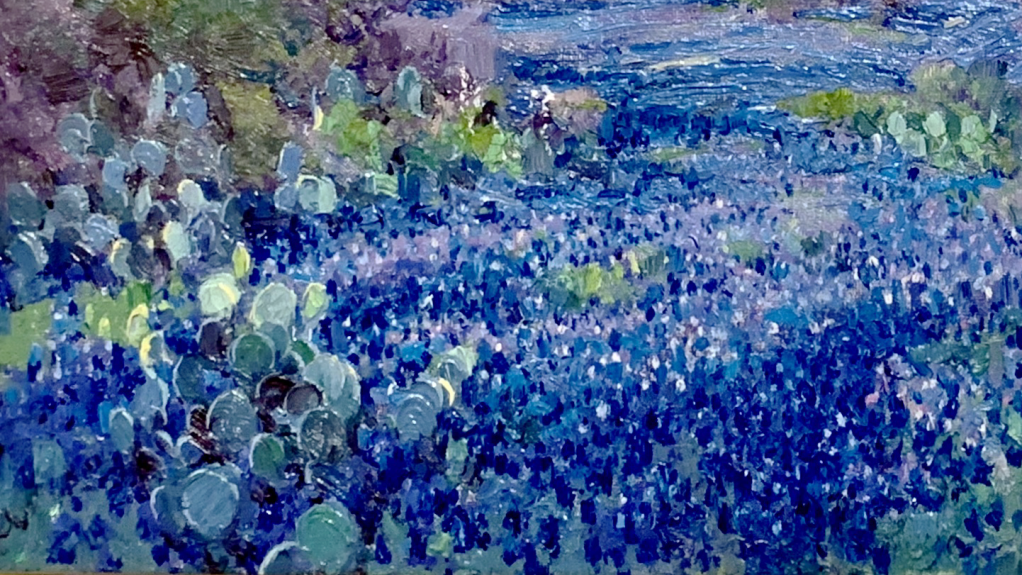
Julian Onderdonk, Blue Bonnets and Cactus in the Rain (1914)
The recomposed 1988 music beginning SPECTRAL LIGHT takes another approach to sound color, layering canonic textures of thicker sonority in a gentle Impressionistic blur, like the brush-blended blur of a Monet painting.
Claude Monet,Waterloo Bridge, Sunlight Effect (1903)
Timbres emerge, echo, and fade in a floating, slow-moving distant landscape of color.
Three pieces of the early 20th century, which I studied deeply in the 1970s and later used extensively in my teaching of modern music, were each masterful explorations of musical sound color:
Claude Debussy’s La Mer (1905), an iconic tone poem of Impressionistic musical painting with an orchestral palette
Arnold Schoenberg’s “Farben (Summer Morning by a Lake: Chord-Colors”, the third of his Five Pieces for Orchestra, Op. 16 (1909) — a gentle study of orchestral sound color
Anton Webern’s Symphony, Op. 21 (1928), whose first movement is a delicate gem of pointillistic color canon built on one enormous, static, symmetrical 13-pitch constellation
After fifty years, these works are embedded more deeply than ever in my musical consciousness. Farben pays special homage to Schoenberg’s masterpiece, layering kaleidoscopic wind-instrument colors to build massive, morphing constellations, echoing Webern’s hidden chord-color symmetry.
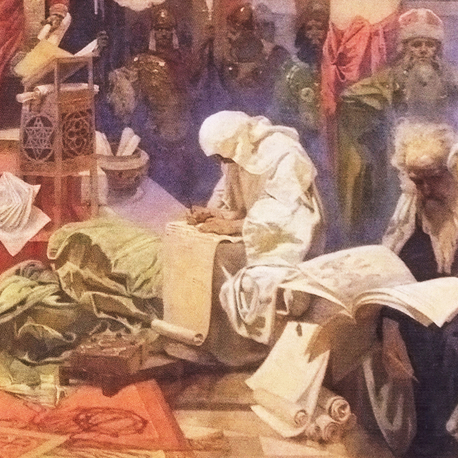
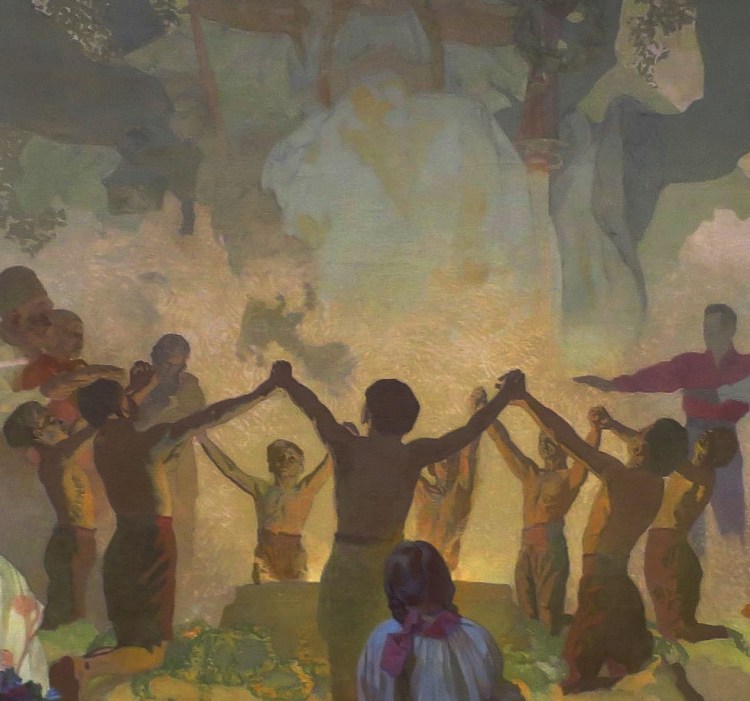
In 1991 I made my first trip to Czechoslovakia to perform at the International Music Festival in the ancient Moravian city of Brno. It was on a side trip to the nearby town of Moravsky Krumlov that I first saw Alfons Mucha’s series of epic paintings depicting the history of the Slavic world. The stories expressed in these 17 enormous unframed canvases were intriguing, but I was most inspired by his dazzling rendering of light, the hallmark of truly great artists. Five stood out and became my challenge to complete the transformation of their depictions of light into music.
Homage to Debussy’s Impressionistic masterpieces, La Mer and Nocturnes
Debussy avoided the label “symphony” or “tone poem” by calling them each “three symphonic sketches”. The first sketch of Nocturnes, subtitled “Nuages,” is musically quoted in IV “Nuages blanc”.
Adopting his French language also recognizes the early explorers of the Great Lakes region of North America. The first decades of my life began there in Michigan’s Lower Peninsula (the “mitten”). It has its own smaller Leelanau Peninsula in the northwest corner (the mitten’s “little finger”) near Interlochen’s National Music Camp, where I spent many summers. Nearby Grand Traverse Bay has its own even smaller Old Mission peninsula, where I loved to visit its lighthouse. The Leelanau has a grand lighthouse at its northern tip and a scenic drive, state highway M21, winding for 64 miles all the way around the peninsula’s shoreline, through forests and past the Great Sleeping Bear Sand Dunes.
In 1984 my piece titled PENINSULA for piano and sound synthesis was a more experimental work that traced a map of the Leelanau and its landmarks to determine by their spatial coordinates the timing and pitches of sound constellations. Moving forward from that mapping phase of my compositions, my Impressionistic phase produced the sound sculpture Leelanau Sketches in 2022. Some of its musical material reappears now in these five symphonic sketches, Belle Péninsule.
In Robert Frost’s poem “My November Guest,” an exquisite expression of loss and sadness, four phrases stood out expressing the gray beauty of November:
“these dark days of autumn rain” . . . “my sorrow when it’s here with me”
“the bare, the withered tree” . . . “the sodden pasture lane”
Autumn RainMusic was originally composed in Ann Arbor for oboe and piano in 1971. Decades later in San Marcos, in 2017 the music evolved into an elegy for unaccompanied English horn, and now to this duo arrangement, heard here with sound-synthesis enhanced background.
In 2005 through 2008, I lived in North Carolina only an hour away from the Blue Ridge Parkway. October Saturdays always involved a scenic drive up to and on the Parkway to absorb the glorious fall colors and trickling of secret waterfalls.
Another in my “Animated Landscapes” Sketchbook for small orchestra, by its title this sound sketch pays homage to Copland’s 1944 masterpiece, Appalachian Spring. My currently developed harmonic sensibilities resemble Copland’s open, bold sonorities. In my composition studies in the 1970s, I was fascinated by Appalachian Spring the ballet as originally scored for only 12 orchestral instruments. This original scoring was a masterpiece of orchestral painting blended with the clear contrapuntal lines of chamber music, highlighting each instrument’s colorful voice.











 Thomas Clark - composer / digital artist