The idea of animating an otherwise static sound mass, devoid of progressive harmony, was a quintessential feature of what I came to think of as the Midwestern Style of 1960s and 1970s large ensemble music. Successful models included prize winning pieces such as (my teacher) Leslie Bassett’s Variations for Orchestra (1966), Donald Erb’s The Seventh Trumpet (1969), and Joseph Schwantner’s …and the mountains rising nowhere (1977) and Aftertones of Infinity (1979).
As a graduate student at the University of Michigan in 1973, I composed my second orchestra piece. The title, Animated Landscapes, was inspired by John Cage’s famous Imaginary Landscapes No. 4, which we performed as I was an ensemble member of Contemporary Directions.
Having begun composing in 1963, I started formal composition study in 1968 at the University of Michigan in Ann Arbor. American composer Eugene Kurtz, based in Paris but filling in that semester at Michigan, was assigned to teach the new freshman. A proponent of modern French music, his compositional models included Debussy and Ravel.
Sonatine
Kurtz assigned me to immerse myself in deep study of their music, in particular Ravel’s Sonatine (1905).
Fifty years later in my career as a more experimental composer, my compositional style began to mellow toward this gentler Impressionistic approach and a lush, bright harmonic language reminiscent of Debussy and Ravel.
An Homage to Ravel, my new Sonatine is spun from a single harmonic progression, seven chords each stacking a Perfect Fifth interval high above another.
This material (what Schoenberg would call a Grundgestalt) generates melodic lines and many arpeggiation patterns, in successive variations of changing register, intensity, and rhythmic pace.
In 1907, French composer Claude Debussy wrote, “I am more and more convinced that music, by its very nature, is something that cannot be cast into a traditional and fixed form. It is made up of colors and rhythms”. Color, light, and texture were also the hallmarks of a new style of painting developed by French artists — Impressionism.
At the threshhold of the 20th century on 15 December 1899, Debussy completed the first of his Impressionist masterpieces for orchestra, Trois Nocturnes. He avoided labeling it “symphony” or “tone poem” by calling the movements “three symphonic sketches”. The first sketch of Nocturnes is subtitled “Nuages,” premiered on 9 December 1900 in Paris.
Debussy’s biography describes the genesis of the piece while crossing the Pont de la Concorde in Paris in stormy weather. The composer’s notes say, “‘Nuages’ renders the immutable aspect of the sky and the slow, solemn motion of the clouds, fading away in grey tones lightly tinged with white.”
Adopting the French language and musical style recognizes the early French explorers of the Great Lakes region of North America. The first decades of my life began there in Michigan’s Lower Peninsula (the “mitten”). It has its own smaller Leelanau Peninsula in the northwest corner (the mitten’s “little finger”) near Interlochen’s National Music Camp, where I spent many summers. Nearby Grand Traverse Bay has its own even smaller Old Mission peninsula, where I loved to visit its lighthouse. The Leelanau has a grand lighthouse at its northern tip and a scenic drive, state highway M21, winding for 64 miles all the way around the peninsula’s shoreline, through forests and past the Great Sleeping Bear Sand Dunes.
In 1984 my piece titled PENINSULA for piano and sound synthesis was a more experimental work that traced a map of the Leelanau and its landmarks to determine by their spatial coordinates the timing and pitches of sound constellations.
Moving forward from that mapping phase of my compositions, my Impressionistic phase produced the sound sculpture Leelanau Sketches in 2022. Some of its musical material reappears now in five symphonic sketches, Belle Péninsule. Here is the fourth movement, which quotes Debussy’s “Nuages.”
Debussy’s completed his second composition of three symphonic sketches for orchestra, La Mer, in 1905. It is a monumental work of Impressionist sound-painted textures and a textbook model of lush, beautiful orchestration. The three sketches are titled:
My homage to La Mer, SeaSketches, sound-paints waves, deep currents, wind, and sun-sparkling surfaces, employing swelling sound colors and post-modern cyclic techniques in a pan-diatonic tonal setting. The end briefly quotes the opening arpeggio of Debussy’s “La fille aux cheveux de lin” (“The Girl with the Flaxen Hair”) from Book I of his Préludes for piano (1909-1910).
There are so many beloved serenades. There is Dvořák’s Serenáda pro dechové nástroje d moll (Op. 44, 1978) for winds. For strings, Smyčcová serenáda E dur(Op.22, 1875) by Dvořák and Serenade for Strings in C Major (Op.48, 1880) by Tchaikovsky stand out as masterful evocations of the genre’s elegance and vibrant color potential. And then there are Mozart’s many wonderful serenades, some for winds and the most popular, Eine Kleine Nachtmusik, for strings. (Our daughter played it as a violist in her high-school string quartet, and everyone in the family sang it around the house.)
The language of my new serenade’s title honors that beloved string piece. It also fits my ongoing obsession with nocturnal and astronomical images. (See Mapping the Music Universe.)
The introductory first part quietly morphs darkly complex sonorities. In contrast, I recently became interested in studying the lovely middle movement of Mozart’s Piano Concerto No. 18 (K.456, 1784). Its simple half-note secondary theme launched a study that led to composing variations on it, becoming the brightening latter two parts of this new serenade.
Three pieces of the early 20th century, which I studied deeply in the 1970s and later used extensively in my teaching of modern music, were each masterful explorations of musical sound color:
Claude Debussy’s La Mer (1905), an iconic tone poem of Impressionistic musical painting with an orchestral palette
Arnold Schoenberg’s “Farben (Summer Morning by a Lake: Chord-Colors”, the third of his Five Pieces for Orchestra, Op. 16 (1909) — a gentle study of orchestral sound color
Anton Webern’s Symphony, Op. 21 (1928), whose first movement is a delicate gem of pointillistic color canon built on one enormous, static, symmetrical 13-pitch constellation
After fifty years, these works are embedded more deeply than ever in my musical consciousness. Farben pays special homage to Schoenberg’s masterpiece, layering kaleidoscopic wind-instrument colors to build massive, morphing constellations, echoing Webern’s hidden chord-color symmetry.
Homage to Debussy’s Impressionistic masterpieces, La Mer and Nocturnes
Debussy avoided the label “symphony” or “tone poem” by calling them each “three symphonic sketches”. The first sketch of Nocturnes, subtitled “Nuages,” is musically quoted in IV “Nuages blanc”.
Adopting his French language also recognizes the early explorers of the Great Lakes region of North America. The first decades of my life began there in Michigan’s Lower Peninsula (the “mitten”). It has its own smaller Leelanau Peninsula in the northwest corner (the mitten’s “little finger”) near Interlochen’s National Music Camp, where I spent many summers. Nearby Grand Traverse Bay has its own even smaller Old Mission peninsula, where I loved to visit its lighthouse. The Leelanau has a grand lighthouse at its northern tip and a scenic drive, state highway M21, winding for 64 miles all the way around the peninsula’s shoreline, through forests and past the Great Sleeping Bear Sand Dunes.
In 1984 my piece titled PENINSULA for piano and sound synthesis was a more experimental work that traced a map of the Leelanau and its landmarks to determine by their spatial coordinates the timing and pitches of sound constellations. Moving forward from that mapping phase of my compositions, my Impressionistic phase produced the sound sculpture Leelanau Sketches in 2022. Some of its musical material reappears now in these five symphonic sketches, Belle Péninsule.
In 2005 through 2008, I lived in North Carolina only an hour away from the Blue Ridge Parkway. October Saturdays always involved a scenic drive up to and on the Parkway to absorb the glorious fall colors and trickling of secret waterfalls.
Another in my “Animated Landscapes” Sketchbook for small orchestra, by its title this sound sketch pays homage to Copland’s 1944 masterpiece, Appalachian Spring. My currently developed harmonic sensibilities resemble Copland’s open, bold sonorities. In my composition studies in the 1970s, I was fascinated by Appalachian Spring the ballet as originally scored for only 12 orchestral instruments. This original scoring was a masterpiece of orchestral painting blended with the clear contrapuntal lines of chamber music, highlighting each instrument’s colorful voice.
A collection of eight new scores for chamber orchestra with the same orchestration (4 winds, 3 brass, timpani, percussion, and strings), the musical sketches are Impressionistic soundscapes rather than symphonic narratives in form. The Sketchbook also includes extensive performance, analytic and program notes.
Each sketch paints vivid harmonic and instrumental colors in simple to complex textures of dynamically evolving tempo and pace. Titles are evocative but not determinant for the development of the musical ideas. My original 1971 orchestral composition titled ANIMATED LANDSCAPES first explored this musical approach in what was then the prevailing Midwestern composers’ large-ensemble moving-sound-mass style of the 1960s and ’70s. My harmonic and contrapuntal craft has matured enormously since then!
Appearing first in this 50-years-later Animated Landscapes Sketchbook for small orchestra, Appalachian Autumn pays homage to Copland’s 1944 masterpiece, Appalachian Spring. In my composition studies in the 1970s, I was fascinated by Appalachian Spring the ballet as originally scored for only 12 orchestral instruments. This original scoring was a masterpiece of orchestral painting blended with the clear contrapuntal lines of chamber music, highlighting each instrument’s colorful voice. My now developed harmonic sensibilities also resemble Copland’s open, bold sonorities.
Appalachian Autumn
Amber Atoms in the Fire Gleaming; Yin Yang (Air); Otter Creek (Water)
Black Canyon (Earth); Glacier Gorge; Palo Duro (sunset)[Canyon Sketches]
Looking for the Rainbow
Massif; Storm; Highland dusk [Highland Sketches]
Viennese Sketches
Blue Ridge; Jupiter Rising [Sinfonia]
Hrad(morning climb to the castle ruins); Ptáci (watching Leoš’s birds); Vody (forest streams and shadows); Bystroušky (mouflons and other mountain wildlife); Podzim (autumn sunset) [Hukvaldy Sketches]
2024 . . . chamber orchestra . . . 8 minutes (Originally for Karla Hamelin and her Texas State cello students)
First composed in 2021 during the COVID pandemic, Looking for the Rainbow expresses both the uncertainty and hopefulness in our collective struggle to survive the storms of disease and violence.
A prequel to Rainbow Rising (2016), an earlier canonic piece for cellos, Looking for the Rainbow explores a more complex rhythmic counterpoint of darker sonorities, evoking a restless spirit of searching, anticipating. (Canon is an ancient compositional technique, a melodic line that while in progress is closely echoed in one or more other “voices” to weave an entire contrapuntal texture out of matching threads.)
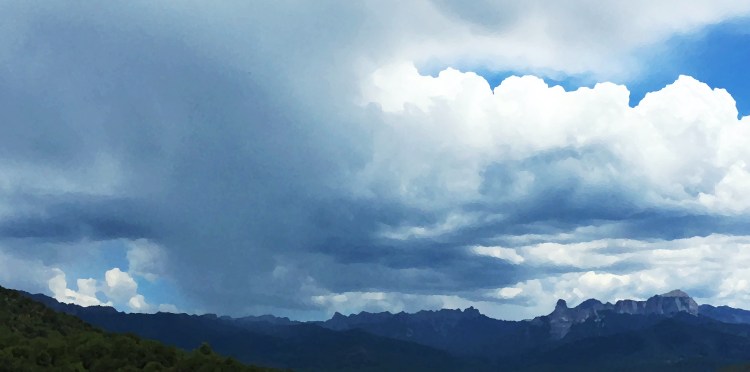
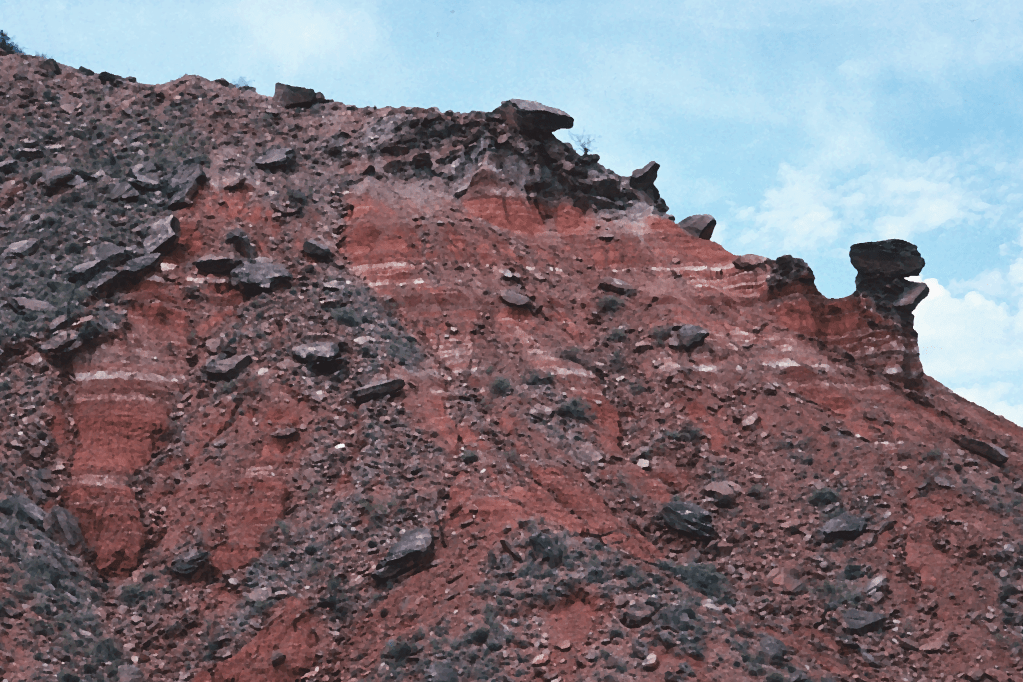
Three sound sketches explore the timeless qualities of three magnificent canyons: Black Canyon of the Gunnison (Colorado); Glacier Gorge in Rocky Mountain National Park; and Palo Duro Canyon (Texas). Actually, each sketch began fundamentally based not so much on the canyons as on musical techniques.
2024 . . . chamber orchestra version (12 minutes)
A complex three-part canon of meandering 12-tone lines musically sketches the colorful streaks of pegmatite dikes in the Black Canyon’s cliff walls of Precambrian gneiss.
1. Black Canyon
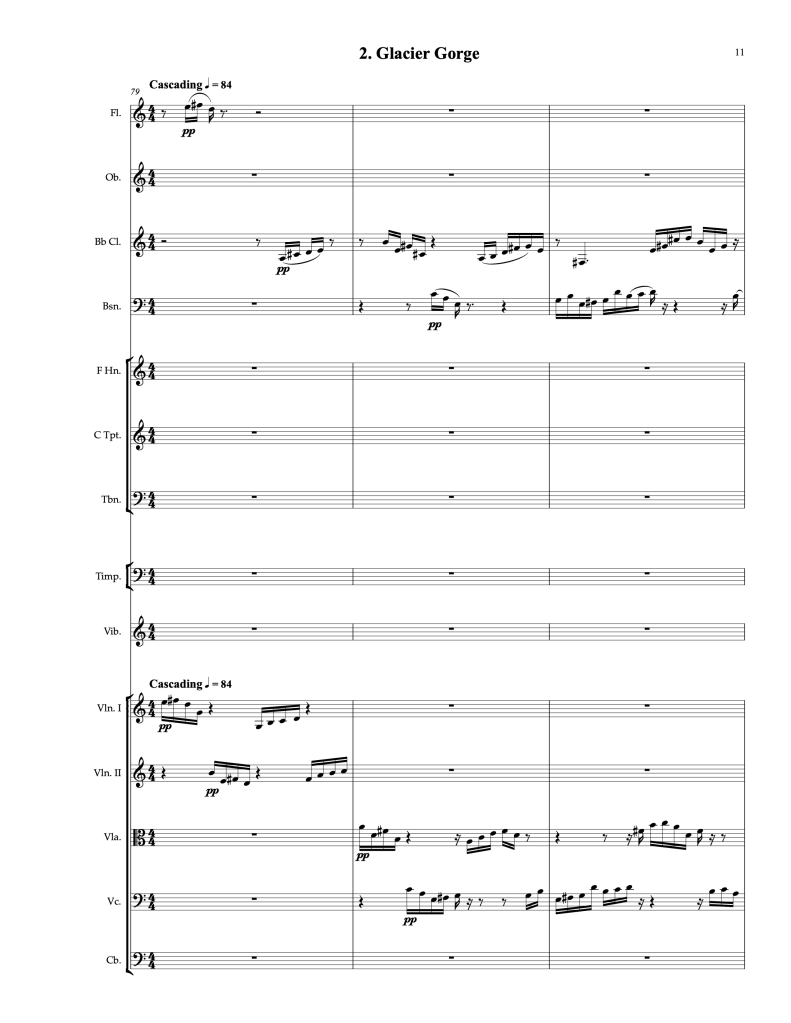
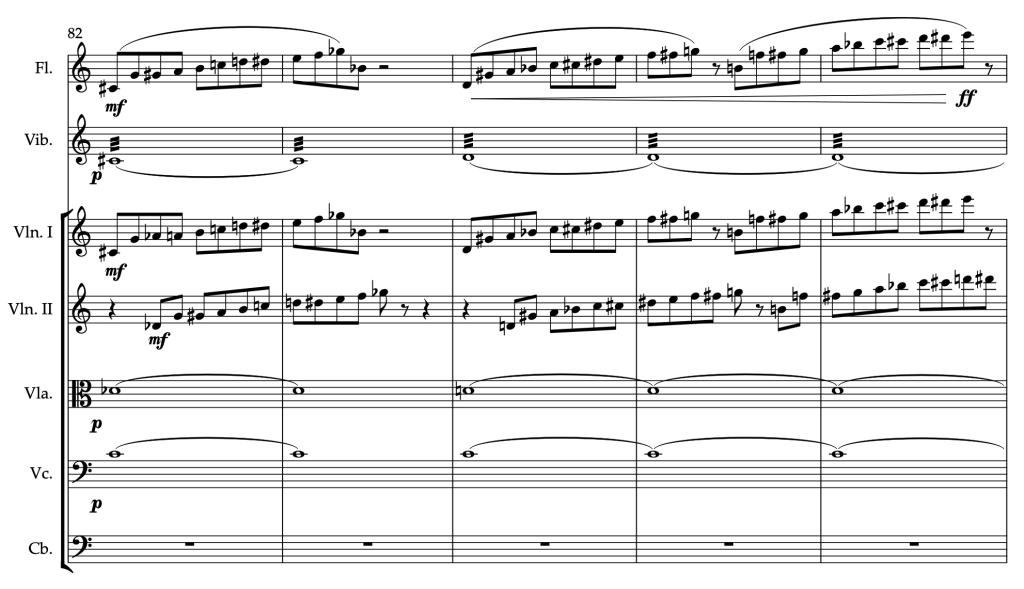
Downward plunging arpeggios experience relentless musical gravity, sounding out the energetic fall of whitewater over boulders.
2. Glacier Gorge
Gently changing kaleidoscopic sonorities and a slow descending progression of pitch constellations to stillness express the timeless quiet of Palo Duro Canyon.
3. Palo Duro dusk
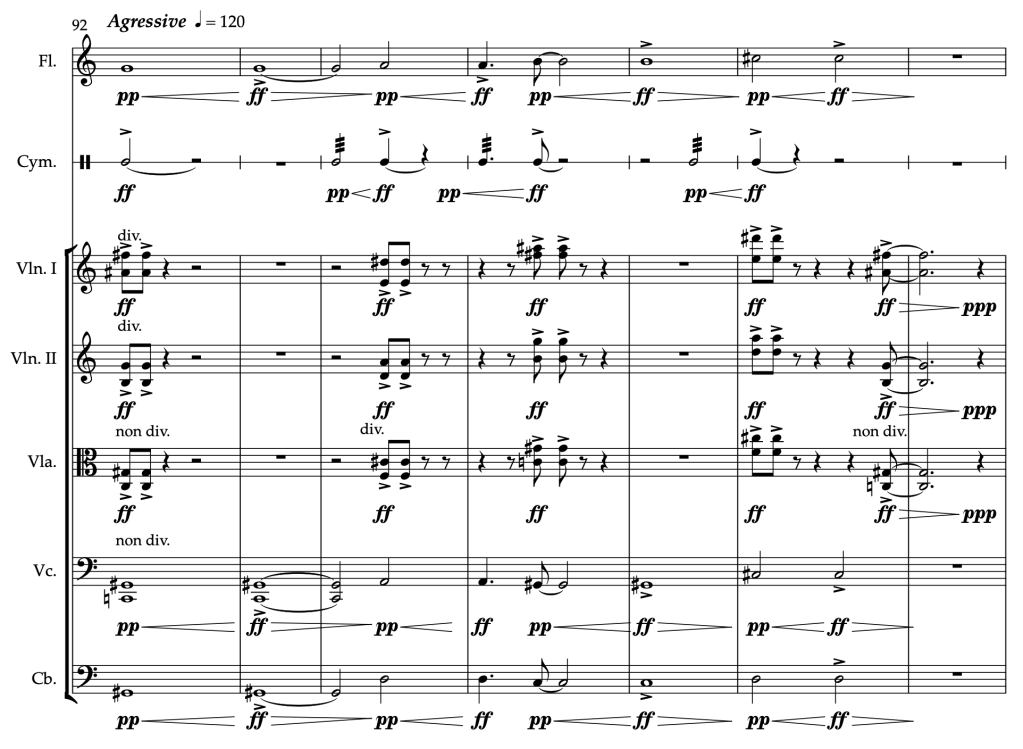
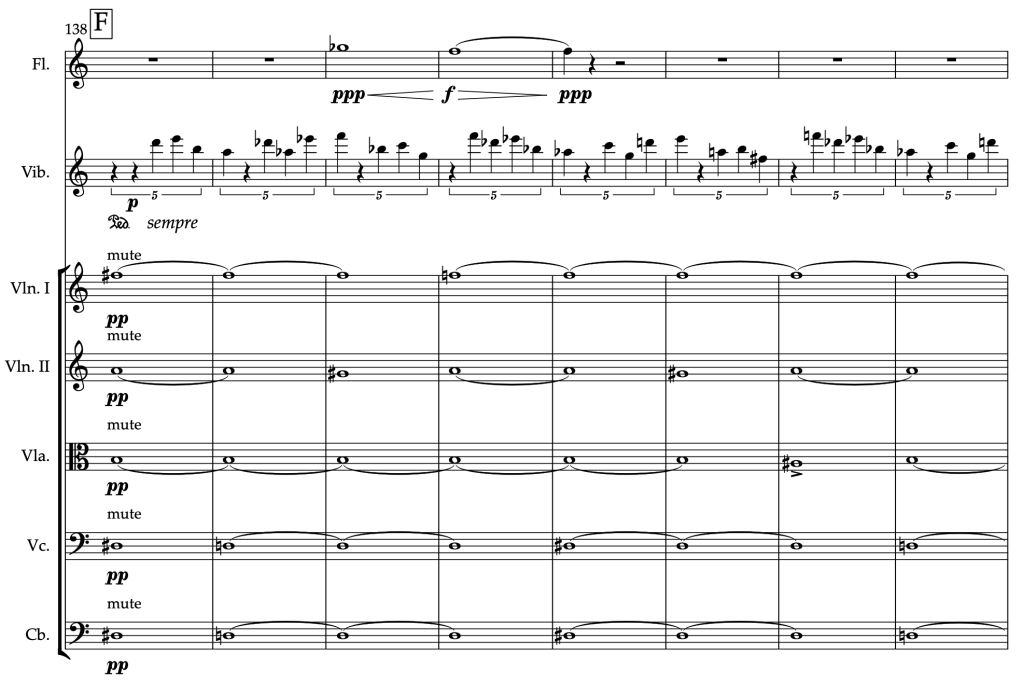
Score excerpts:
Email the composer to request a PDF of the complete 47-page full score and 14 parts.
There are many Highlands in my life. I am part Scottish, though my great grandparents are from Glasgow, not the Highlands. I do enjoy its single-malt whiskeys, though, and I went to Howell High School, the “Highlanders.” And I now live in the Texas Hill Country.
Then there is Českomoravská vrchovina. I first visited what was then still Czechoslovakia in 1991. The Bohemian-Moravian Highlands are between the two main regions of what is now the Czech Republic. The ancient town of Tabor and the massif Blaník are two points of scenic and historical interest. Highlands Sketches sound paints climbing the mountain’s rugged slope, a thunderstorm of dissonant accents, and the quiet harmonic progression of an autumn dusk.

















 Thomas Clark - composer / digital artist