Category: podcast

  • IMAGINED WORLDS

    serial music

    surreal images

    YouTube podcast

    2026 . . . abstract serial music and surreal digital images . . . 13 minutes

    While the Belgian Magritte began making surrealist art in 1920s Paris, the Russian Kandinsky was at the Bauhaus in Weimar making abstract art. In 1923 Vienna, Arnold Schoenberg unveiled his newly developed “method of composing with twelve tones related only with one another.” This serial 12-tone row technique became a prevalent compositional method through the middle of the 20th century.
    A hundred years later, IMAGINED WORLDS synthesizes music from VIENNESE SKETCHES, which draws on material from my earliest 12-tone work in 1975 through 2023.

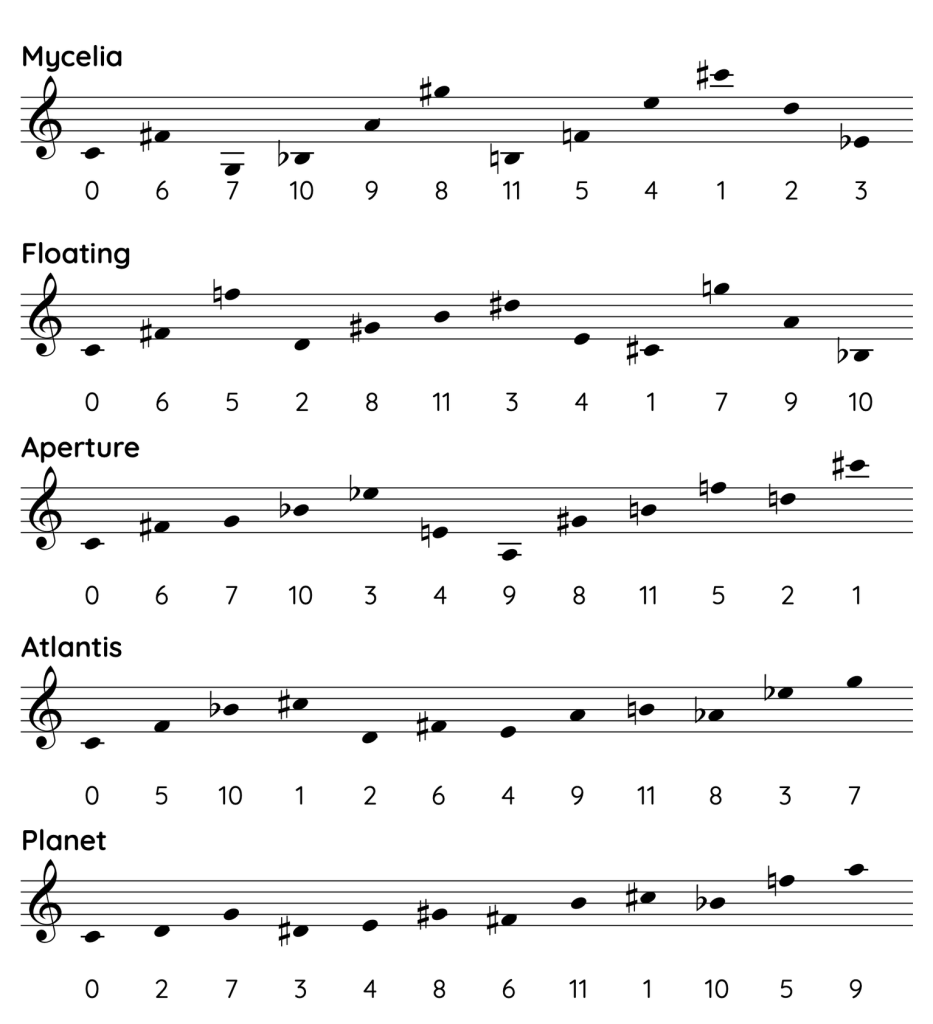
    12-tone rows

    The five rows generating each of the tableaux are distinct but subtle variants of each other.

    Standard Pitch Class numbers (C=0) are identified.

  • LIGHTFORMS

    Radiant music

    YouTube podcast

    Like light, music can radiate in intensity, change color, evolve.

    Each YouTube episode presents a 21st-century composition in synthesized sound exploring a luminous possibility — reflection, refraction, diffusion, sunlight, starlight, color spectrum . . . even light disappearing into a black hole.

  • CANTUS

    Ancient chants in a new millenium

    YouTube podcast

    A thousand years ago, monks sang plainchant melodies in stone monasteries. Today, composers are still weaving these ancient songs into the lyrical fabric of their art.

    Each piece by composer Thomas Clark in this YouTube podcast weaves a 21st-century fabric from one ancient plainchant thread.

  • HARMONIA MUNDI

    YouTube podcast

    Musical explorations of the cosmos — a series of multimedia compositions, each portraying one intriguing aspect of astronomy. Complex patterns of experimental harmony are synthesized in electronic sound and juxtaposed with imagined images.

    YouTube podcast by composer/professor Thomas Clark

  • MATH MUSIC

    YouTube podcast

    How do prime numbers sound? Or Pi, or the Fibonacci series? It depends completely on how these patterns are interpreted as sound.


    This YouTube podcast by composer/professor Thomas Clark brings them to time-life with many eclectic compositional styles of contemporary art music. Interesting number patterns are realized as intriguing sound colors, chords, melodic lines, even as the ancient musical technique of canons, over a kinetic visual background of my semi-abstract art images.