Tag: canon

  • Brno Variations

    2024 . . . wind ensemble . . . (13 min.) . . . Picc, Fl, Ob, 3 Clar, Alto Sax, Ten Sax, Bari Sax, Bsn, 3 Trp, 2 Hn, 2 Tbn, Euph, Tuba, Timp, Perc, Dbl Bass

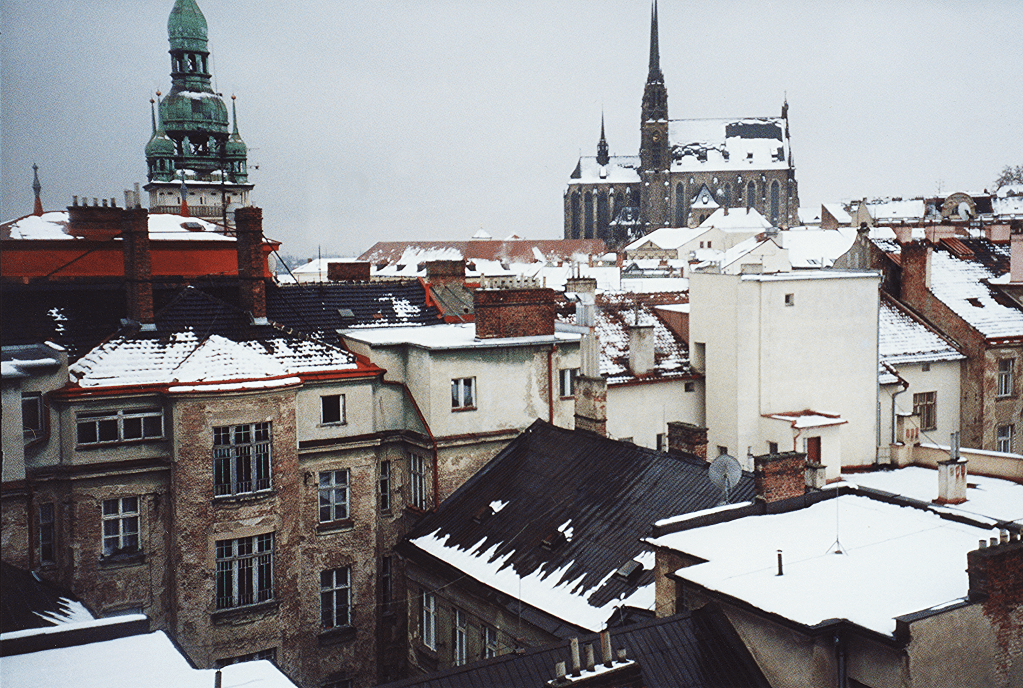
    Leos Janácek composed his great concert work, Sinfonietta, in 1926 for the Sokol Gymnastic Festival in Prague. It is what I call musical sketches of his home city, Brno, the largest city in the Moravian east of what was then Czechoslovakia. I visited Brno several times starting in 1991 to perform my music at its International Music Festival. The festival traditionally ends with a performance of Sinfonietta by the Brno Philharmonic in Janácek Divadlo (theatre). In 1993 my ballet, PTACI, was premiered at historic Mahunovo Divadlo, across a plaza from Janácek Divadlo.

    Though I could have continued my “Sketches” series with a “Brno Sketches,” instead this new work is a set of more abstract variations partly based on and quoting themes from Sinfonietta (in the tradition of Brahms’ Variations on a Theme of Haydn). Variation 1 “Canon” engages that ancient musical technique, evoking Brno’s medieval history. Variation 2 “Overtones” explores two harmonic series, C and Bb, painted over each other in layers of color, with hints of fanfare emerging through the clouds. Variation 3 “Constellations” is a kaleidoscopic succession of large sonorities built on stone-sturdy Perfect Fifth intervals brightened by jazz-like added tones. Variation 4 “Fanfare” is an ostinato pattern-music fantasia on Sinfonietta‘s grand fanfare themes.
    To obtain free performance materials, email: TC24@txstate.edu
  • Looking for the Rainbow

    2024 . . . chamber orchestra . . . 8 minutes (Originally for Karla Hamelin and her Texas State cello students)

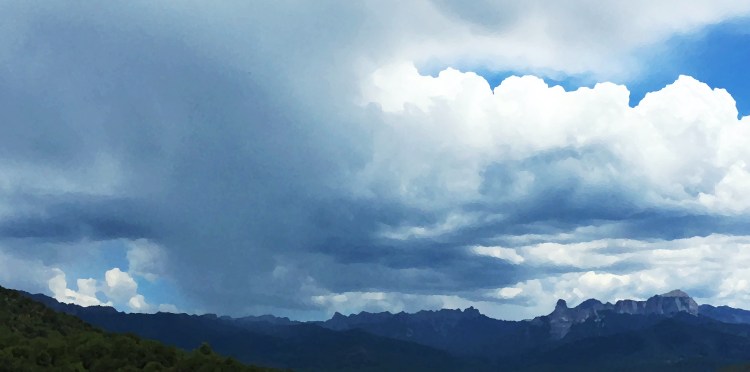
    First composed in 2021 during the COVID pandemic, Looking for the Rainbow expresses both the uncertainty and hopefulness in our collective struggle to survive the storms of disease and violence.

    A prequel to Rainbow Rising (2016), an earlier canonic piece for cellos, Looking for the Rainbow explores a more complex rhythmic counterpoint of darker sonorities, evoking a restless spirit of searching, anticipating. (Canon is an ancient compositional technique, a melodic line that while in progress is closely echoed in one or more other “voices” to weave an entire contrapuntal texture out of matching threads.)

  • Canyon Sketches

    2024 . . . synthesized soundscape (14 minutes)

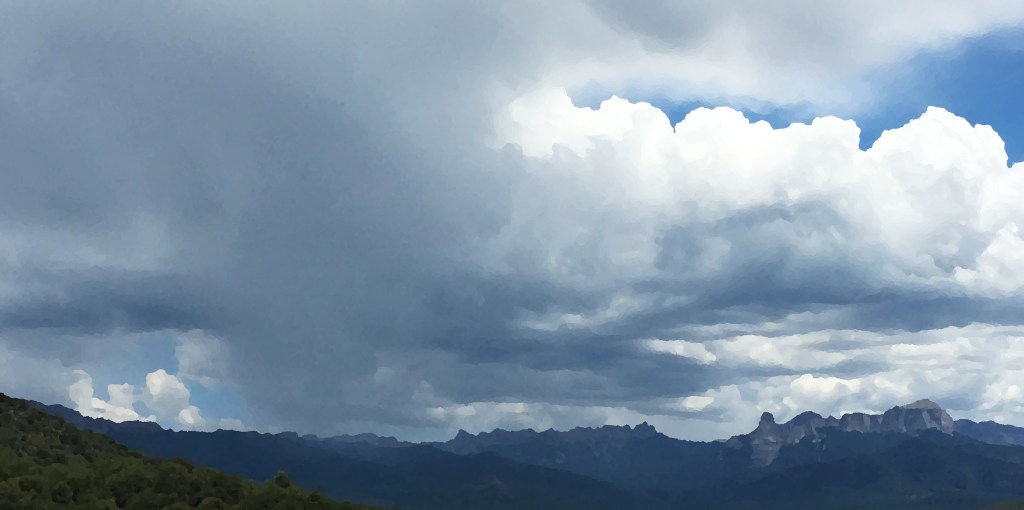
    Three sound sketches explore the timeless qualities of three magnificent canyons: Black Canyon of the Gunnison (Colorado); Glacier Gorge in Rocky Mountain National Park; and Palo Duro Canyon (Texas). Actually, each sketch began fundamentally based not so much on the canyons as on musical techniques.

    2024 . . . chamber orchestra version (12 minutes)

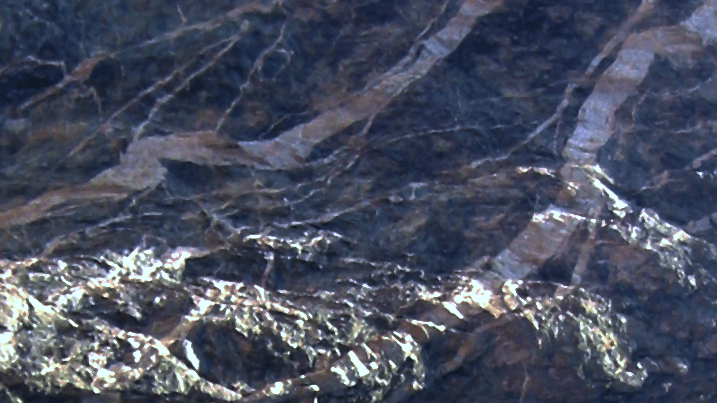
    A complex three-part canon of meandering 12-tone lines musically sketches the colorful streaks of pegmatite dikes in the Black Canyon’s cliff walls of Precambrian gneiss.

    1. Black Canyon

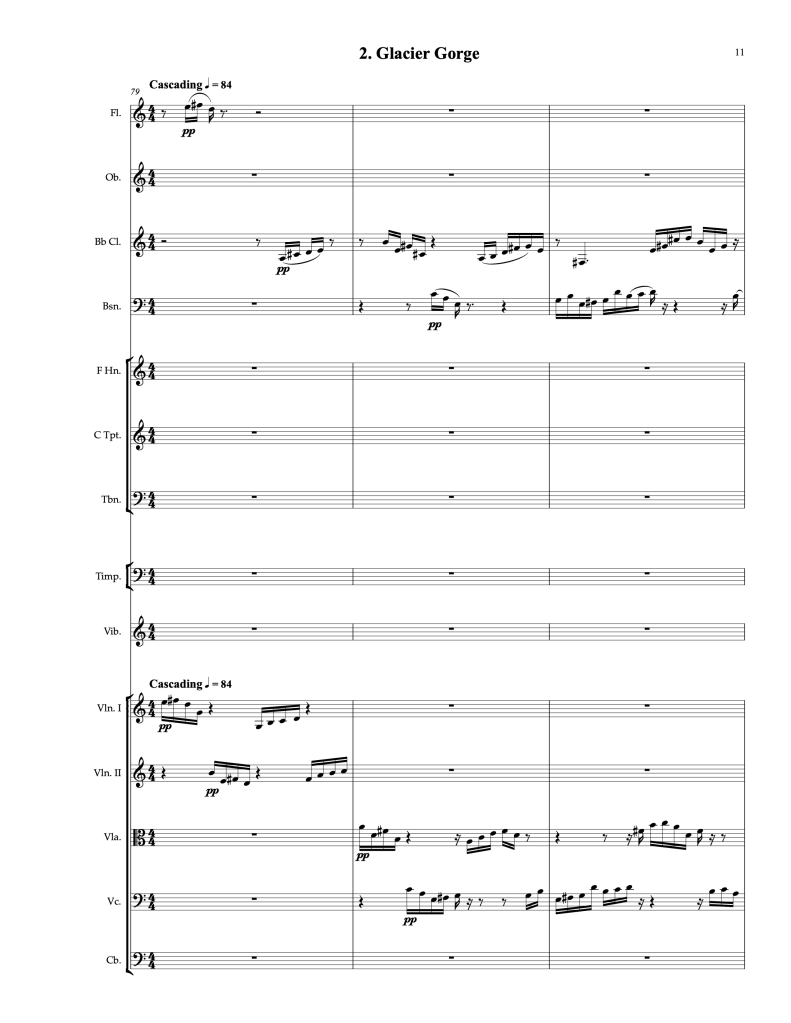
    Downward plunging arpeggios experience relentless musical gravity, sounding out the energetic fall of whitewater over boulders.

    2. Glacier Gorge

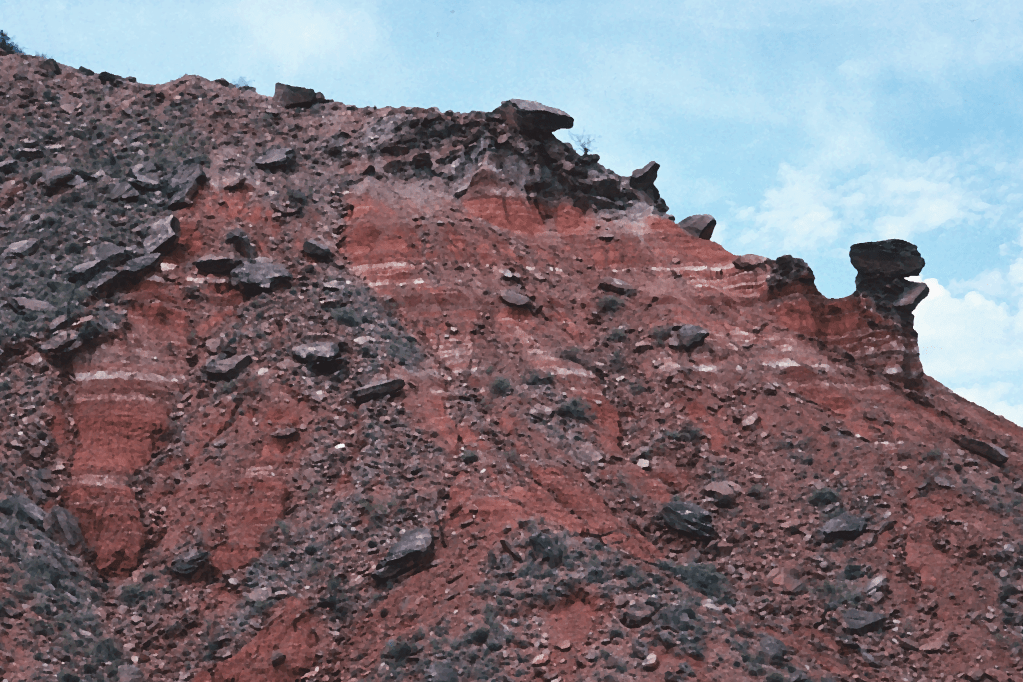
    Gently changing kaleidoscopic sonorities and a slow descending progression of pitch constellations to stillness express the timeless quiet of Palo Duro Canyon.

    3. Palo Duro dusk

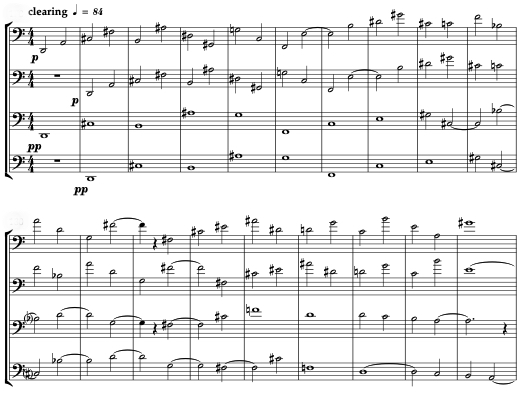
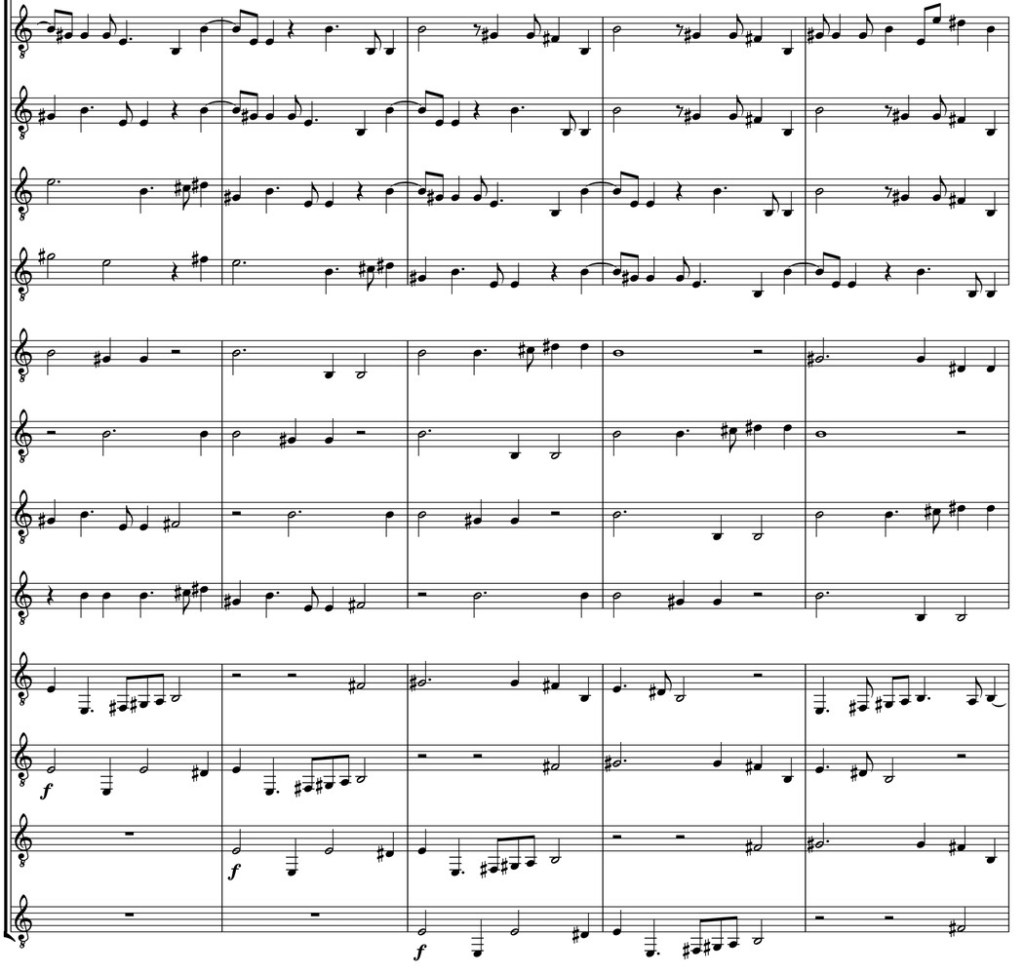
    Score excerpts:

    Email the composer to request a PDF of the complete 47-page full score and 14 parts.

    tc24@txstate.edu

  • Black Canyon

    2024 . . . Meditative sound environment.

    Colorado’s Black Canyon of the Gunnison lies between narrow, tall rock cliffs of metamorphic Precambrian gneiss and schist formed 1.7 billion years ago crosscut by lighter-colored streaks of pegmatite. Due to the canyon’s depth and narrow width, its river falls from the Continental Divide in continual shadows.

    This piece takes musical counterpoint from The Book of Canons. An ancient form of Rumpelstiltskin magic, canon spins complex counterpoint out of a single melodic subject that is echoed after some delay by one or more answering lines of identical rhythmic values and melodic shape (possibly transposed).

    The art of canon pervades much of my 21st-century writing, a challenging yet stimulating and gratifying approach to texture weaving with continuous strands of material. The Book of Canons collects excerpts from these works, showing each canon’s subject as well as points and pitch levels of answers, worked out in three voices.

  • Forest Paths

    from

    Book of Canons

    2022 . . . Sound environment (18 minutes)

    My compositional fascination with musical canons began in the early 1970s with study (at the University of Michigan) of Ockeghem’s 15th-century polyphony, the 10 canons in Bach’s 18th-century The Musical Offering, and Webern’s 20th-century Symphonie Op.21. As a young professor in the 1980s teaching 16th-century counterpoint at what was then North Texas State University (now UNT), I used canon as a challenging contrapuntal writing assignment. In 1985, a wind ensemble piece, Parallel Horizons (Homage to Schoenberg), was my first formal composition constructed by canon. In Dark Matter, other contrapuntal writing surrounds an extended canon. Now canon pervades much of my 21st-century writing, a challenging yet stimulating and gratifying approach to texture and continuity of material.

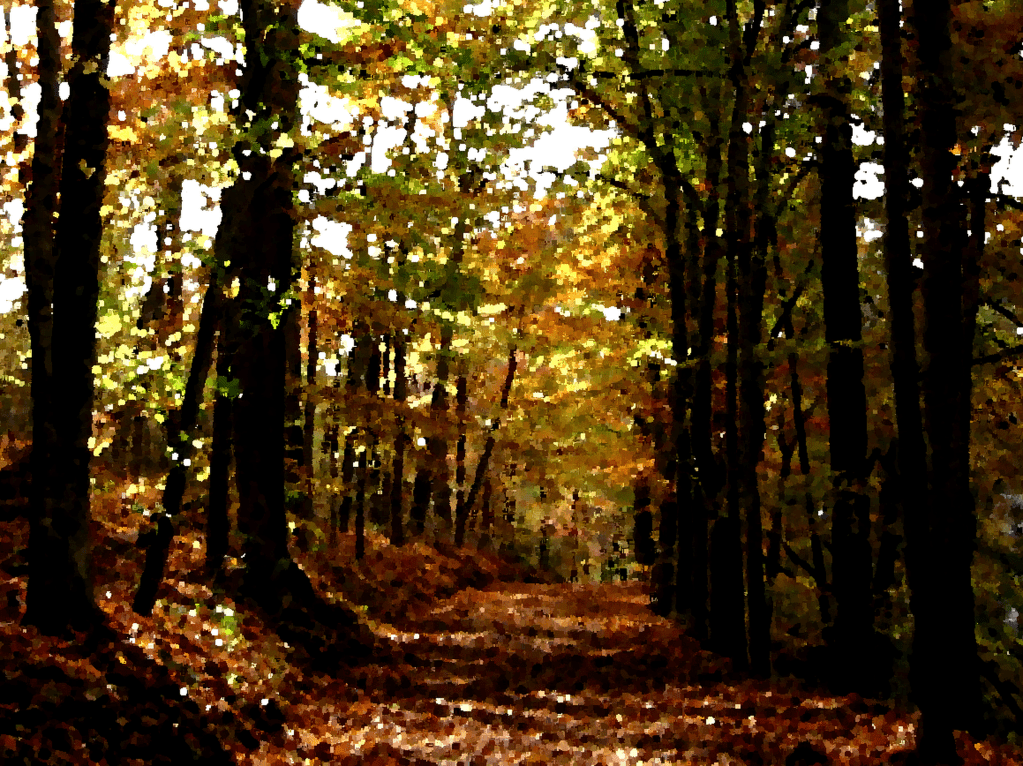
    Book of Canons collects 14 excerpts from these works, showing each canon’s subject, points and pitch levels of answer, and sounding each excerpt scored as a string trio. Forest Paths stitches them together in an ambling journey along a path through a metaphorical sound environment of sunlight, shadows, and leaf-fluttering breezes.

  • Sinfonia

    2021 . . . chamber orchestra (Flute, Oboe, Clarinet, Bassoon, 2 Horns, C Trumpet, Trombone, Timpani, Percussion, Strings)

    Duration: 21 minutes in three movements – I. 8 min.; II. 8 min.; III. 5 min.

    Mozart’s Jupiter Symphony is one of his greatest masterpieces. His No. 40 in G Minor and No. 38 “Prague” are also magnificent. It makes one wonder if he had lived longer, what other stunning music would have poured forth. Back to No. 41 Jupiter, the first theme is a curving melody of such rhythmic vitality and fascinating turning shape that I used it as an example of both in my ebook, Mapping the Music Universe. Mozart makes the theme into a fugato, and I have adopted it in my obsessive study of canons. You can see the shape of its first six notes in the violin opening of Jupiter Rising, then elsewhere it permeates the contrapuntal material of the rest of the piece. The middle movement takes a break from it, setting the main themes from the opening of the G Minor No. 40 as a languid tango tune, followed by a trio in slow waltz meter that reverts briefly back to the bright Jupiter tune. The final movement actually extends our signature Jupiter theme into a 12-tone row, generating a more expansive tonality in its animated landscape.

    I. Jupiter Rising depicts the mysterious splendor of moonrise, large and deeply-hued in the eastern evening sky. This movement creates a sonic metaphor for that visual phenomenon, but portraying instead the rising of Jupiter, the largest object in the solar system other than the sun itself. It only looks much, much smaller to us than the moon because it is so much farther away. My favorite Mozart symphony is Symphony No. 41 in C Major, K.551. His longest and last symphony, it is nicknamed “Jupiter” — fitting that his lengthiest and greatest symphony is named for the largest planet, a great gas giant. A vivid musical motive begins and generates the majestic final movement. I use it as the musical subject of this movement, relentlessly canonic in deployment. At some moments, as many as 8 contrapuntal soundings overlap each other in a gentle, cloud-like texture.

    II. Tango is set in an actual key, appropriate for this venerated dance form though uncharacteristic for my writing. The harmonies flow like dancers, the musicians feeling their way through the tonalities while never seeing an actual key signature.

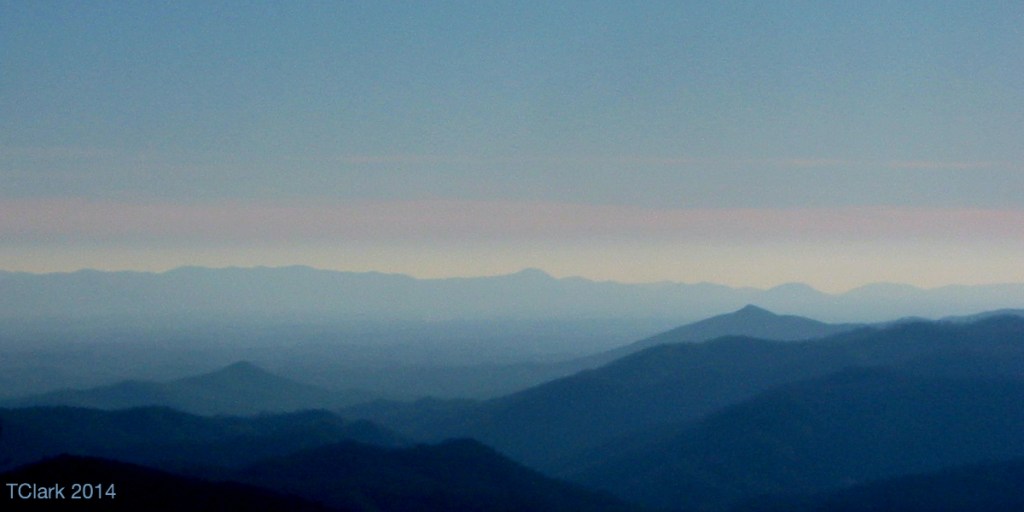
    III. Blue Ridge refers to the beautiful hazy curves on the horizon as one gazes out from the top of the Blue Ridge Parkway, an hour west of my former home in the Piedmont in North Carolina. I also remember a similarly mystic vista looking south from Monterrey, Mexico toward the foothills of the Sierra Madre Oriental mountains. The musical fabric is what I have called an “animated landscape,” not a still postcard but a soaring flight over and through the soundscape.

  • Looking for the Rainbow

    2021 . . . . cello quartet or cello choir . . . . duration: 9 minutes

    Written during the COVID pandemic for Karla Hamelin and her Texas State cello students, Looking for the Rainbow expresses both the uncertainty and hopefulness in our collective struggle to survive the storms of disease and violence.

    A prequel to Rainbow Rising (2016), an earlier canonic piece for cellos, Looking for the Rainbow explores a more complex rhythmic counterpoint of darker sonorities, evoking a restless spirit of searching, anticipating.

    (Canon is an ancient compositional technique, a melodic line that while in progress is closely echoed in one or more other “voices” to weave an entire contrapuntal texture out of matching threads.)

    To request performance materials and permission, email the composer, tc24@txstate.edu.

  • Sacred Springs

    2020 . . . . trombone or euphonium and piano . . . . duration: 7:50

    Peaceful Spring Lake and the San Marcos River flow from ancient springs emanating up from the Edwards Aquifer in the Texas Hill Country. For centuries, Native American tribes considered these powerful springs a sacred place where they worshiped eternal spirits. In the 20th century, the springs became the centerpiece of a famous recreation resort, Aquarena Springs. Now that the park has been restored to its original natural habitat, it remains a place of beauty and spiritual contemplation.

    The main tune of Sacred Springs is based on a 15th-century English carol, a graceful tune that became the melody for the lyrical modern hymn, “O Love, How Deep.” The melody’s canonic treatment, both in somber chant and spinning ostinato, continues my modern obsession with that ancient musical technique.

    To request performance materials, email the composer, tc24@txstate.edu.

    COMPLETE SCORE

  • Flanders Canon

    2020 . . . . . . . for 8, 12, or 16 guitars. . . . . . . duration: 6:40

    Merging two fascinations, musical canons and the contrapuntal style of 15th-Century Flemish composers, this work sets in modern style a wonderful quadruple canon of the period (composer uncertain). The style difference, though, is subtle: the 2oth-Century explorations of some American composers (Riley, Reich, Adams) involved hypnotic overlapping ostinato repetition of diatonic patterns much like this magical Medieval canon.

    To request performance materials and permission, email the composer, tc24@txstate.edu.

  • SUSPIRA

    Canonic meditation on the Salve Regina chant      2017       computer music     duration  5:30