Tag: Earle Brown

  • GEODES

    2025 . . . 17 winds / percussion . . . 12:30

    In the midst of my recent Impressionistic “Sketches” series, the 2024 piece Folio was a throwback to the more abstract sound mass style of the 1960s and ’70s. Its percussive attacks and inert masses of sound were all synthesized, also throwbacks to my early days of electronic tape music. (One of the earliest electronic compositions, Stockhausen’s 1960 Nr. 12 Kontakte, was full of sounds like giant steel beams hitting a concrete floor!) The other retro feature of Folio is suggested in its title: homage to Earle Brown’s 1952 FOLIO, a collection of abstract art scores in stark, proportional graphic notation.

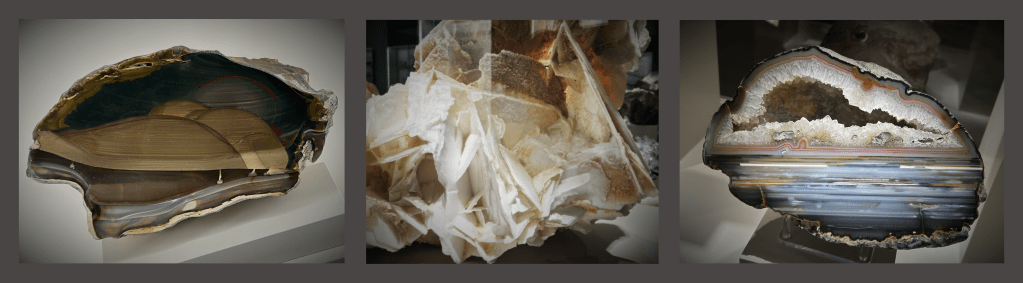
    This wind and percussion transformation of Folio was challenging. But I thought about the chaotic boldness of rocks — my own collection of many found on beaches and hikes, but also splendid displays at three places: Dick’s Rock Shoppe in Estes Park, Colorado; Lizzadro Museum of Lapidary Art in Elmhurst (now in Oak Brook), Illinois; and a wonderful gallery of geodes at the Permian Basin Petroleum Museum in Midland, Texas. Geodes are Nature’s sculptures, inscrutable gray rocks that, when sawed open, reveal magical worlds of dazzling-colored crystal structure.
  • FOLIO

    2024 . . . 16:36

    In the 1950s, the New York School of composers, John Cage, Morton Feldman, Christian Wolff and Earle Brown led a mid-century American avant-garde movement with their radical musical experiments. Brown in 1954 published his Folio and Four Systems, a collection of striking abstract-sound compositions emblematic of his concept of “open form.” They were minimalist both in material and somewhat in notation, inspired by the abstract art of Alexander Calder and Jackson Pollock. The famous score of Brown’s Dec.’52 in the Folio was just a stark rectilinear graphic of black rectangles separated in white space.

    My massive project, Animated Landscapes – Sketchbook for Small Orchestra took Impressionist art as its inspiration. Wanting now to turn a fresh aesthetic page, I actually turn back to my own avant-garde experimental roots of the 1960s and ’70s. This FOLIO is a collection of 2024 abstract sound sculptures, in the form of mobiles: sound-mass textures that reappear in various orders and combinations. Following Brown’s model, their subtitles are dates referring back to significant times and places in my personal history — a kind of musical memoir.

    The first mobile, Aug ’76 (Ann Arbor), builds massive sonorities isolated by silent time-space, similar to some of Morton Feldman’s piano music. The second, Dec ’86 (Denton), pays homage to Brown’s Folio with playful pointillism. My next Folio page, July ’17 (Good Harbor Bay), captures the rhythms of sparkling sunlight on windblown Lake Michigan. And the last, June ’24 (San Marcos), is directly inspired by Brown’s Dec.’52 in its narrow palette of static sound blocks, separated by lots of silent time-space in open form.