2022 . . . digital sound sculptures . . . (9:30)
Nimbus
Modern physics understands that all matter is built up from just five fundamental “particles”: electrons, up quarks and down quarks with electrical charge; and gluons and photons with no electrical charge. They are not exactly particles, though, but infinitesimal points of spin in space/time. That’s where this sound composition experiment began. Two 4-pitch segments of the octatonic scale appear (“quarks”), then spin at their own speeds, while smaller 3-pitch sets (“electrons”) spin above and below them. At times, the sound mass explodes with a shower of electron sparks, then reforms.
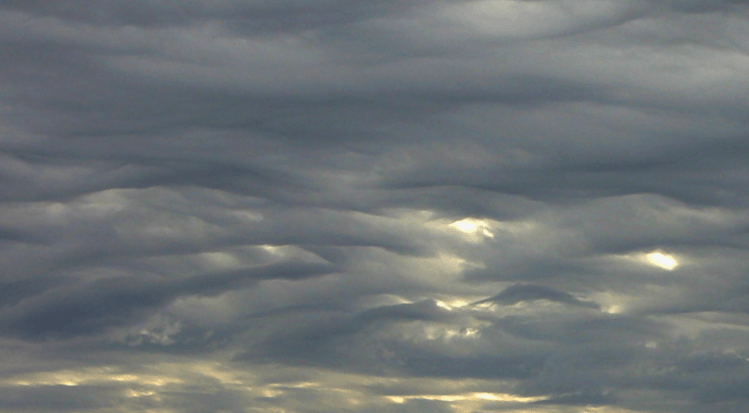
While quarks are hard to imagine and impossible to visualize, we love to watch puffy white cumulus clouds. Their kinetic energy becomes more visible when they grow into dark, precipitation-bearing cumulonimbus storm clouds, bringing rain and crackling electricity.
Squall

A tree limb branching out from a trunk, then smaller limbs branching from it, again and again to smaller and smaller branches — a classic example of a recursive process. Sometimes lightning shows this same recursive branching process. While the tree branches take years to fill out, lightning is a sudden explosion of electricity over a split second. Thunder, as sound travels much slower than light, is heard later than the lightning flash is seen — unless, of course, it is very close by!
 Thomas Clark - composer / digital artist