Tag: music

  • Musique Française

    Having begun composing in 1963, I started formal composition study in 1968 at the University of Michigan in Ann Arbor. American composer Eugene Kurtz, based in Paris but filling in that semester at Michigan, was assigned to teach the new freshman. A proponent of modern French music, his compositional models included Debussy and Ravel.

    Kurtz assigned me to immerse myself in deep study of their music, in particular Ravel’s Sonatine (1905).

    Judith Valerie Engel on YouTube

    Fifty years later in my career as a more experimental composer, my compositional style began to mellow toward this gentler Impressionistic approach and a lush, bright harmonic language reminiscent of Debussy and Ravel.

    An Homage to Ravel, my new Sonatine is spun from a single harmonic progression, seven chords each stacking a Perfect Fifth interval high above another.

    This material (what Schoenberg would call a Grundgestalt) generates melodic lines and many arpeggiation patterns, in successive variations of changing register, intensity, and rhythmic pace.

    Clark 2025 (TC-00)

    In 1907, French composer Claude Debussy wrote, “I am more and more convinced that music, by its very nature, is something that cannot be cast into a traditional and fixed form. It is made up of colors and rhythms”. Color, light, and texture were also the hallmarks of a new style of painting developed by French artists — Impressionism.

    At the threshhold of the 20th century on 15 December 1899, Debussy completed the first of his Impressionist masterpieces for orchestra, Trois Nocturnes. He avoided labeling it “symphony” or “tone poem” by calling the movements “three symphonic sketches”. The first sketch of Nocturnes is subtitled “Nuages,” premiered on 9 December 1900 in Paris.

    Debussy’s biography describes the genesis of the piece while crossing the Pont de la Concorde in Paris in stormy weather. The composer’s notes say, “‘Nuages’ renders the immutable aspect of the sky and the slow, solemn motion of the clouds, fading away in grey tones lightly tinged with white.”

    Vienna Philharmonic on Youtube

    Adopting the French language and musical style recognizes the early French explorers of the Great Lakes region of North America. The first decades of my life began there in Michigan’s Lower Peninsula (the “mitten”). It has its own smaller Leelanau Peninsula in the northwest corner (the mitten’s “little finger”) near Interlochen’s National Music Camp, where I spent many summers. Nearby Grand Traverse Bay has its own even smaller Old Mission peninsula, where I loved to visit its lighthouse. The Leelanau has a grand lighthouse at its northern tip and a scenic drive, state highway M21, winding for 64 miles all the way around the peninsula’s shoreline, through forests and past the Great Sleeping Bear Sand Dunes.

    In 1984 my piece titled PENINSULA for piano and sound synthesis was a more experimental work that traced a map of the Leelanau and its landmarks to determine by their spatial coordinates the timing and pitches of sound constellations.

    Moving forward from that mapping phase of my compositions, my Impressionistic phase produced the sound sculpture Leelanau Sketches in 2022. Some of its musical material reappears now in five symphonic sketches, Belle Péninsule. Here is the fourth movement, which quotes Debussy’s “Nuages.”

    IV. “Nuages blanc

    Clark 2024 (TC-147)

    Debussy’s completed his second composition of three symphonic sketches for orchestra, La Mer, in 1905. It is a monumental work of Impressionist sound-painted textures and a textbook model of lush, beautiful orchestration. The three sketches are titled:

    “De l’aube à midi sur la mer”

    “From dawn to midday on the sea”

    “Jeux de vagues”

    “Play of the Waves”

    “Dialogue du vent et de la mer”

    “Dialogue of the wind and the sea”

    My homage to La Mer, Sea Sketches, sound-paints waves, deep currents, wind, and sun-sparkling surfaces, employing swelling sound colors and post-modern cyclic techniques in a pan-diatonic tonal setting. The end briefly quotes the opening arpeggio of Debussy’s “La fille aux cheveux de lin” (“The Girl with the Flaxen Hair”) from Book I of his Préludes for piano (1909-1910).

    Clark 2023 (TC-132)

  • Tonal color

    In notes on a recent composition, Frost Serenade, I described “changing tonal temperature.” Here is a deep dive into what that meant.

    The metaphor of tonal color and temperature has to do with what we normally call consonance and dissonance in a chord or other harmonic entity.

    Centuries-old tradition classified musical pitch-intervals as pure, perfect consonances (“Perfect Fifth” and “Perfect Octave” for example); major or minor (exp. “Major Third” or “minor Sixth”); or problematic (“Augmented Fourth” and “diminished Fifth”). Some major and minor intervals (thirds and sixths) were considered imperfect consonances; the others (seconds and sevenths) were considered dissonant. Every music student learns these categories while studying 16th-century model counterpoint.

    Using the color spectrum in temperature order:

    Let’s convert the consonance/dissonance concept to think of a pitch-interval’s acoustic complexity. Every musical tone has a fundamental pitch, plus faint overtones that give the sound its color. They are of fading intensity and felt (as color) more than actually heard as the distinct pitches they are. Discovered by Pythagoras as partial vibrations in whole-number fractions, the overtones are always in a fixed interval ladder rising from the fundamental: Up an octave, then a Perfect Fifth, then a Perfect Fourth, a Major third, minor third, then to the eccentric seventh partial, which is out of tune by our scale-trained pitch perception (and shown a darker gray below), and on to the eighth partial, which is three octaves above the fundamental. (An octave is a multiply-by-2 operator, so partials 2, 4, 8, and 16 of the C overtone series are also the pitch-class C. Likewise, partials 3, 6, and 12 are all octave related.)

    Two different fundamental pitches sounding together each bring into the acoustical mix their distinct overtones. The overtones from one either match (simple) or clash with (complex) overtones of the other. This is what makes the sonic complexity or perceived purity of the interval between two fundamental pitches. Using this relationship, we theorize that the higher we need to go to start finding matching overtones between the two pitches, the more complex is the interval. Following this logic, here is an overtone-match analysis of all harmonic intervals smaller than an octave.

    PERFECT CONSONANCES

    The rather pure Perfect Fifth interval between fundamental pitches, C up to G, matches overtones at G’s partial 2, a low level in the series, matching the C’s partial 3. The interval makes four such matches in this lowest-two-octaves span. The pitch match up of the G’s 2nd partial with the C’s 3rd partial (both are the same pitch, G) will be duplicated in all higher octaves, making this an acoustically simple interval. The two pitches’ overtones mostly match and don’t interfere with each other much.

    IMPERFECT CONSONANCES

    The triadic consonant Major 3rd interval between fundamental pitches, C up to E, matches overtones at a somewhat higher level in the series, partial 4, and makes two matches in this lowest-two-octaves comparison.

    DISSONANCES

    The dissonant minor 7th interval between fundamental pitches, C up to Bb, matches overtones makes only one match in this lowest-two-octaves comparison, at partial 5. That means its harmonic quality is more complex, with most of the lower overtones interfering, not matching. Not a strong dissonance, but more complex than the others.

    By contrast, with the more complex Major Seventh interval (ex. C up to B), you have to go all the way up three octaves to the B’s 8th partial (matching the C’s 15th partial!) to find an overtone that matches and doesn’t conflict/interfere. The Major 7th interval can be considered much more complex at a rating of 8 than a Perfect 5th at rating 2.

    The most complex interval analyzed, the minor 2nd, clashes all the way up until the 15th partial.

    Summarizing the analysis with a complexity rating number for each interval:

    minor 2nd = 1 semitone
    15
    Major 2nd = 2 semitones
    8
    minor 3rd = 3 semitones
    5
    Major 3rd = 4 semitones
    4
    Perfect 4th = 5 semitones
    3
    Augmented 4th = 6 semitones
    10
    Perfect 5th = 7 semitones
    2
    minor 6th = 8 semitones
    5
    Major 6th = 9 semitones
    3
    minor 7th = 10 semitones
    5
    Major 7th = 11 semitones
    8

    Now we can add up the ratings of each interval in a chord and take an average complexity quotient. And we can think of complex as darker than simple, or we can invoke the color spectrum. In digital photo imaging, we use a temperature metaphor, seeing red as warmest (infrared heat) down through orange, yellow, green, down to blue, the coolest. The “hottest,” most complex harmonic interval is the minor 2nd. The “coolest,” purest (other than the octave) is the Perfect 5th.

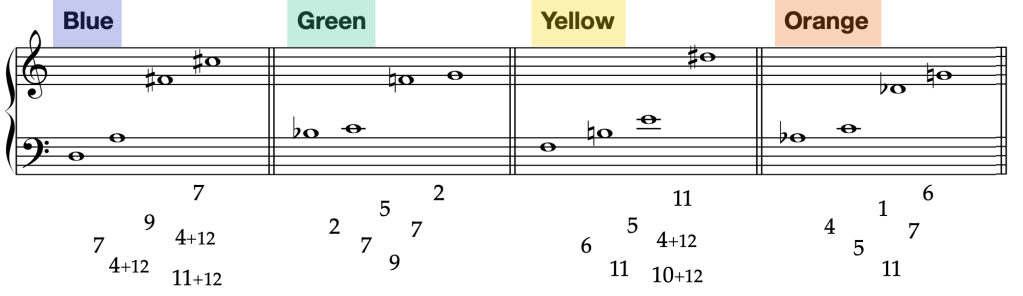
    The intervals in the following example are shown in semitones. Each chord has four pitch classes and six intervals between them. The Blue chord has an average complexity rating of 3.8. Green chord is slightly more complex, at 4.3. Yellow, which includes the more complex 11-semitone Major 7ths, rates 5.5. And Orange, with the only minor 2nd 1-semitone hot dissonance, is warmest at 6.2. Try to hear the differences. (No attempt here to demonstrate a red-hot cluster mashup of pitch!)

    Here is a little demonstration phrase using those four chord types to build a progression of tonal temperature colors. Again, as you listen, try to feel the temperature warm up then cool back down.