Tag: oboe music

  • Webern Elegy

    Vienna, 15 September 1945

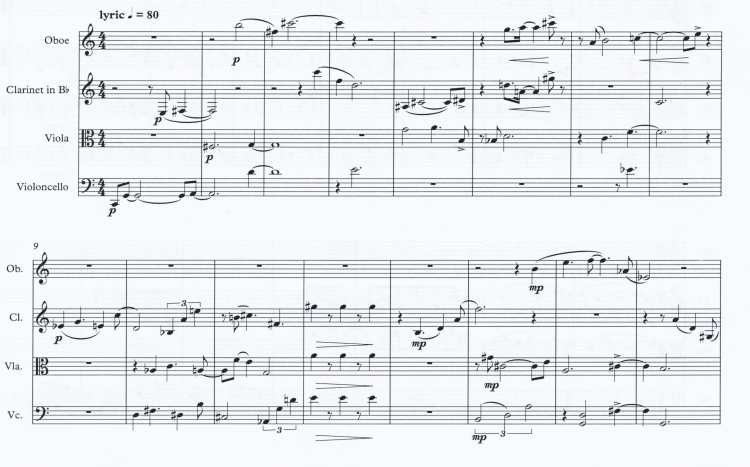
    Oboe, Clarinet, Viola . . . or Clarinet, Piano . . . or Viola, Piano (5 min.) TC-115 (2021)
    COMPLETE TRIO SCORE
    COMPLETE SCORE for CLARINET & PIANO
    COMPLETE SCORE for VIOLA & PIANO

    I have long admired and been influenced by the music of early 20th-century Austrian composer Anton Webern. Known historically as a member of the Second Viennese School with Alban Berg and mentor Arnold Schoenberg, the three were pioneers of so-called atonal music and 12-tone-row serial harmonic organization. I find the term “atonal” misleading and negative, as their 12-tone processes achieved new “12-tone tonalities” — not simply a rejection of traditional tonal harmony but also striving to create new and more complex tonalities.

    What I admire most about Webern’s mostly-quiet instrumental miniatures (his Symphonie has only two sparsely-scored movements) is the delicate, crystalline quality of his pitch constellations; and their gently lyric, precious setting into transparent textures, pearl-strings of delicate sound colors ( called Klangfarbenmelodie). Here is a transcription for chamber orchestra with sound color much like Webern’s Symphonie Op. 21:

    Webern’s mentor, Schoenberg, as a Jew was compelled to emigrate to the U.S. in 1933 before it was too late. Webern, not Jewish, stayed in Vienna and survived World War II, only to be fatally shot by a U.S. Army soldier during the Allied occupation of Austria.

  • Webern Elegy

    Vienna, 15 September 1945 – five miniatures

    2021 . . . . for the Pleasant Street Players — Ian Davidson (oboe), Vanguel Tangarov (clarinet), Ames Asbell (viola) . . . . duration: 5 minutes

    Clarinet shows transposed (not concert) pitches

    I have long admired and been influenced by the music of early 20th-century Austrian composer Anton Webern. Known historically as a member of the Second Viennese School with Alban Berg and mentor Arnold Schoenberg, the three were pioneers of so-called atonal music and 12-tone-row serial harmonic organization. I find the term “atonal” misleading and negative, as their 12-tone processes achieved a new “12-tone tonality” — not simply a rejection of traditional tonal harmony but also striving to create new and more complex tonalities.

    What I admire most about Webern’s mostly-quiet instrumental miniatures (even his Symphonie has only two sparsely-scored movements) is the delicate, crystalline quality of his pitch constellations; and their gently lyric, precious setting into transparent textures, pearl-strings of delicate sound colors ( called Klangfarbenmelodie).

    Webern’s mentor, Schoenberg, as a Jew was compelled to emigrate to the U.S. in 1933 before it was too late. Webern, not Jewish, stayed in Vienna and survived World War II, only to be fatally shot by a U.S. Army soldier during the Allied occupation of Austria.
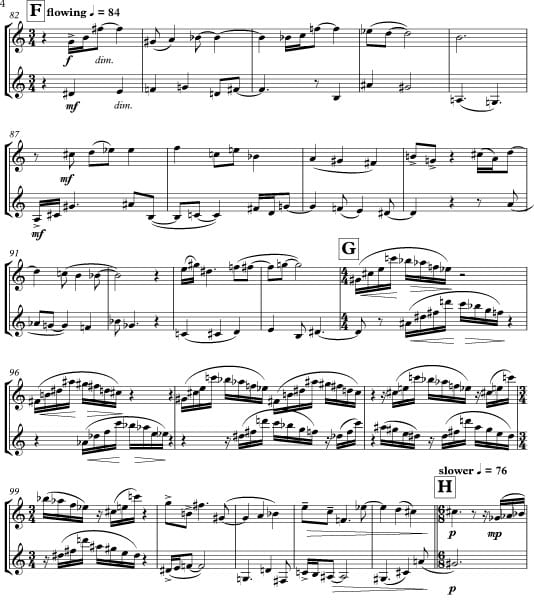
    Synthetic rendering of sample excerpt from movement II:

    Synthetic rendering of sample excerpt from movement V:

  • Sur la Neige

    Sur la Neige

    2019            oboe, clarinet            duration: 8 minutes

    Written for Pleasant Street Players Ian Davidson and Vanguel Tangarov, colleagues at the Texas State School of Music, Sur la Neige is a snow fantasy on three quoted musical ideas. The work begins with an obscure quote from Stravinsky’s L’Histoire du Soldat, elaborated and then transitioning into a quote from Debussy’s Prelude No. 6 in his Préludes, Book I, subtitled “de pas sur la neige.” “Eventually, a small decorative figure from Janácek’s Sinfonietta appears and quickly disappears like a scurrying bystroušky (fox).

    Two memories of walking in the snow stand out in long-term memory. In about 1965, one recreation of a restless Michigan teenager on winter nights was to put on boots and parka and hike through snow-covered fields and forest in the moonlight. In 1992, my composer friend Arnošt Parsch led me on a walk into the logging forest above his Moravian village, Bílovice nad Svitavou. Through late-fall snowflakes, we retraced the steps of Janácek, passed the natural-spring well and the Sokol tavern up to a beautiful promontory view of the snow-covered village below.

    MIDI preview:

    To request performance materials and permission, email the composer, tc24@txstate.edu.

  • Karlův Most (Charles Bridge)

    2018     oboe, clarinet, viola, cello.    Duration 7:30

    Middle in a series of three works (following Hukvaldy Sketches and preceding Climbing Blaník) inspired by Czech culture and written for the Pleasant Street Players, Ian Davidson, Vanguel Tangarov, Ames Asbell, and their musical associates.

    The stone Charles Bridge spans the great Vltava in Prague, connecting Old Town to the Lesser Quarter’s St. Vitus Cathedral and Presidential Palace. Built in the 14th century, its 16 arches are guarded at each end by magnificent bridge towers typical of Prague‘s Gothic architecture. Some 30 statues watch over peddlers and a constant stream of local and tourist pedestrians. To be among them always evokes strong feelings of history and the joy of Bohemian life.


    To request performance materials and permission, email BMI-affiliated composer Thomas Clark, tc24@txstate.edu