Tag: Ockeghem

  • Forest Paths

    from

    Book of Canons

    2022 . . . Sound environment (18 minutes)

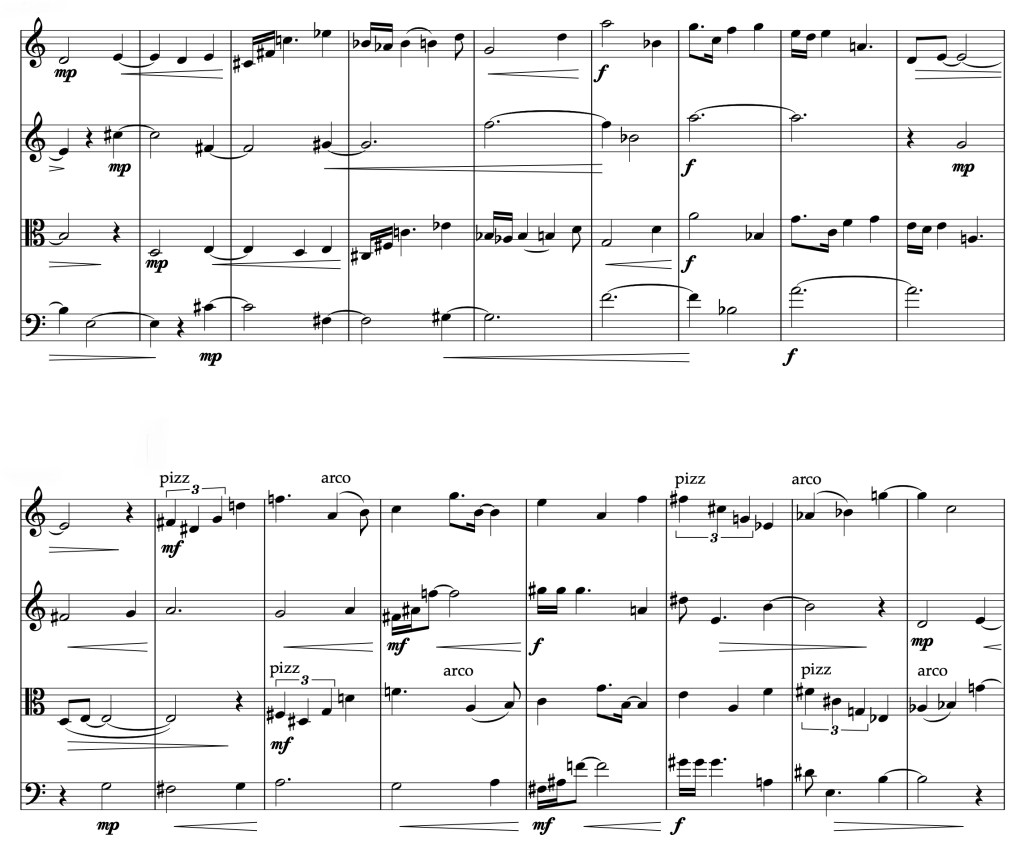
    My compositional fascination with musical canons began in the early 1970s with study (at the University of Michigan) of Ockeghem’s 15th-century polyphony, the 10 canons in Bach’s 18th-century The Musical Offering, and Webern’s 20th-century Symphonie Op.21. As a young professor in the 1980s teaching 16th-century counterpoint at what was then North Texas State University (now UNT), I used canon as a challenging contrapuntal writing assignment. In 1985, a wind ensemble piece, Parallel Horizons (Homage to Schoenberg), was my first formal composition constructed by canon. In Dark Matter, other contrapuntal writing surrounds an extended canon. Now canon pervades much of my 21st-century writing, a challenging yet stimulating and gratifying approach to texture and continuity of material.

    Book of Canons collects 14 excerpts from these works, showing each canon’s subject, points and pitch levels of answer, and sounding each excerpt scored as a string trio. Forest Paths stitches them together in an ambling journey along a path through a metaphorical sound environment of sunlight, shadows, and leaf-fluttering breezes.


  • Canzona 1497

    Canzona 1497

    Canons for antiphonal brass . . . 2020 . . . duration: 7 minutes

    The death of the great Flemish composer Jan Ockeghem in 1497 marked the end of Western Music’s Medieval style period. The most famous composer of the late 15th century, Ockeghem’s style of choral music was intensely contrapuntal, filled with canons, and freely exploratory in harmony and form. Josquin, already emerging as the great pioneering composer of the early Renaissance, revered Ockeghem, as do I. The first part of Canzona 1497 explores such canonic contrapuntal structures in a modern harmonic setting. While the second part settles into a more Medieval harmony of simple diatonic lines, both parts of the piece indulge in a striking Ockeghem idea: spinning repetitive contrapuntal material in a texture that is paradoxically animated in surface but stationary in prolonging one sustained harmony. I hear this feature of Ockeghem’s music as an ancestor to the mid-20th-century ostinato music of American composers Terry Riley, Steve Reich, John Coolidge Adams . . . and me.

    To request performance materials and permission, email the composer, tc24@txstate.edu.

  • Dark Matter

    2019      string quartet     duration: 7 minutes

    Excerpt:

    My compositional fascination with musical canons began in the early 1970s with study (at the University of Michigan) of Ockeghem’s 15th-century polyphony, the 10 canons in Bach’s 18th-century The Musical Offering, and Webern’s 20th-century Symphonie Op.21. As a young professor in the 1980s teaching 16th-century counterpoint at what was then North Texas State University (now UNT), I used canon as a challenging contrapuntal writing assignment. In 1985, a wind ensemble piece, Parallel Horizons (Homage to Schoenberg), was my first formal composition constructed by canon. In Dark Matter, other contrapuntal writing surrounds an extended canon.

    According to Wikipedia: “Dark matter is believed to be a form of matter thought to account for approximately 85% of the matter in the universe and about 27% of its total mass–energy density. Its presence is implied in a variety of astrophysical observations, including gravitational effects that cannot be explained by accepted theories of gravity unless more matter is present than can be seen. For this reason, most experts think that dark matter is abundant in the universe and that it has had a strong influence on its structure and evolution. Dark matter is called dark because it does not appear to interact with the electromagnetic field, which means it does not absorb, reflect or emit electromagnetic radiation, and is therefore difficult to detect.”

    To request performance materials and permission, email the composer, tc24@txstate.edu.