How do prime numbers sound? Or Pi, or the Fibonacci series? It depends completely on how these patterns are interpreted as sound.
This YouTube podcast by composer/professor Thomas Clark brings them to time-life with many eclectic compositional styles of contemporary art music. Interesting number patterns are realized as intriguing sound colors, chords, melodic lines, even as the ancient musical technique of canons, over a kinetic visual background of my semi-abstract art images.
How do prime numbers sound? Or Pi, or the Fibonacci series? It depends completely on how these patterns are interpreted as sound. MATH MUSIC brings them to time life with many eclectic compositional styles of contemporary art music. Interesting number patterns are realized as intriguing sound colors, chords, melodic lines, even as the ancient musical technique of canons.
Prime Cycles . . . Fibonacci Music . . . Mystical Pi
Permutation . . . Slopes and Asymptotes . . . Golden Ratio
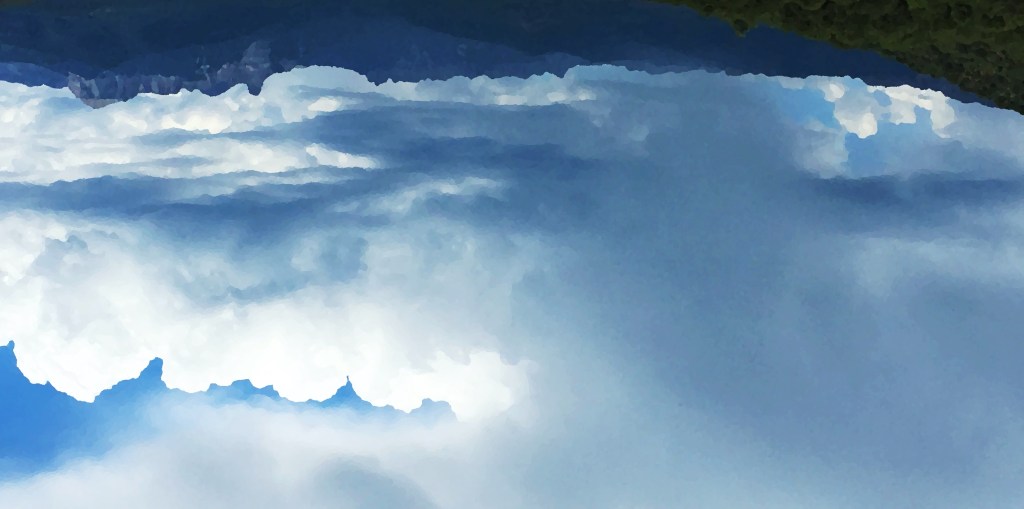
Ever since it was viewed and photographed from space (see below) by Apollo 17 in 1972, Planet Earth has become known as the Blue Planet.
The Blue Marble
Such a distant perspective reveals the pervasive blue water of oceans, brilliant white of cloud layers, and some brown/green shapes of land masses beneath. It also reveals the spherical shape of our globe. (Euclid said a sphere is a hollow 3-dimensional rotation of a circle, and scientists have measured that Earth is not a perfectly round ball but a solid ellipsoid.) Nonetheless, the eternal, perfect rotating sphere is our iconic notion of Earth’s shape. Spheres and the Euclidean circle that generates them in three dimensions are governed by the mathematical constant π, defined in Euclidean geometry as the ratio of a circle’s circumference to its diameter.
Pi is magic, an irrational number that cannot be expressed as a common fraction. Its decimal calculation never ends, never settling into a repeating pattern of digits, which appear to be random . . . and infinite. It starts 3.1415926535897932384626433…
The beginning of its decimal expression was used in composing Blue Sphere as both a rhythmic timing pattern and a corresponding dance of the lowest 9 pitches of a Pythagorean overtone series. This is one way to literally hear π, expressing musically the eternal restlessness of our rotating blue sphere.
The music is fashioned out of a small set of sound resources: simple sounds of drums, bright sounds of ringing metal instruments, and deep shining sounds of tam-tams. The piece is about these distinct timbres – only the sparkles employ any pitch constellations, and then just one “chord” that recycles kaleidoscopically. Most of all, the piece is about time and its articulation in free, ametric rhythm. In Thunder and Waves, the time patterns are governed by the digits of the magical numer Pi. In Sparkles, the timed recurrence of each pitch is determined by prime numbers. Both number schemes transcend periodicity, letting time float.
Growing up in the Great Lake State, being surrounded by three of the five Great Lakes formed a big part of my Michigander character. Since many summers working at what was then called the National Music Camp in Interlochen, my favorite was the closest, Lake Michigan. Its magnificent coast forms the western edge of the lower peninsula, stretching from New Buffalo all the way up to the Straits of Mackinac. Its waters reach from many Michigan harbor towns across to Chicago and Milwaukee. Its varied environments offer fascinating features such as sand dunes, ice dunes, and remote islands. This piece depicts three phenomena: approaching thunder echoing across the vast lake; sunlight sparkling on the cold surface; and eternal, powerful waves.
STAGING: Antiphonal, three widely separated batteries
LEFT – 4 low tom-toms, bass drum, orchestra bells
CENTER – small and large tam-tams, vibraphone
RIGHT – 4 low tom-toms, bass drum, orchestra bells