
The middle movement, “Tango,” of my 2021 piece for chamber orchestra, Sinfonia, turned out to be easily transcribed for a number of different quartets. Here’s how it sounded in a version for four saxophones premiered April 15, 2022, at Texas State University:
Corvus Quartet performers Nolan Hopkins (soprano sax), Garrett Iler (alto), Ryan Halbert (tenor), and Jack Woodruff (baritone sax) studied with saxophone professor Dr. Todd Oxford.
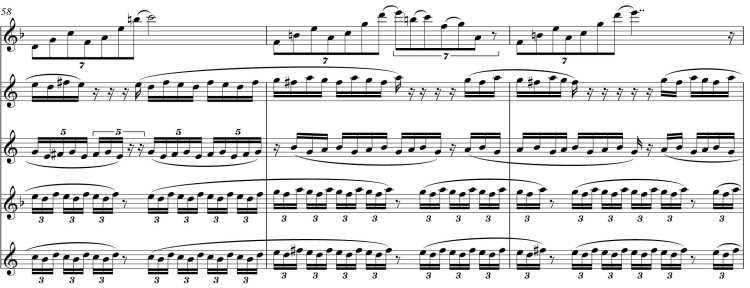
Tango is for me uncharacteristically set in actual keys, appropriate for this venerated dance form. The keys flow like dancers, the musicians feeling their way through them while never seeing an actual key signature.
Mozart’s “Jupiter” Symphony No. 41 is one of his greatest masterpieces. His No. 40 in G Minor and No. 38 “Prague” are also magnificent. It makes one wonder if he had lived longer, what other stunning music would have poured forth. Back to No. 41 Jupiter, the first theme is a curving melody of such rhythmic vitality and fascinating turning shape that I used it as an example of both in my ebook, Mapping the Music Universe. Mozart makes the theme into a fugato, and I have adopted it in my obsessive study of canons.
Tango first sets the two main themes from the opening of the G Minor No. 40 as a languid tango tune. Following is a trio in slow waltz meter whose tune is the “Jupiter” motive from Symphony No. 41. A da capo takes us back one more time to the haunting No. 40 G Minor tango tune.
 Thomas Clark - composer / digital artist