Tag: Schoenberg

  • FARBEN

    2025 . . . 17 wind/perc. instruments . . . 6 minutes

    Three pieces of the early 20th century, which I studied deeply in the 1970s and later used extensively in my teaching of modern music, were each masterful explorations of musical sound color:

    • Claude Debussy’s La Mer (1905), an iconic tone poem of Impressionistic musical painting with an orchestral palette
    • Arnold Schoenberg’s “Farben (Summer Morning by a Lake: Chord-Colors”, the third of his Five Pieces for Orchestra, Op. 16 (1909) — a gentle study of orchestral sound color
    • Anton Webern’s Symphony, Op. 21 (1928), whose first movement is a delicate gem of pointillistic color canon built on one enormous, static, symmetrical 13-pitch constellation

    After fifty years, these works are embedded more deeply than ever in my musical consciousness. Farben pays special homage to Schoenberg’s masterpiece, layering kaleidoscopic wind-instrument colors to build massive, morphing constellations, echoing Webern’s hidden chord-color symmetry.

  • Viennese Sketches

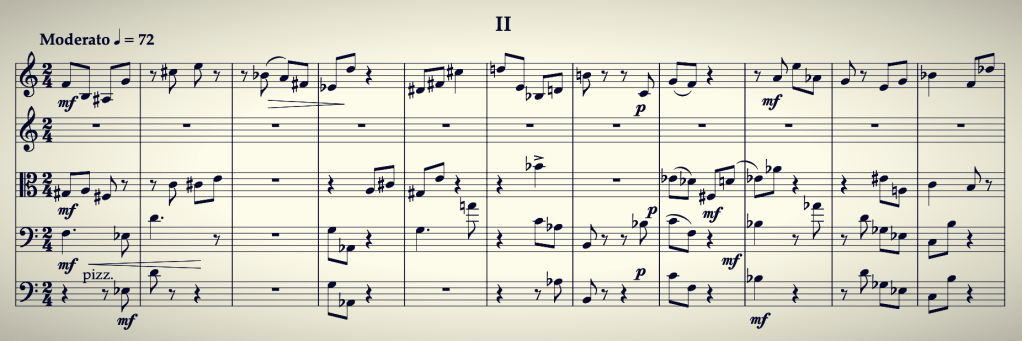
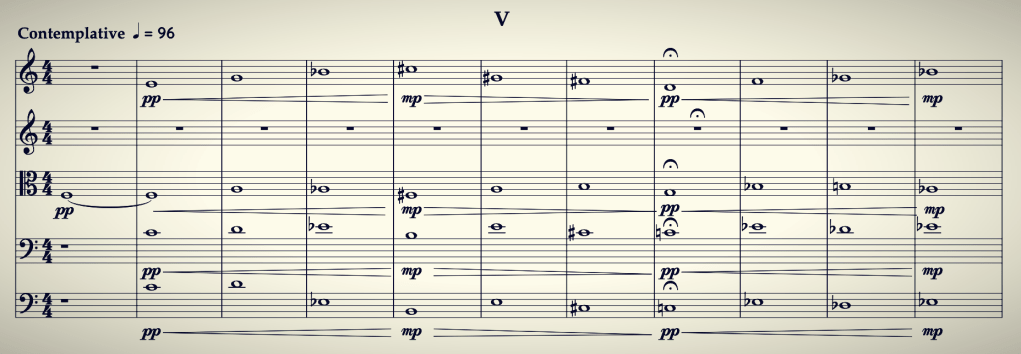
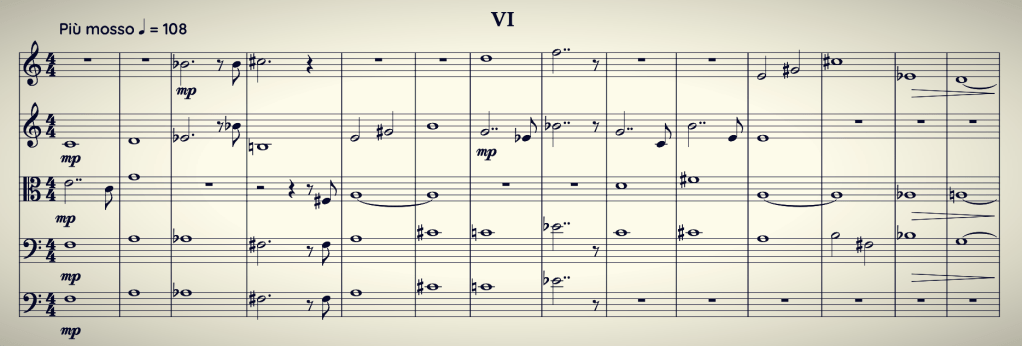
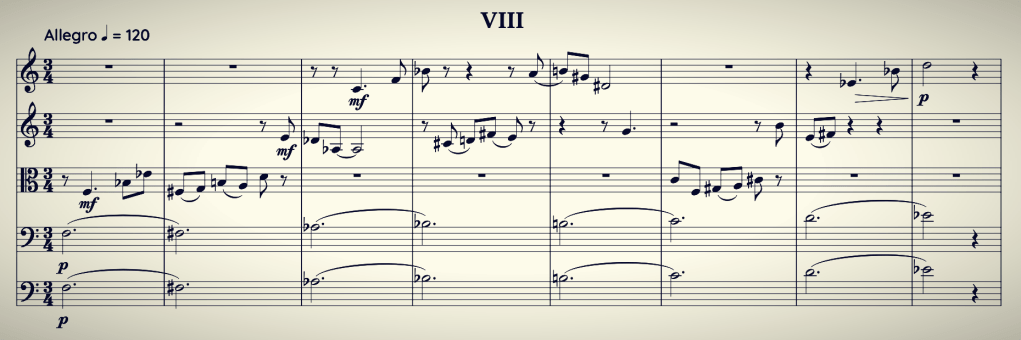
    Twelve Miniatures in Twelve Tones

    2023 . . . chamb. orch: Fl, Ob, Clar, Bsn, Hn, Trp, Tbn, Timp, Vibraphone, Strings

    12 minutes

    I have long admired and been influenced by the music of early 20th-century Austrian composer Anton Webern. Known historically as a member of the Second Viennese School with Alban Berg and mentor Arnold Schoenberg, the three were pioneers of so-called atonal music and 12-tone-row serial harmonic organization. I find the term “atonal” misleading and negative, as their 12-tone processes achieved new “12-tone tonalities” — not simply a rejection of traditional tonal harmony but also striving to create new and more complex tonalities.

    What I admire about Webern’s mostly-quiet instrumental miniatures (his Symphonie Op. 21 has only two sparsely-scored movements) is the delicate, crystalline quality of his pitch constellations; and their gently lyric, precious setting into transparent textures, pearl-strings of delicate sound colors (called Klangfarbenmelodie).

    Webern’s mentor, Schoenberg, as a Jew was compelled to emigrate to the U.S. in 1933 before it was too late. Webern, not Jewish, stayed in Vienna and survived World War II, only to be fatally shot by a U.S. Army soldier during the Allied occupation of Austria.

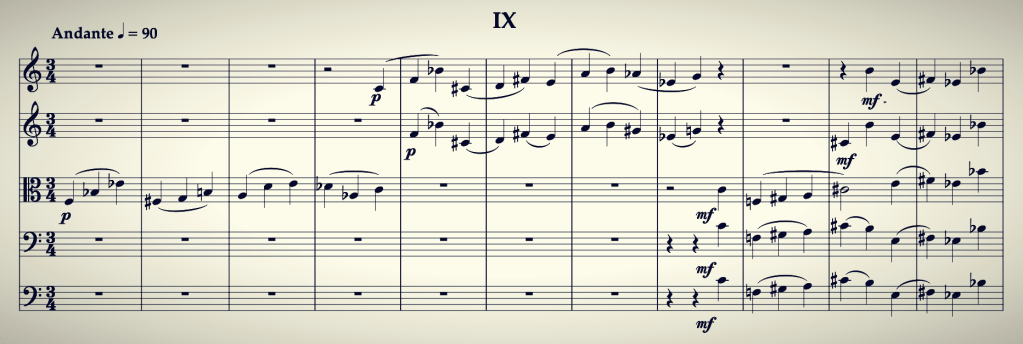
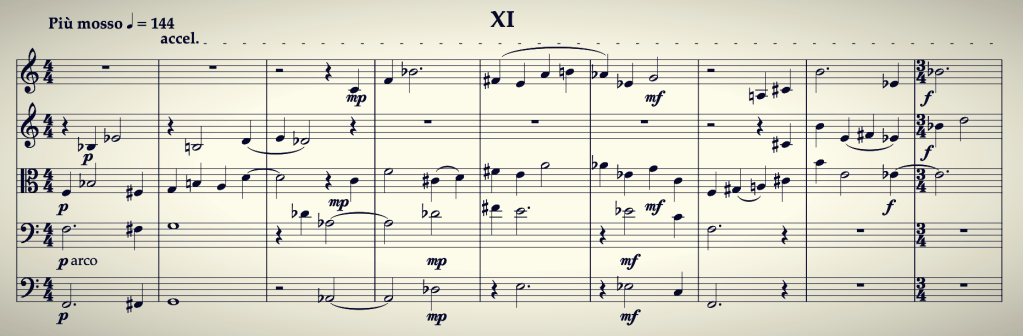
    Miniatures I through IV are adapted from Webern Elegy and V through XII from MapLab7For Little Arnold. Viennese Sketches does not portray the historical European city but rather explores various musical textures and tonalities using the 12-tone serial techniques of the so-called Second Viennese School of composers associated with Schoenberg. While their music using these techniques was unfortunately dubbed “atonality,” my uses focus on creating constellations and counterpoint that is complex but much less dissonant and more sonorous, my sense of a new tonality.

    While the chamber orchestra work is organized in six movements and a coda, each miniature is excerpted below to show changing pace and textures.

  • Dark Matter

    2019      string quartet     duration: 7 minutes

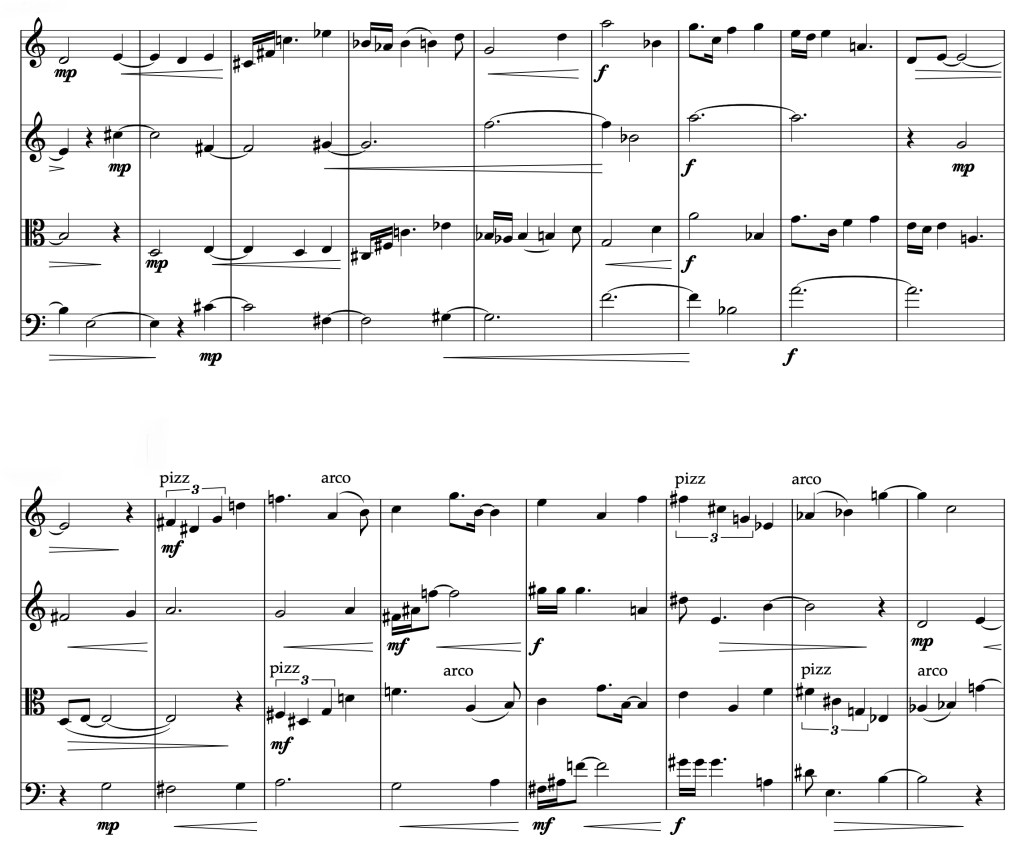
    Excerpt:

    My compositional fascination with musical canons began in the early 1970s with study (at the University of Michigan) of Ockeghem’s 15th-century polyphony, the 10 canons in Bach’s 18th-century The Musical Offering, and Webern’s 20th-century Symphonie Op.21. As a young professor in the 1980s teaching 16th-century counterpoint at what was then North Texas State University (now UNT), I used canon as a challenging contrapuntal writing assignment. In 1985, a wind ensemble piece, Parallel Horizons (Homage to Schoenberg), was my first formal composition constructed by canon. In Dark Matter, other contrapuntal writing surrounds an extended canon.

    According to Wikipedia: “Dark matter is believed to be a form of matter thought to account for approximately 85% of the matter in the universe and about 27% of its total mass–energy density. Its presence is implied in a variety of astrophysical observations, including gravitational effects that cannot be explained by accepted theories of gravity unless more matter is present than can be seen. For this reason, most experts think that dark matter is abundant in the universe and that it has had a strong influence on its structure and evolution. Dark matter is called dark because it does not appear to interact with the electromagnetic field, which means it does not absorb, reflect or emit electromagnetic radiation, and is therefore difficult to detect.”

    To request performance materials and permission, email the composer, tc24@txstate.edu.