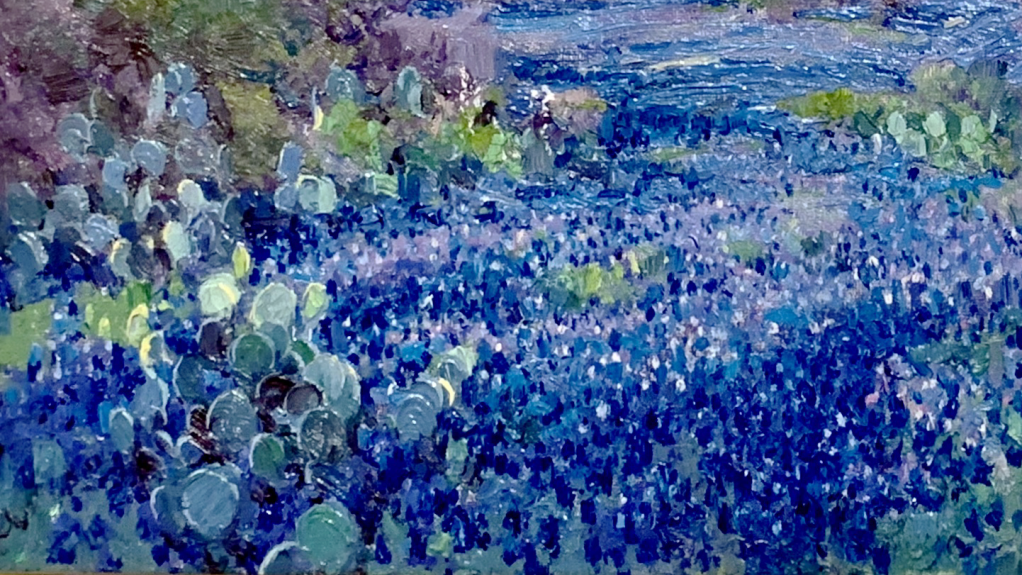
Revisiting my 1988 improvisation sketch for the New Music Performance Lab at University of North Texas became a prequel to a recent composition. FARBEN (2025), variations on the first movement of Webern’s Symphony, isolates instrumental colors as “prickly-pear” points of sound separated in time-and-pitch space.
Julian Onderdonk, Blue Bonnets and Cactus in the Rain (1914)
The recomposed 1988 music beginning SPECTRAL LIGHT takes another approach to sound color, layering canonic textures of thicker sonority in a gentle Impressionistic blur, like the brush-blended blur of a Monet painting.
Claude Monet,Waterloo Bridge, Sunlight Effect (1903)
Timbres emerge, echo, and fade in a floating, slow-moving distant landscape of color.
Three pieces of the early 20th century, which I studied deeply in the 1970s and later used extensively in my teaching of modern music, were each masterful explorations of musical sound color:
Claude Debussy’s La Mer (1905), an iconic tone poem of Impressionistic musical painting with an orchestral palette
Arnold Schoenberg’s “Farben (Summer Morning by a Lake: Chord-Colors”, the third of his Five Pieces for Orchestra, Op. 16 (1909) — a gentle study of orchestral sound color
Anton Webern’s Symphony, Op. 21 (1928), whose first movement is a delicate gem of pointillistic color canon built on one enormous, static, symmetrical 13-pitch constellation
After fifty years, these works are embedded more deeply than ever in my musical consciousness. Farben pays special homage to Schoenberg’s masterpiece, layering kaleidoscopic wind-instrument colors to build massive, morphing constellations, echoing Webern’s hidden chord-color symmetry.
In 1973, I composed my second orchestra piece as a graduate student at the University of Michigan. The title was inspired by John Cage’s famous Imaginary Landscapes No. 4, which we performed as I was an ensemble member of Contemporary Directions. The idea of animating an otherwise static sound mass, devoid of progressive harmony, was a quintessential feature of what I came to think of as the Midwestern Style of 1960s and 1970s large ensemble music. Successful models included prize winning pieces such as (my teacher) Leslie Bassett’s Variations for Orchestra (1966), Donald Erb’s The Seventh Trumpet (1969), and Joseph Schwantner’s …and the mountains rising nowhere (1977) and Aftertones of Infinity (1979).
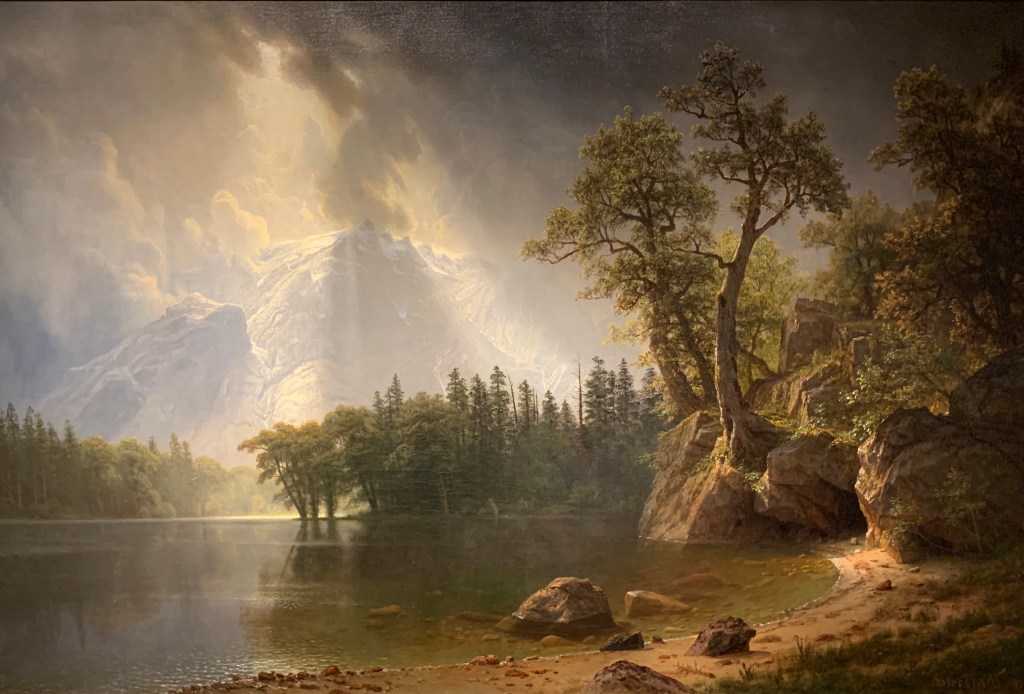
So many great American landscape artists of the 19th century painted fascinating panoramic scenes. One of my favorites, who captured the grandeur of Western, mountainous landscapes, was Albert Bierstadt:
Albert Bierstadt: Passing Storm over the Sierra Nevadas (1870) – San Antonio Museum of Art
You can see stark contrasts in brightness and in sense of motion between the mirror-smooth water and roiling clouds. Even the word “passing” in the title suggests change, a necessary ingredient of an analog musical landscape.
While not trying to actually map the physical composition of any painting, my musical inspiration came from considering this painting’s features of background, foreground, and highlights of strong visual focus. Musical gestures started with distant swelling sonorities, which as they crescendo feel like they are emerging forward toward us. After deciding to name the piece Passing Storm after the Bierstadt, however, I realized I had no storm in the music, just gentle sprinkles. Thus was created a stronger sonic rendering of the sprinkles to provide a more aggressive introduction. The following four minutes overlaps sound masses animated in time, contrasting dark vs. bright sounds, loud vs. soft, and timeless sustained sound vs. busy points of “light.”




 Thomas Clark - composer / digital artist