In Robert Frost’s poem “My November Guest,” an exquisite expression of loss and sadness, four phrases stood out expressing the gray beauty of November:
“these dark days of autumn rain” . . . “my sorrow when it’s here with me”
“the bare, the withered tree” . . . “the sodden pasture lane”
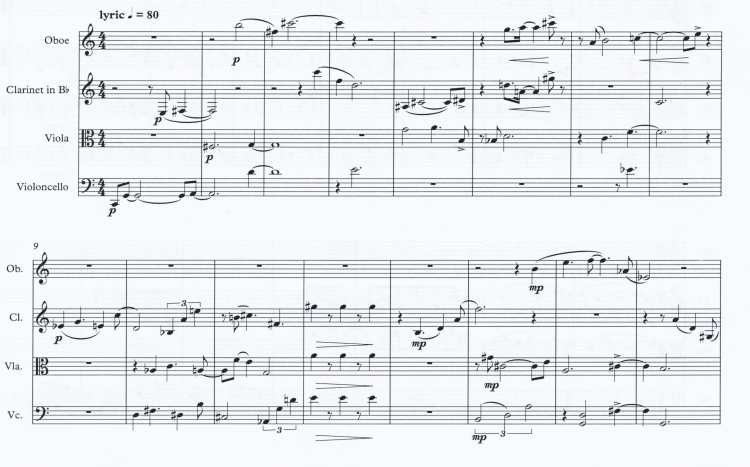
Autumn RainMusic was originally composed in Ann Arbor for oboe and piano in 1971. Decades later in San Marcos, in 2017 the music evolved into an elegy for unaccompanied English horn, and now to this duo arrangement, heard here with sound-synthesis enhanced background.
I have long admired and been influenced by the music of early 20th-century Austrian composer Anton Webern. Known historically as a member of the Second Viennese School with Alban Berg and mentor Arnold Schoenberg, the three were pioneers of so-called atonal music and 12-tone-row serial harmonic organization. I find the term “atonal” misleading and negative, as their 12-tone processes achieved new “12-tone tonalities” — not simply a rejection of traditional tonal harmony but also striving to create new and more complex tonalities.
What I admire most about Webern’s mostly-quiet instrumental miniatures (his Symphonie has only two sparsely-scored movements) is the delicate, crystalline quality of his pitch constellations; and their gently lyric, precious setting into transparent textures, pearl-strings of delicate sound colors ( called Klangfarbenmelodie). Here is a transcription for chamber orchestra with sound color much like Webern’s Symphonie Op. 21:
Webern’s mentor, Schoenberg, as a Jew was compelled to emigrate to the U.S. in 1933 before it was too late. Webern, not Jewish, stayed in Vienna and survived World War II, only to be fatally shot by a U.S. Army soldier during the Allied occupation of Austria.
2021 . . . . for the Pleasant Street Players — Ian Davidson (oboe), Vanguel Tangarov (clarinet), Ames Asbell (viola) . . . . duration: 5 minutes
Clarinet shows transposed (not concert) pitches
I have long admired and been influenced by the music of early 20th-century Austrian composer Anton Webern. Known historically as a member of the Second Viennese School with Alban Berg and mentor Arnold Schoenberg, the three were pioneers of so-called atonal music and 12-tone-row serial harmonic organization. I find the term “atonal” misleading and negative, as their 12-tone processes achieved a new “12-tone tonality” — not simply a rejection of traditional tonal harmony but also striving to create new and more complex tonalities.
What I admire most about Webern’s mostly-quiet instrumental miniatures (even his Symphonie has only two sparsely-scored movements) is the delicate, crystalline quality of his pitch constellations; and their gently lyric, precious setting into transparent textures, pearl-strings of delicate sound colors ( called Klangfarbenmelodie).
Webern’s mentor, Schoenberg, as a Jew was compelled to emigrate to the U.S. in 1933 before it was too late. Webern, not Jewish, stayed in Vienna and survived World War II, only to be fatally shot by a U.S. Army soldier during the Allied occupation of Austria.
Synthetic rendering of sample excerpt from movement II:
Synthetic rendering of sample excerpt from movement V:
Premiered 6 February 2018 by Youna Hartgraves (voice), Ames Asbell (viola), Joey Martin (piano)
Riding Backwards on a Train
“The cider mill beside the river, cows grazing by a dead tree, a red barn stuffed with hay. An old square house alone on a hilltop, a church’s silent steeple above the trees, a country cemetery, old stone crosses guarding against oblivion. Then the sun is gone, storm clouds ripple across meadow skies, the river turns away. Riding backwards on a train, frozen fields float by. Glossy sheets of white ice glow with winter sun. Dead brown stubble breaks the mirror, patchy footprints of autumn’s retreat. Pale late light of afternoon flickering through leafless trees that line the lifeless fields in rows, through fields of withered cornstalks. Leap into brown dry woods, plunge past barren trees, spray a wake of fallen leaves, lunge into holy autumn stillness, riding backwards on a train, headed east into a frozen future.”
Sailing at Sunset
“Dusty dusk settling silk on dying silver of wave-modulated water, the sail still silently searching for a departing breeze, swinging gently its boom and softly rattling its blocks in confounded cross-rhythms to the lapping shore. Streams of crimson flowing dust streak the sky above looming shadowed firs. Deepening shadows settle dark dust on the deck while still the mast peak rages red and soars into a deepening sky. Scorched face soothed by the oncoming night breeze, eyes searching the sunset sky for sign of tomorrow’s wind. Where will we sail then? Wherever wind wills . . . and a new dusk consume our shadows.”
To request performance materials and permission, email BMI-affiliated composer Thomas Clark, tc24@txstate.edu
Middle in a series of three works (following Hukvaldy Sketches and preceding Climbing Blaník) inspired by Czech culture and written for the Pleasant Street Players, Ian Davidson, Vanguel Tangarov, Ames Asbell, and their musical associates.
The stone Charles Bridge spans the great Vltava in Prague, connecting Old Town to the Lesser Quarter’s St. Vitus Cathedral and Presidential Palace. Built in the 14th century, its 16 arches are guarded at each end by magnificent bridge towers typical of Prague‘s Gothic architecture. Some 30 statues watch over peddlers and a constant stream of local and tourist pedestrians. To be among them always evokes strong feelings of history and the joy of Bohemian life.
To request performance materials and permission, email BMI-affiliated composer Thomas Clark, tc24@txstate.edu
This set of 12 etudes for two contrapuntal voices was first composed as modern 20th-century style studies for the aural skills workbook ARRAYS. They echo the musical characters of early 20th-century composers Debussy, Bartók, Stravinsky, Hindemith, Varese, Webern, and others of mid-century such as Dallapiccola. Though the “invention” designation recalls Bach’s great Two-Part Inventions, a more direct inspiration was Bartók’s Mikrokosmos, six books of piano etudes.
Though originally scored in limited treble and bass ranges suitable for singing, the intervallic and rhythmic complexities are more suitable for instrumental studies. Versions of the twelve are available for string orchestra, or for pairs of instruments:
viola & cello
clarinet & bass clarinet
trombone & bass trombone
The 12 Contrapuncti are graduated in challenge for study, but can also be performed, as one short suite of four, or two or three suites altogether in any order.
Suite I
1. Strolling – tempo = 48
2. Boldly – tempo = 72
3. Celestial – tempo = 54
4. Proudly – tempo = 78
Suite II
5. Dancing – tempo = 54
6. Skating – tempo = 126
7. Exploring – tempo = 132
8. Contemplative – tempo = 128
Suite III
9. Emphatically – tempo = 84
10. Precise – tempo = 66
11. Mysterious – tempo = 72
12. Aggressive – tempo = 84
Here are all 12 played by strings:
[order – Suite II, Suite III, Suite I]
To request study/performance materials, email composer



 Thomas Clark - composer / digital artist