A visit to the shores of Michigan’s Leelanau Peninsula inspired me to write a poem:
Peninsula upon peninsula upon grand peninsula, Lee upon Leelanau upon Lower. Cove from bay from great lake, Suttons Bay off Grand Traverse Bay off Lake Michigan.
Land curves in myriad shore shapes, Reaching out to blue water. Fresh wind weds the land and water, Sun warms bright sails and sailor.
Setting it as lyrics for an art song made an example for MapLab 2: Sketch a Song. The lab instructions include a step-by-step explanation of the compositional process. (The synthesized audio rendering below is not capable of pronouncing the words.)
These are a distillation of my guiding principles through many years of teaching, serving as an academic leader, and meeting, working with, and understanding many very successful musicians. They don’t really belong on this composer-and-photo-art site. Or do they?
Clark’s Rules for Musician Success
Teaching is not so much imparting knowledge as it is facilitating learning. A teacher is an enabling coach on the sideline; all the on-field action is by the student, the learner. From a veteran coach, here is a simple but effective playbook.
Each rule is a command to action.
Rule 1: SHOW UP.
Music is a team sport, and the team depends on you being there every time.
Rule 2: PAY ATTENTION.
Don’t just watch and listen — think about what you see and hear.
Rule 3: DO THE WORK.
Just enough? No, all there is to do.
Rule 4: JOIN A TEAM.
Commit to the team’s success as your own.
Rule 5: PLAN AHEAD.
Essential to accomplishing Rules 1 and 3.
Rule 6: BECOME A LEADER.
It’s a lifelong process of self-development, not a hat you can simply put on.
Rule 7: ENCOURAGE OTHERS.
Part of Rule 4, this is what it means to be a humane human.
Feel free to quote and pass them on!
The original Clark’s Rules for Musician Success above are basic principles to live by, originally posted in my Texas State School of Music Director’s DIARY on January 16, 2017 . They have worn well, largely drawn from my observation of the common traits of great musicians I’ve had the good fortune to meet or work with.
Clark’s Rules for Good Leadership
As I headed toward the end of my administrative career, I reflected also on the many wonderful leadership mentors I’ve had the honor to work with, especially Dave Shrader. My reflections, incorporating a few of the first 7 rules, were posted in Director’s DIARY on. We start by repeating Rules 5 through 7:
Rule 6: BECOME A LEADER
Whatever you endeavor to lead, it’s a lifelong process of self-development.
Rule 5: PLAN AHEAD
Fundamentally, that’s the main thing a leader does.
Rule 7: ENCOURAGE OTHERS
Enable their good ideas. Trust their skill and commitment. Seek the best in others.
Rule 8: IDENTIFY GOALS
Embrace a true mission. Let the practical goals flow from the mission.
Rule 9: TAKE RISKS
Take calculated, reasonable risks worth the payoff. Don’t be afraid of failure. Redefine it as simply not succeeding on the first try.
Rule 3: DO THE WORK
Not everything can or should be delegated. Be well informed. Know how the systems and teams you lead operate.
Rule 10: SOLVE PROBLEMS
Not necessarily quickly. Sometimes with time they solve themselves. Wait while seeking all the information, possibilities you need to consider. For the toughest, brainstorm, think the unthinkable. Engage others in the solution.
Rule 11: ACT ETHICALLY
Be considerate but honest. Avoid being unnecessarily judgmental. Transcend stereotypes. Don’t assume you know what’s best for others. Choose the greatest benefit for the greatest number of stakeholders, while being fair to all.
Rule 12: SHARE CREDIT
Or just simply give it away. It will come back to you if it’s deserved. Everyone knows anyway, the best accomplishments are team collaborations.
Since 12 is to me an almost magical number, I think I’ll stop . . . for now.
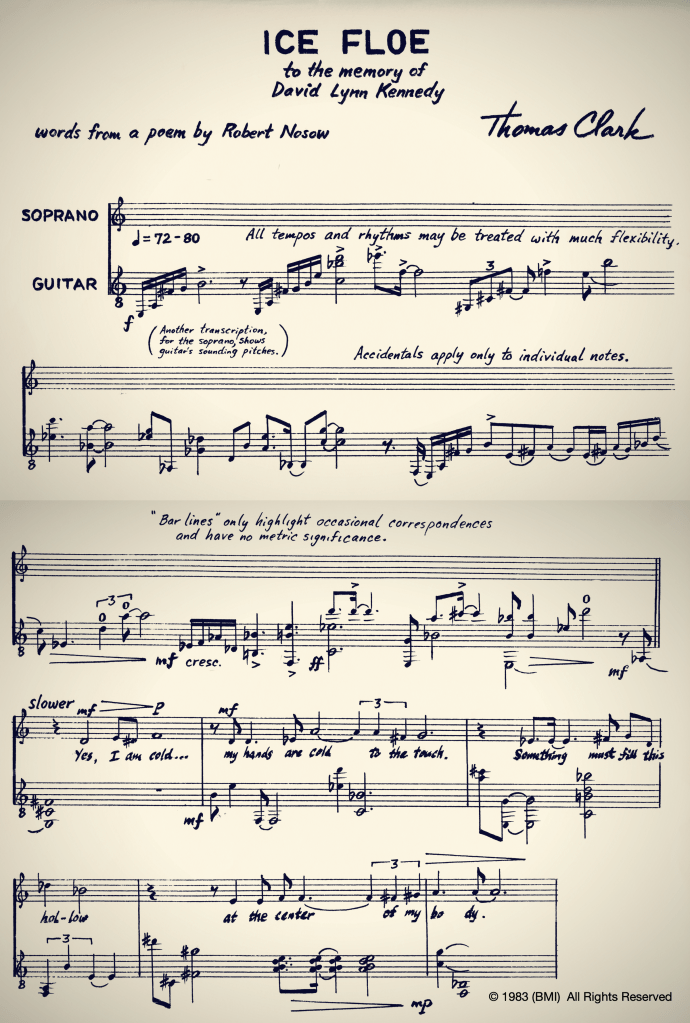
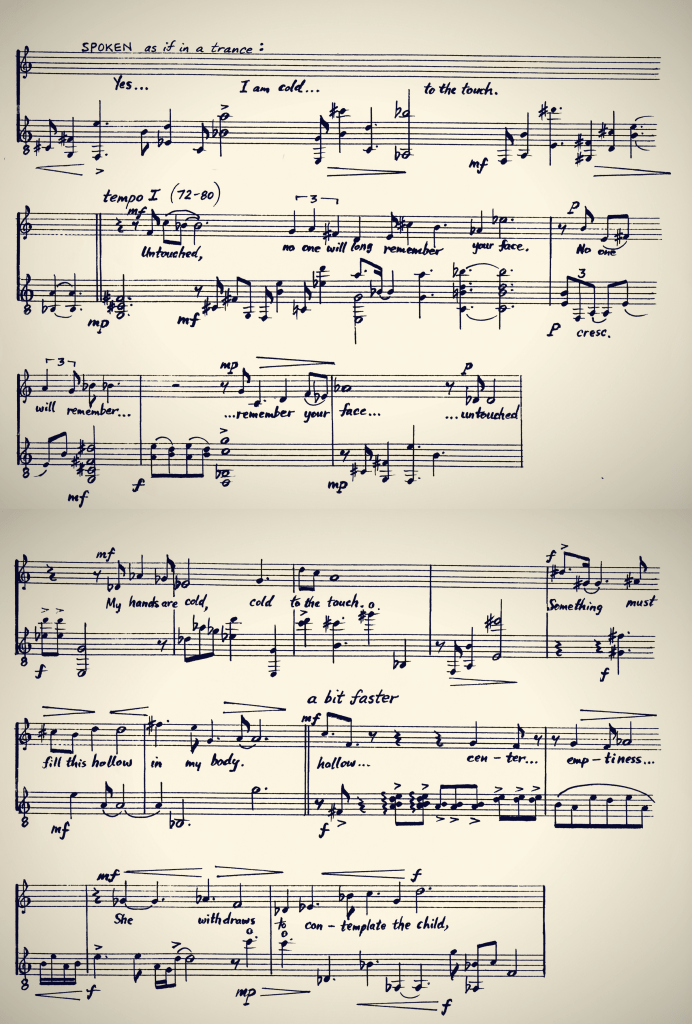
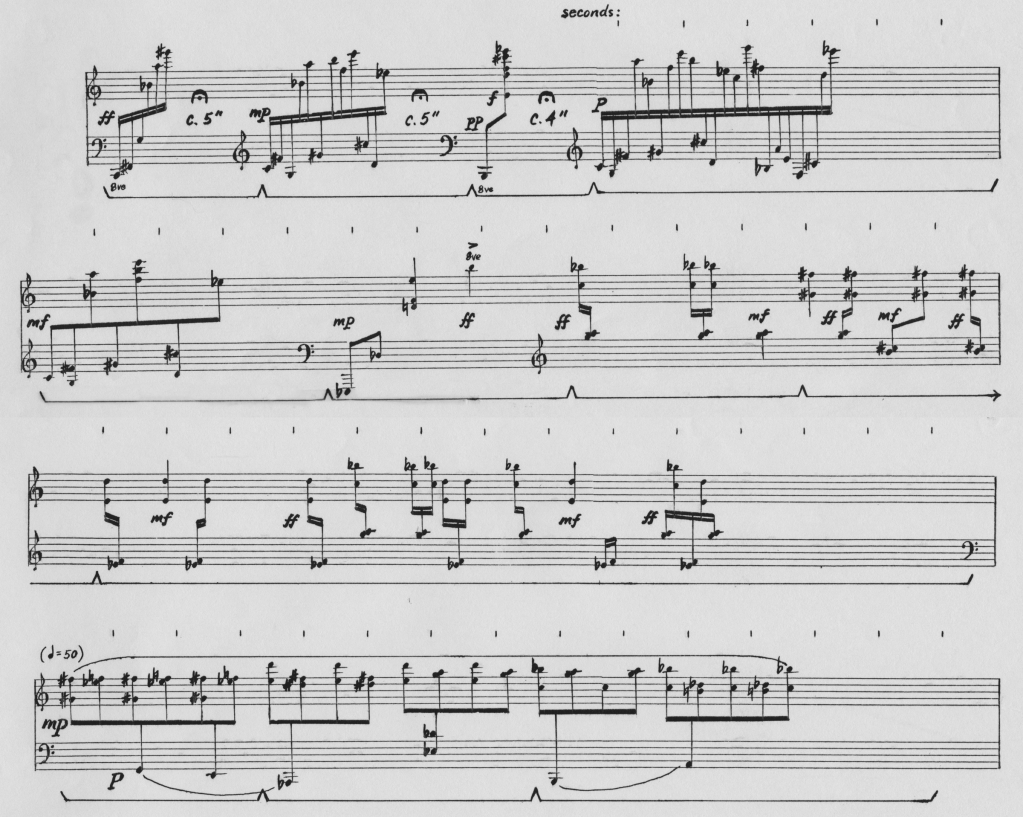
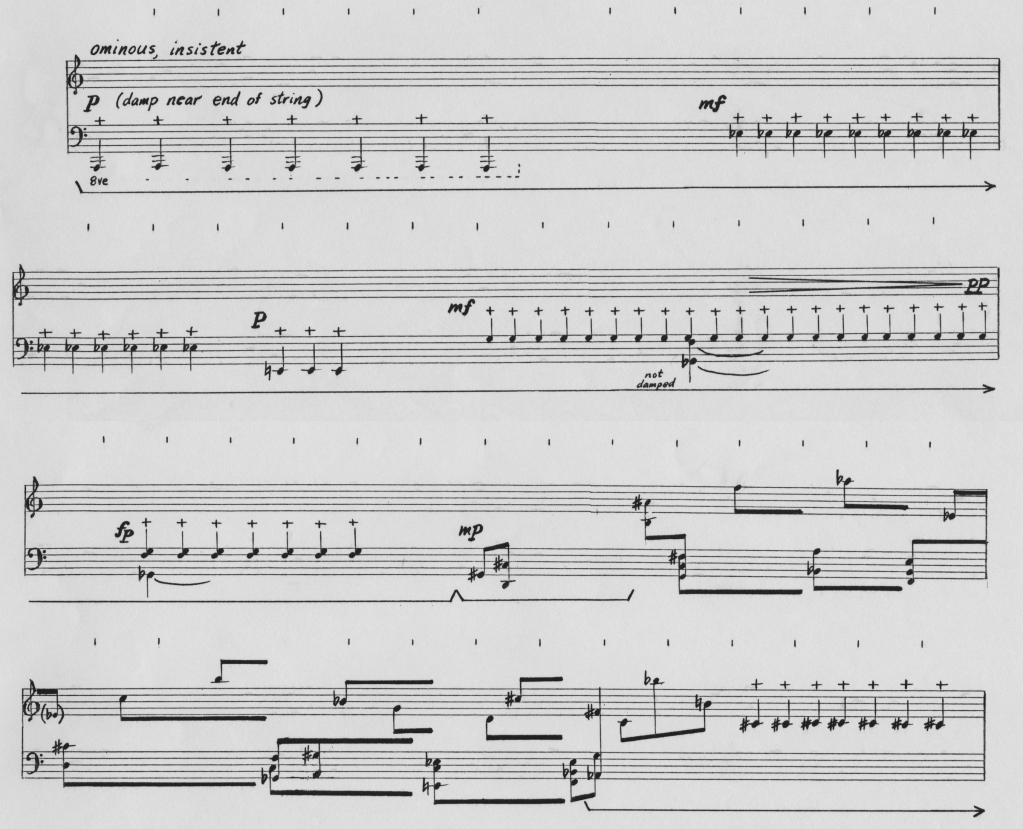
1983 . . . soprano, guitar (7:50 min.) . . . words by Robert Nosow
Robert Nosow was a graduate student in musicology at North Texas when the poem was written. David Lynn Kennedy was a grad student in guitar killed by Denton police in a tragic incident in 1983. Soprano Jing Tam was a doctoral student who also knew Kennedy, one of many NTSU/UNT music students who died during my 28 years there.
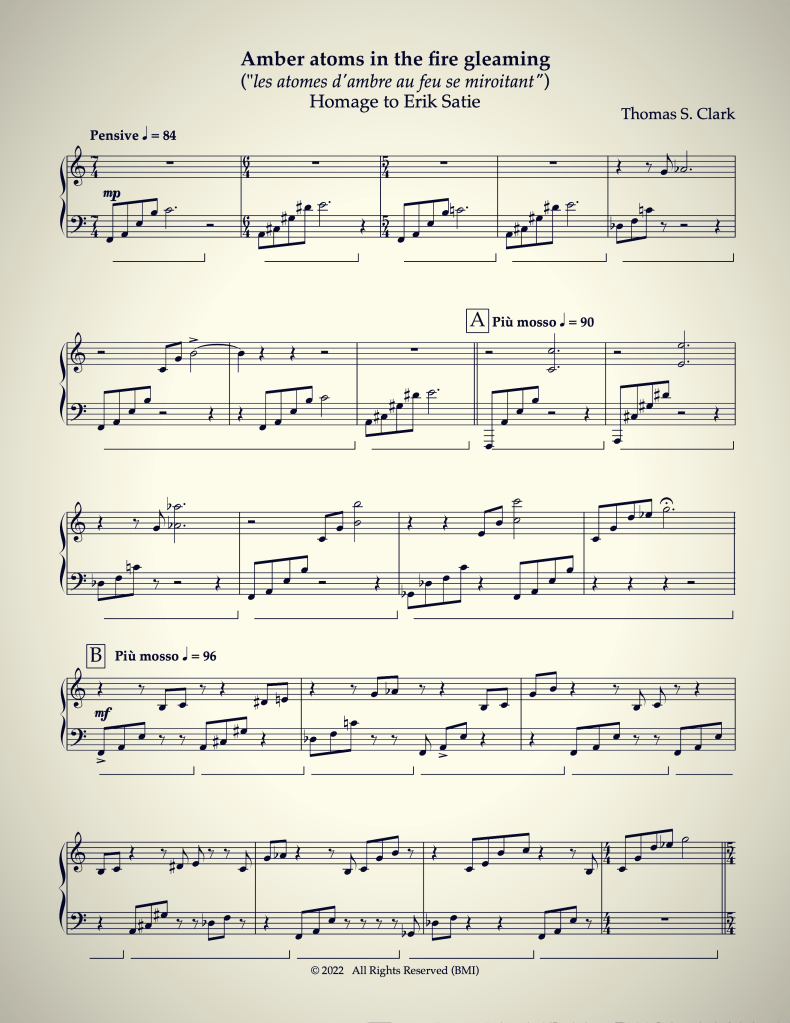
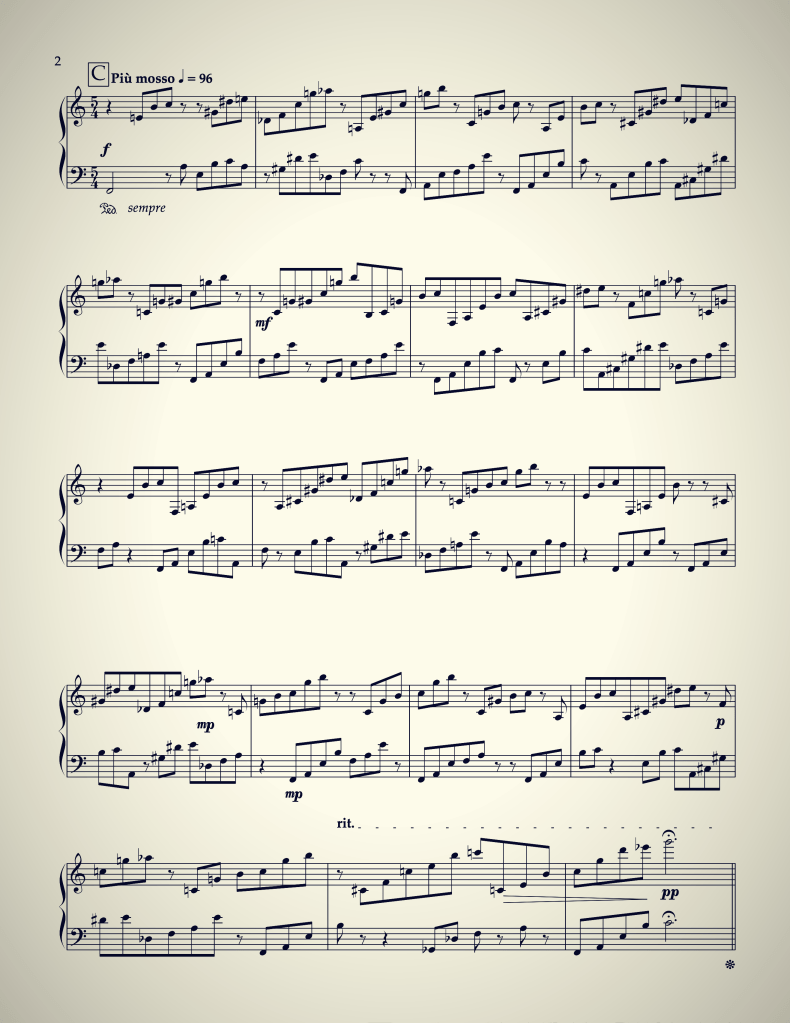
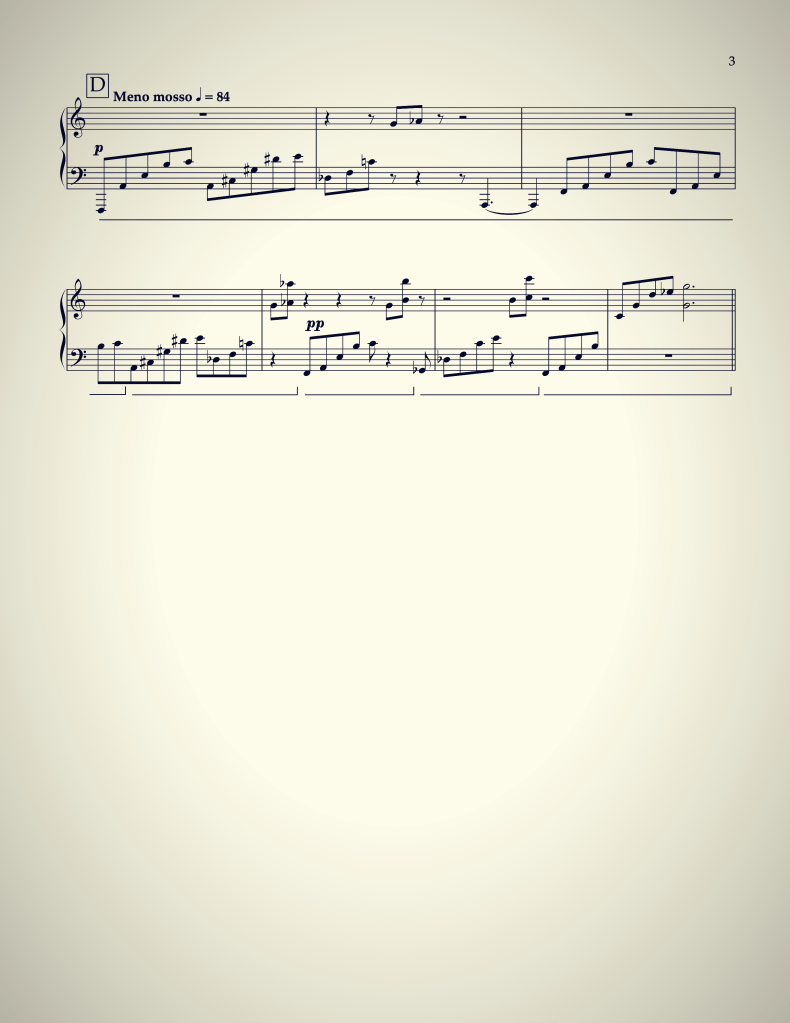
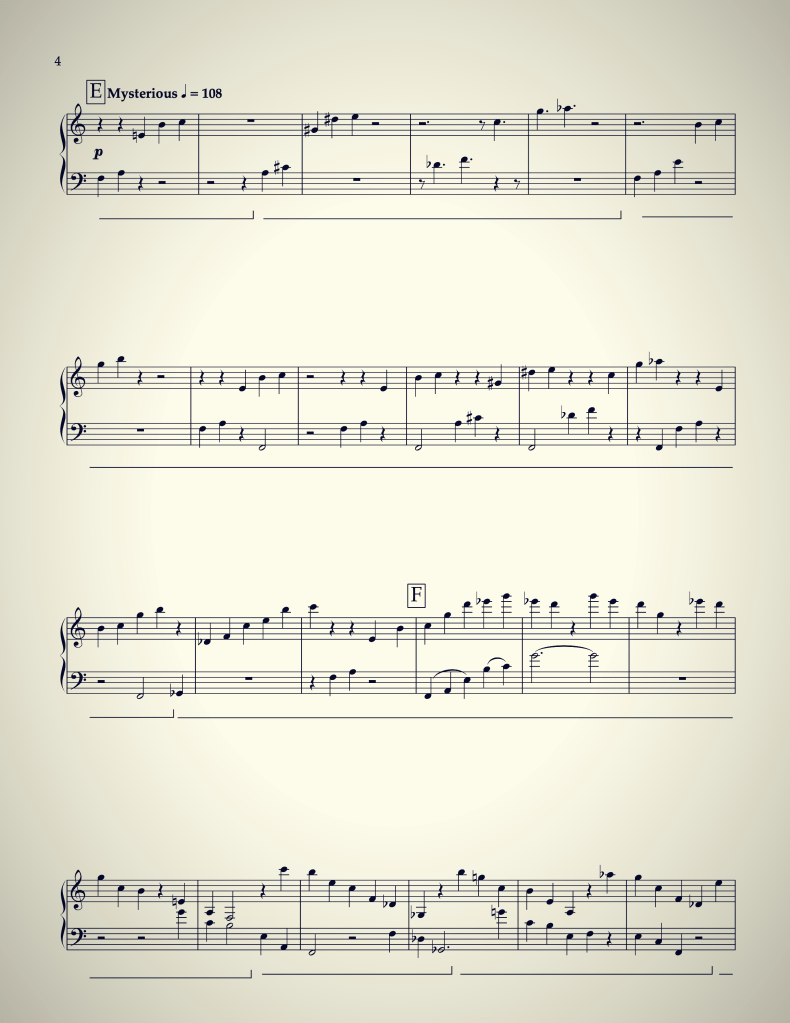
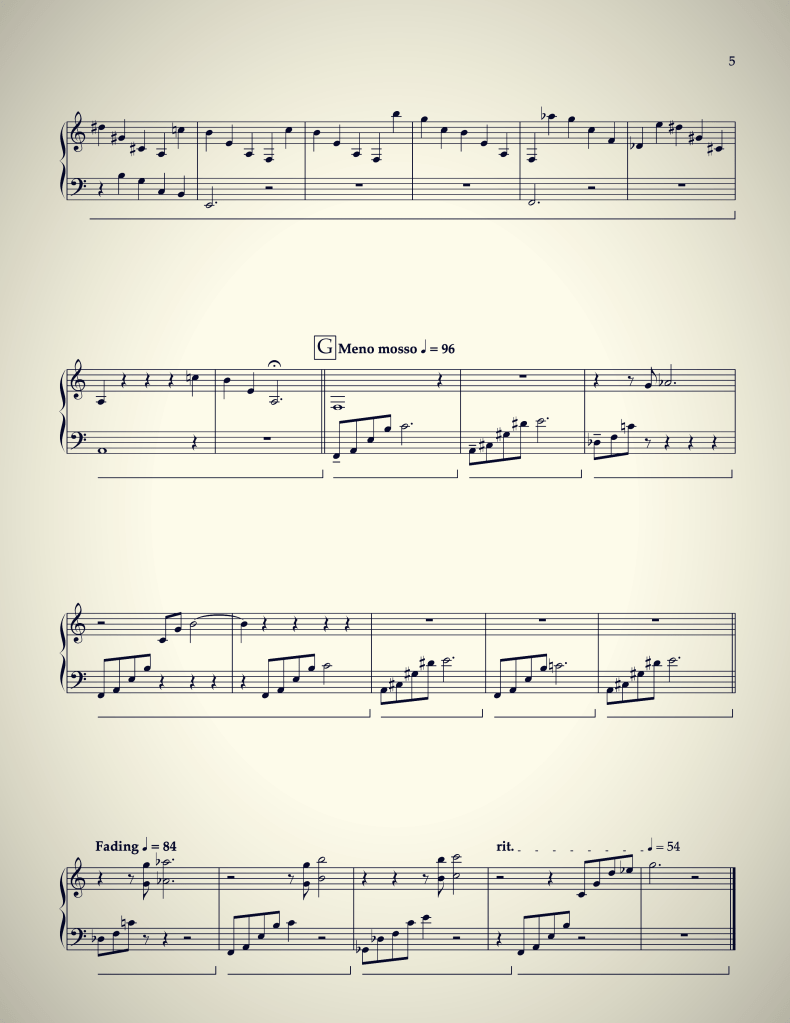
This musical sketch is titled with a translated line (“Où les atomes d’ambre au feu se miroitant”) of a French poem by de Latour that may have inspired Erik Satie — the poem ends with the word “gymnopaedia.” In keeping with Satie’s radically sparse, (one could even say) minimalist style in his Trois Gymnopédies for piano (1888), this homage generates entirely from one modern harmonic constellation, arpeggiated repeatedly in a gentle, almost imperceptible meter, then growing colorful “amber” sustained highlight sounds. Eventually the arpeggios begin to spin and swirl in a layered, kaleidoscopic texture that is “minimalist” in the 20th-century usage as the description for repetitive ostinato music.
Go to Lab 1: Genesis of a Gymnopédie in Mapping the Music Universe for a complete step-by-step explanation of the process of composing Amber Atoms in the Fire Gleaming.
Since this is modeled on a piano piece, Gymnopédie, here is a playable piano version:
Quoting Debussy as homage to the first of his beautiful Nocturnes, musical patterns float, repeat, morph, disappear. Many of my earlier compositions are titled under the category of “Animated Landscapes,” referencing a musical analog to landscape painting, sketching musical textures of moving, evolving pitch constellations and colors. Perhaps that makes Nuages a “skyscape.”
Much of the musical material is shared with the third movement of my string orchestra work, Three States of Water.
Composed after reading Ed Viesturs’ book, No Shortcuts to the Top, his first-person account of the successful quest to climb to the summits of the 14 tallest mountains in the world, all taller than 8,000 meters (26,247 feet) above sea level. My most vivid personal and photographic experience with glacier-topped mountain ridges includes several visits to Rocky Mountain National Park, where the Continental Divide rises to a spectacular ridge of 12,000-ft. peaks beside 14,259-ft. Long’s Peak. My son Owen and I once hiked to the summit of 12,234-ft. Flattop Mountain — less than half the elevation of Viesturs’ 8,000 meters. As its name suggests, Flattop’s summit is not dramatic but connects with the string of ridges between spectacular Hallett Peak (center of photo) and Otis Peak (left of Hallett).
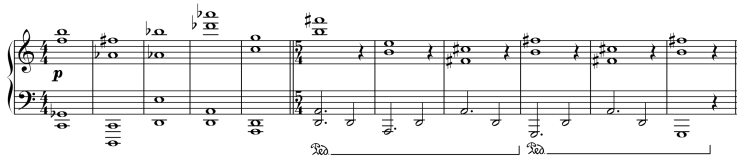
Musical patterns are all based on constellation streams of four complex 8-pitch interval arrays, as explained in Mapping the Music Universe. The chords are first presented as tall monolithic blocks separated by silence in the style of Morton Feldman:
Then they become rhythmically steady arpeggios, constantly repeating in the style of John Adams. Out of this continuous ridge of arpeggios emerge the individual pitches of the four sonorities, rising to sonic summits.
Other majestic mountain ridges I’ve admired include the Sierra Madre Oriental Mountains on the southwestern horizon of Monterrey, Nuevo León, Mexico, as seen from the Macroplaza. Then there is the Blue Ridge Mountains in North Carolina, where we once lived just an hour from the scenic Blue Ridge Parkway. Neither as high as the Rockies, both these sloping ridges change their deep blue hues with clouds and the sun’s progress through a day. Finally, though the Texas Hill Country is not really mountains at all, we live on its eastern edge on a road named Summit Ridge Drive.
2022 . . . collection of more advanced etudes for Piano
Mapping the Music Universeproduced several small etudes to illustrate the compositional potential of musical patterns explained in the ebook. The inspiration to collect them into a series came from many years of fascination with Bartók’s wonderful Mikrokosmos series of 153 piano pieces in modern styles. Book I contains 7 short etudes, each titled with an astronomical entity named for a mythological character and ranging in difficulty for the pianist.
Book II presents more extended compositional explorations, each suitable as a stand-alone recital piece. Beyond Mikrokosmos, Book IIpays homage to Debussy’s revered books of Preludes. The pieces in Book II embrace the Impressionist approach to texture and form, while evolving beyond Debussy’s tonal language.
My compositional fascination with musical canons began in the early 1970s with study (at the University of Michigan) of Ockeghem’s 15th-century polyphony, the 10 canons in Bach’s 18th-century The Musical Offering, and Webern’s 20th-century Symphonie Op.21. As a young professor in the 1980s teaching 16th-century counterpoint at what was then North Texas State University (now UNT), I used canon as a challenging contrapuntal writing assignment. In 1985, a wind ensemble piece, Parallel Horizons (Homage to Schoenberg), was my first formal composition constructed by canon. In Dark Matter, other contrapuntal writing surrounds an extended canon. Now canon pervades much of my 21st-century writing, a challenging yet stimulating and gratifying approach to texture and continuity of material.
Book of Canons collects 14 excerpts from these works, showing each canon’s subject, points and pitch levels of answer, and sounding each excerpt scored as a string trio. Forest Pathsstitches them together in an ambling journey along a path through a metaphorical sound environment of sunlight, shadows, and leaf-fluttering breezes.












 Thomas Clark - composer / digital artist