Author: thomasclarkumich

  • Canzona 1497

    Canzona 1497

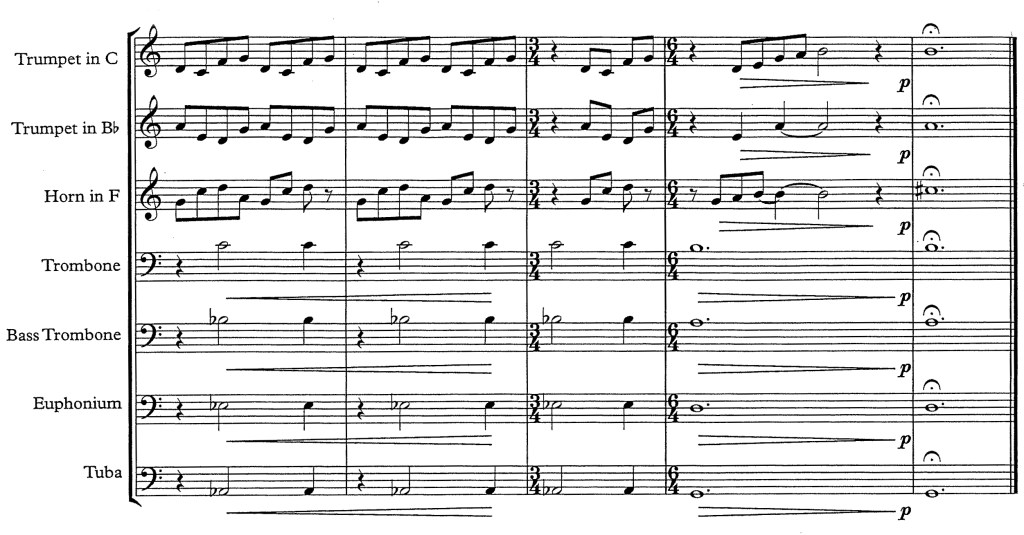
    Canons for antiphonal brass . . . 2020 . . . duration: 7 minutes

    The death of the great Flemish composer Jan Ockeghem in 1497 marked the end of Western Music’s Medieval style period. The most famous composer of the late 15th century, Ockeghem’s style of choral music was intensely contrapuntal, filled with canons, and freely exploratory in harmony and form. Josquin, already emerging as the great pioneering composer of the early Renaissance, revered Ockeghem, as do I. The first part of Canzona 1497 explores such canonic contrapuntal structures in a modern harmonic setting. While the second part settles into a more Medieval harmony of simple diatonic lines, both parts of the piece indulge in a striking Ockeghem idea: spinning repetitive contrapuntal material in a texture that is paradoxically animated in surface but stationary in prolonging one sustained harmony. I hear this feature of Ockeghem’s music as an ancestor to the mid-20th-century ostinato music of American composers Terry Riley, Steve Reich, John Coolidge Adams . . . and me.

    To request performance materials and permission, email the composer, tc24@txstate.edu.

  • Jupiter Rising

    2020 . . . synthetic sound sculpture . . . duration: 8 minutes

    We all enjoy the mysterious splendor of moonrise, large and deeply-hued in the eastern evening sky. This sound sculpture creates a sonic metaphor for that visual phenomenon, but portraying instead the rising of Jupiter, the largest object in the solar system other than the sun itself. It only looks much, much smaller to us than the moon because it is so much farther away.

    One of my favorite Mozart symphonies is Symphony No. 41 in C Major, K.551. His longest and last symphony, it is nicknamed “Jupiter” — fitting that his lengthiest and greatest symphony is named for the largest planet, a great gas giant. A vivid musical motive begins and generates the majestic final movement. I use it as the musical subject of this sound sculpture, relentlessly canonic in deployment. At some moments, as many as 8 contrapuntal soundings overlap each other in a cloud-like texture.

    Notice that my rhythmic setting of the motive is designed irregularly, so that the two lines seldom move at the same time in what I would call a contrapuntal accent. This creates the overall floating quality of the contrapuntal rhythmic texture. One refreshing feature of a sound sculpture is this freedom from the metric march of time. The music does not progress, but instead creates a sonic cloud to be experienced by relaxed absorption and contemplation.

  • Three States of Water

    2021       string orchestra         duration: 22 minutes

    Inspired by the great serenades for strings of Dvořák and Tchaikovsky, this suite explores musical metaphors for the physics of H2O in interesting atmospheric and geographic settings.

    I. Cold front (VAPOR becomes SOLID): In low clouds on mountain tops, water vapor can become super-cooled and become freezing fog, filling the air with small ice crystals and freezing to surfaces, similar to very light snow. In the western United States, the common name for freezing fog is “pogonip.”

    II. Ice Dunes (SOLID): In the Leelanau Peninsula of Michigan, the Lake Michigan surf sometimes whips up and freezes in mid-air, forming weird ice caverns and ice dunes.

    III. Nuages (VAPOR), French for clouds, is one of Debussy’s three beautiful Nocturnes for orchestra, quoted here as a theme for variations. Water vapor is technically invisible. The clouds we see are actually masses of minute liquid droplets and frozen crystals. Thus this movement embodies all three states of water.

    IV. Vltava (LIQUID): The great river Vltava flows majestically through Prague. Smetana’s depiction of it in his monumental Ma Vlast is usually translated as The Moldau.

    To request performance materials and permission, email the composer, tc24@txstate.edu.

  • Špilberk Castle

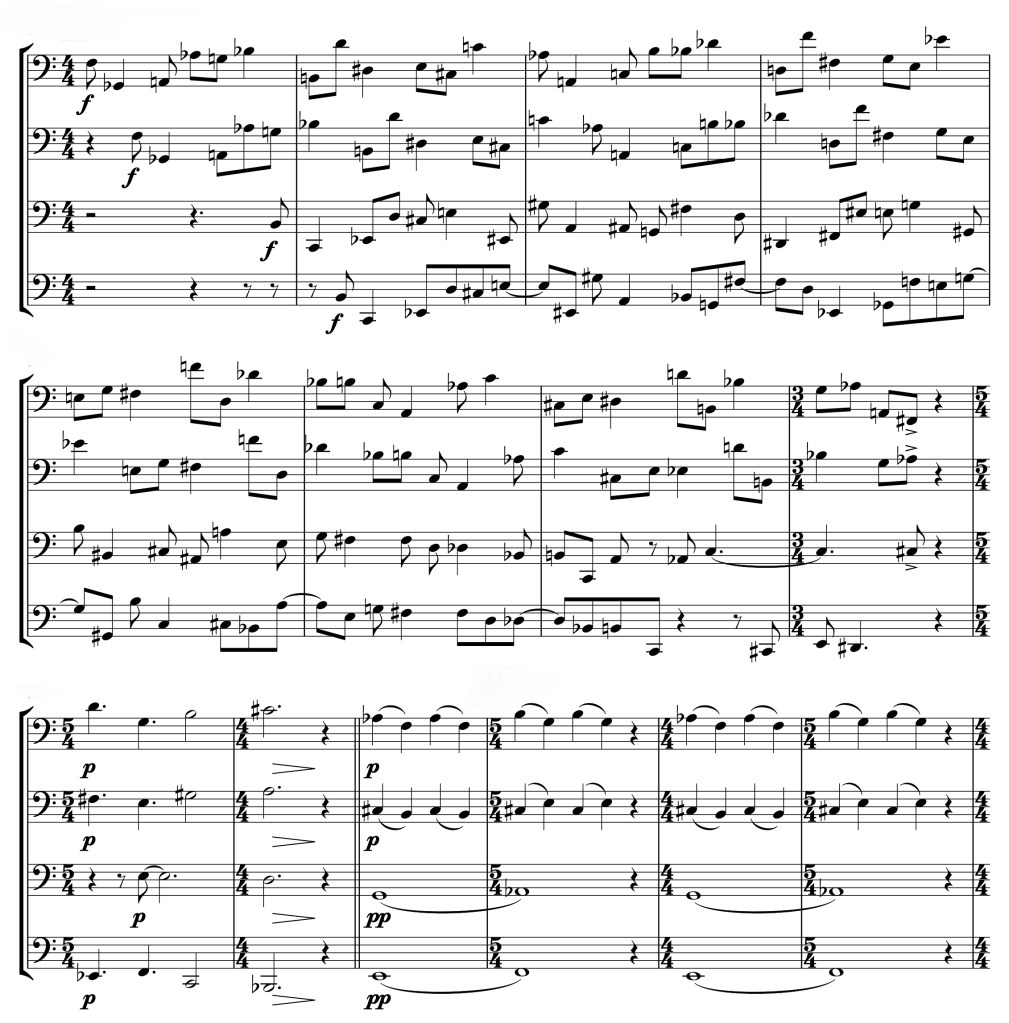
    Tuba / euphonium quartet            2019        duration: 8 minutes

    Dating back to the 13th century, Špilberk Castle has a dark history. Standing on a hilltop in the Moravian city of Brno, surrounded by chestnut trees in a beautiful park, its dungeons served for six centuries as a prison, holding war prisoners, Polish political prisoners, persecuted religious groups, and Czech patriots resisting the Nazis. Eventually it was a military barracks, and finally in 1959 became a municipal building and park and home to the Brno City Museum.

    During several visits to Brno in the 1990s, Clark spent much time walking in the surrounding park, as well as participating in rehearsals inside the castle with the municipal dance company for which he composed his ballet, PTACI. Two memories remain vivid:

    “Dark Rain”  – leaving the castle on a pitch-black night in a cold, late-October rain.

    “Moravian Autumn” – one of many sunny autumn afternoons walking through golden chestnut leaves in a timeless euphoria.

    MIDI synthesis rendering:


    To request performance materials and permission, email the composer, tc24@txstate.edu.

  • Sur la Neige

    Sur la Neige

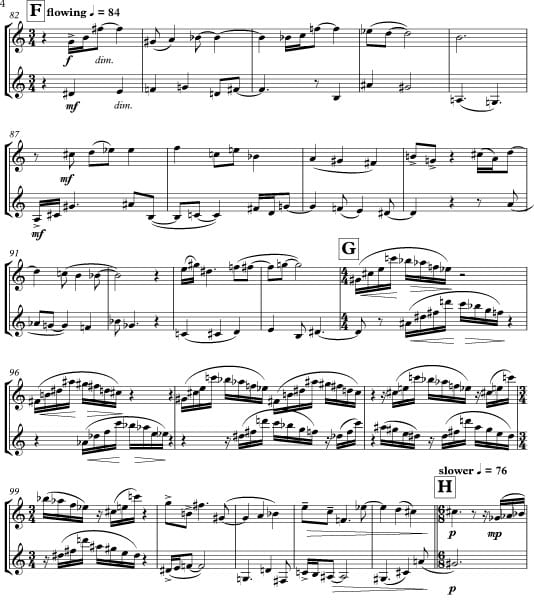
    2019            oboe, clarinet            duration: 8 minutes

    Written for Pleasant Street Players Ian Davidson and Vanguel Tangarov, colleagues at the Texas State School of Music, Sur la Neige is a snow fantasy on three quoted musical ideas. The work begins with an obscure quote from Stravinsky’s L’Histoire du Soldat, elaborated and then transitioning into a quote from Debussy’s Prelude No. 6 in his Préludes, Book I, subtitled “de pas sur la neige.” “Eventually, a small decorative figure from Janácek’s Sinfonietta appears and quickly disappears like a scurrying bystroušky (fox).

    Two memories of walking in the snow stand out in long-term memory. In about 1965, one recreation of a restless Michigan teenager on winter nights was to put on boots and parka and hike through snow-covered fields and forest in the moonlight. In 1992, my composer friend Arnošt Parsch led me on a walk into the logging forest above his Moravian village, Bílovice nad Svitavou. Through late-fall snowflakes, we retraced the steps of Janácek, passed the natural-spring well and the Sokol tavern up to a beautiful promontory view of the snow-covered village below.

    MIDI preview:

    To request performance materials and permission, email the composer, tc24@txstate.edu.

  • Kladno Sketches

    2019      duration: 10 minutes

    1. Zámek – peaceful gardens      2. Poldi – ironworks      3. Svobody – Freedom plaza

    Kladno is a Czech city in the Central Bohemian Region 25 kilometers northwest of Prague. In the middle of the 19th century, the discovery of coal there led to the establishment of one of the great ironworks and then steel mills in all of Europe.

    Kladno is near Lidice, the village destroyed by the Gestapo in 1942. Of the Lidice men who were all shot in the atrocity, many had walked to Kladno each day to work in the coal mine or the Poldi steel works.

    Poldi has thrived and survived for more than 100 years, through two world wars and occupations of the country, but the factory finally closed and most of the buildings are now abandoned.

    The city remains a thriving place with a population of 70,000, a large church, municipal building, state library and archives, monuments, theaters, museums, and beautiful parks. The Czech people have always been hard working, they love gardens, especially roses, and they love beer in the fine pilsner style they created.

    Suffering under so much occupation and oppression throughout their history in the center of Europe, Czechs especially value “svobody” – freedom.

    To request performance materials and permission, email the composer, tc24@txstate.edu.

  • A Peaceful Place

    Digital sound sculpture      2019       duration: 5:16

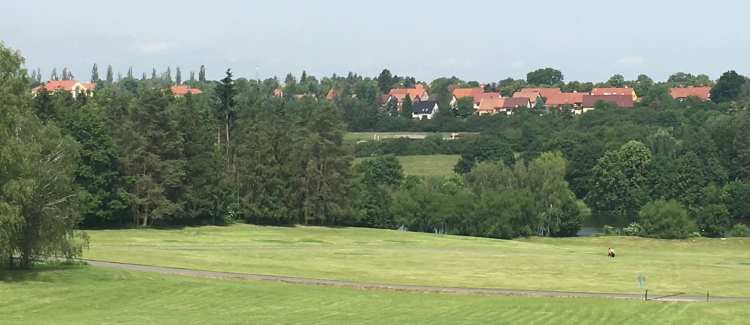
    The title, from the poem “The Murder of Lidice” by Edna St. Vincent Millay, is an expression of the feeling evoked by the verdant valley below the Lidice Memorial. Though horrible tragedy struck this place on 10 June 1942, now the sloping lawn and babbling creek are a safe haven to peaceful spirits.

  • SUSPIRA

    Canonic meditation on the Salve Regina chant      2017       computer music     duration  5:30

  • Carte du Ciel

    sky map

    2019      digitally synthesized sound sculpture      duration: 8 minutes

    Carte du Ciel was an ambitious second phase of an international star-mapping project initiated in 1887 by Paris Observatory director Amédée Mouchez.  A new photographic process revolutionizing the gathering of telescope images inspired the first phase, the Astrographic Catalogue of a dense, whole-sky array of star positions. Carte du Ciel, never completed after 70 years, used the Catalogue as a reference system for a complex survey of the vast field of even fainter images.

    In the music, ghostly wisps of sound are punctuated by brighter bursts, clustered in a natural, not-quite randomly dispersed texture.

  • A New Lidice

    2019      SSAA choir, string trio       duration: 7 minutes

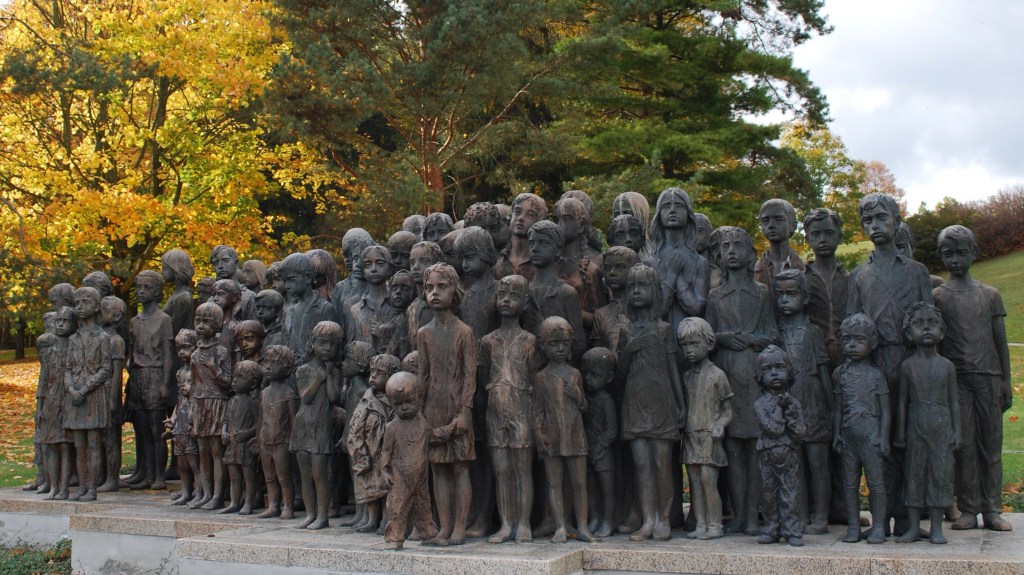
    A New Lidice is the third piece composed commemorating the story of Lidice near Prague, a charming Czech village that was brutally destroyed by the Gestapo in 1942. LIDICE REMEMBERED expressed the dark brutality of the atrocity, while RAINBOW RISING celebrated the power of hope symbolized by the beautiful memorial rose garden there.

    On June 10, 1942, all the village men were shot, the children taken away to orphanages or gas chambers, the women sent to concentration camps, and the entire village was razed. After the war, concerned British citizens led by Sir Barnett Stross convinced the world that the village should be rebuilt. The women of Lidice were able to return and were given beautiful new Czech-style homes in a planned village next to the Memorial Gardens.

    Lyrics are taken in part from a stirring Stross speech, but the voices are those of the women who bravely rebuilt their community:

    “We build a new village, while a just world watches.
    Stavíme novou vesnici. Spravedlivý svêt bude sledovat.
    Lidice belongs to the world of all who suffered.
    Mankind has one common enemy – War.
    Only a realization of our common humanity can save mankind.
    The just world will watch.”

    Premiere performance:

    April 23, 2022, Texas State University Performing Arts Center
    Student ensemble Aurora Voce conducted by Lynn Brinckmeyer
    with string students Kailey Johnson, Kelsey Sexton, Tina Moritz